

What Is Leadership Coaching and Who It Helps
Leadership coaching is a confidential, goal-focused partnership that helps a leader change how they think, decide and act at work, rather than a class, a diagnosis or an expert who does the job for them.
The popular advice to become a better leader often amounts to doing more: communicate more, take on a bigger challenge, become more resilient. But a leader who's already answering client emails at bedtime may not need another performance target. She may need to make a different decision about what belongs to her, what belongs to her team, and what her employer must change.
Useful coaching helps distinguish those problems. It should sharpen your leadership without making you personally responsible for every condition around you.
Table of Contents
What Leadership Coaching Is - From a broad concern to a workable goal
How Leadership Coaching Differs From Other Help - Training teaches a method, coaching examines its use - Advice, deliverables and clinical care serve different purposes
How a Leadership Coaching Engagement Works - From the first conversation to practical experiments - Make the commitment explicit
What Coaching Can Change for a Tired Leader - Workload and decision ownership - Boundaries and advancement
Leadership Coaching in Workplace Moments - Client pressure and recognition - Shared responsibility and owner decisions
When Coaching Is the Wrong First Move - Match the response to the problem - The employer's responsibilities remain
Decide If Coaching Fits This Quarter - Make the decision concrete
What Leadership Coaching Is
For a leader who is already stretched thin, coaching should not become another demand to perform. It is a structured conversation that helps you examine a workplace situation, clarify what you can influence, and choose a practical response.
The coach acts like a thinking partner beside you, helping you notice a familiar route and consider another. They do not deliver a standard lesson or take over your decisions.
A finance director ends each day with a queue of unanswered team questions. She assumes she needs better time management. Coaching can help her examine which decisions require her approval, what happens when she is unavailable, and whether her team has learned to wait for permission.
From a broad concern to a workable goal
Feeling overwhelmed is a starting point, not yet a coaching goal. The concern becomes more useful when it is connected to an observable workplace pattern:
Notice the pattern: Team members bring recommendations, but the director rechecks every detail.
Examine the assumption: She believes accountability means personally approving everything.
Test a different approach: She defines which decisions the team can make independently and which require escalation.
The goal is not to feel more confident. It is to make a specific decision differently and observe what changes.
Leadership development is a widely prioritized organizational concern. Understanding what a coaching offer includes helps leaders judge whether it fits their needs.
For women in law, accounting, consulting, finance, and business ownership, useful outcomes can connect to recognizable work: preparing for a compensation conversation, handing off a team responsibility, or setting clearer expectations about availability.
A useful starting point: Name a workplace situation you want to handle differently, rather than a personality trait you think you need to repair.
How Leadership Coaching Differs From Other Help
Coaching isn't automatically the best form of professional support. The right choice depends on whether you need to learn something, hear experienced advice, obtain an expert plan, change your own behavior, or receive clinical care.
Leadership coaching beside nearby kinds of help
Kind of help | Who sets the agenda | Main focus | Privacy | Best when |
|---|---|---|---|---|
Leadership coaching | The client, with the coach | Goals, decisions, behavior and energy | Session content should be separate from the boss's performance process, under an agreed contract | The leader needs a thinking partner for their own change |
Management training | The curriculum or employer | Skills taught to a group | Participation and assessments may be observed or reported | A shared, teachable skill gap |
Mentoring | The mentor's experience guides advice | Advice from someone who has done the role | Informal unless explicitly agreed | The leader wants a path already walked |
Consulting | The consultant shapes the analysis within an agreed brief | Expert recommendations and deliverables | Contractual | The organization needs an outside plan |
Therapy | Client and clinician | Mental health, diagnosis and treatment | Clinical, with explained limits | Distress, trauma or health symptoms need care |
Training teaches a method, coaching examines its use
A manager who doesn't know how to give constructive feedback may need training. A workshop can teach her to describe an observed behavior, explain its effect, and agree on a next step.
A manager who knows that method but avoids using it with a defensive colleague has a different problem. Coaching can help her examine what she anticipates, rehearse the conversation, and decide how she'll respond if the colleague pushes back.
Neither approach replaces the other. Knowing what to do and being able to do it in a difficult situation are different tasks.
For a complementary explanation of business coaching, Spark's Italian-language resource on supporting managers through coaching offers another way to consider where individual support fits alongside organizational development.
Advice, deliverables and clinical care serve different purposes
A mentor might explain how she handled partnership discussions or chose between specialist and management roles. Her experience is the resource. Agree explicitly on what stays private, especially when she works inside your organization.
A consultant takes responsibility for expert analysis and a deliverable, such as a revised operating model. A coach may challenge your reasoning about that model, but shouldn't become the person designing it while still calling the work coaching.
Therapy addresses mental health and may include diagnosis and treatment when appropriate. You can use coaching to prepare a compensation conversation while receiving therapy for anxiety, but each relationship needs a clear purpose.
Choose by the task: Use the table's Best when column to identify the help your situation requires.
Clarify overlapping roles: If a professional offers several services, establish which service you're receiving.
Check the privacy agreement: Confidentiality shouldn't be assumed from the service name alone.
A good match starts with the problem, not with the prestige of the intervention.
How a Leadership Coaching Engagement Works
A coaching engagement should turn reflection into action without becoming another demanding project. In our one-to-one work, we meet each client where she is and provide coaching and tools suited to her circumstances.
The broad progression moves from checking fit to reviewing what changed.
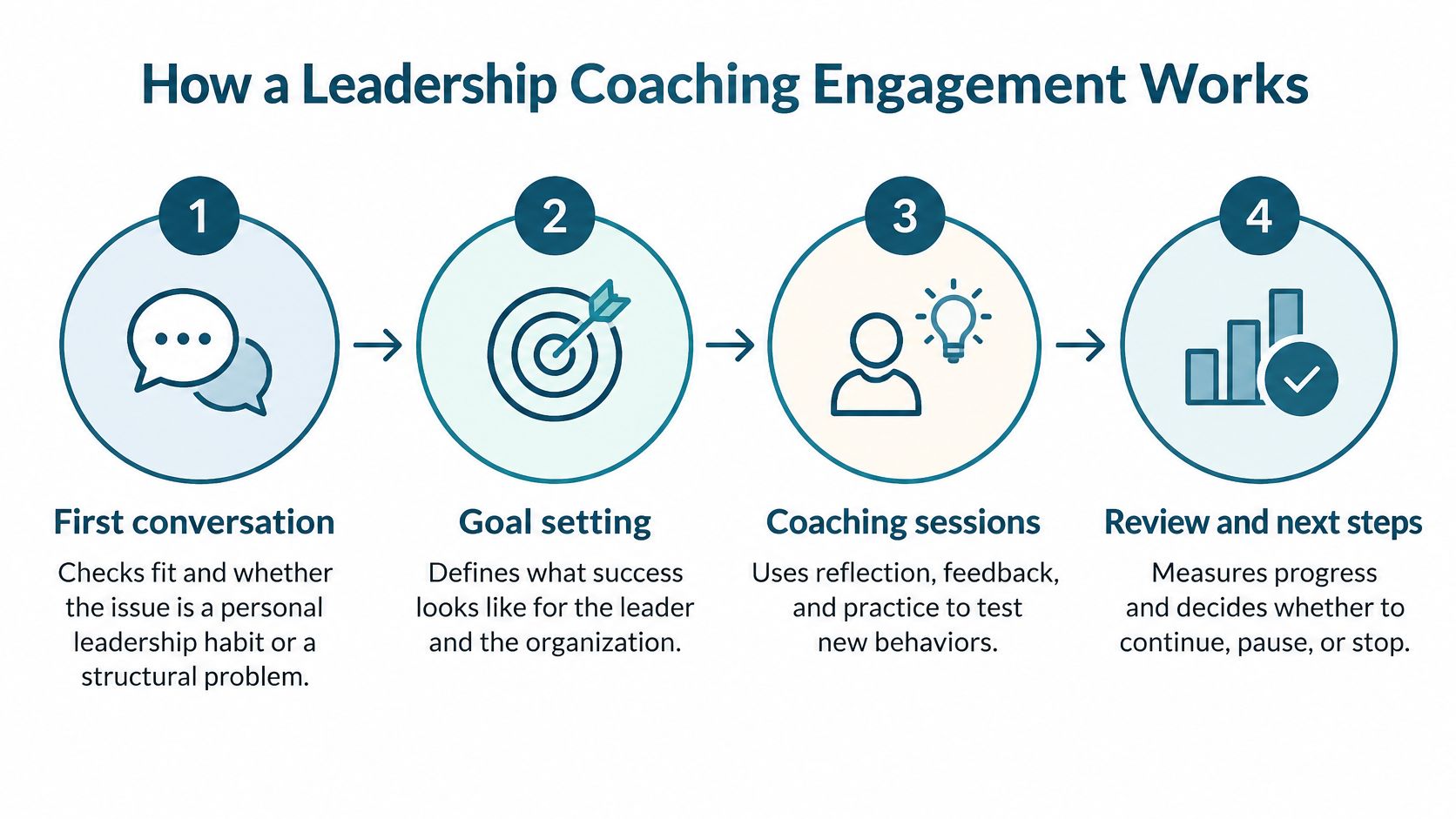
From the first conversation to practical experiments
Check whether coaching fits the problem. The first conversation should establish what you want to change and whether you have meaningful influence over it. For example, a department head who struggles to delegate needs a different response from one who has nobody available to receive the work.
Identify the hurdles and the thinking behind them. Intake forms or a self-assessment may help organize the starting point. A consultant might notice that she accepts every client request because she assumes any refusal will damage the relationship.
Agree on observable outcomes. Replace a broad ambition such as stronger executive presence with something you can recognize. For a promotion discussion, that might mean preparing a written account of impact and making a direct request without minimizing your contribution.
Work through a live situation. Sessions can examine a staffing choice, an underperforming direct report, or an upcoming client conversation. The coach asks questions, challenges assumptions, and helps you rehearse options rather than choosing for you.
Try a small change between sessions. A leader might ask an associate to bring a recommendation instead of an open-ended question. She then considers what happened, what surprised her, and what needs adjustment; our coach is also available between sessions.
Build toward harder decisions. An initial delegation experiment can prepare you for a broader conversation about your role. Our approach starts with small wins and progressively scales up, rather than demanding an immediate overhaul.
We begin by identifying work hurdles and the current mindset, then follow a five-pillar process. The framework organizes the work; it doesn't remove the need to tailor it to the person.
Make the commitment explicit
Before agreeing to an engagement, get a written outline of session length, meeting frequency, total duration, fees, cancellation terms, and between-session support. There isn't a single schedule or price established by the evidence discussed here, so a precise typical commitment would be misleading.
The coach shouldn't write your business strategy, manage your team, or promise a promotion. Those responsibilities and decisions remain elsewhere.
Before you commit: Establish who owns the agenda, what information can be shared, and how you'll both recognize progress.
A useful engagement makes those terms clear before asking you to invest your time and money.
What Coaching Can Change for a Tired Leader
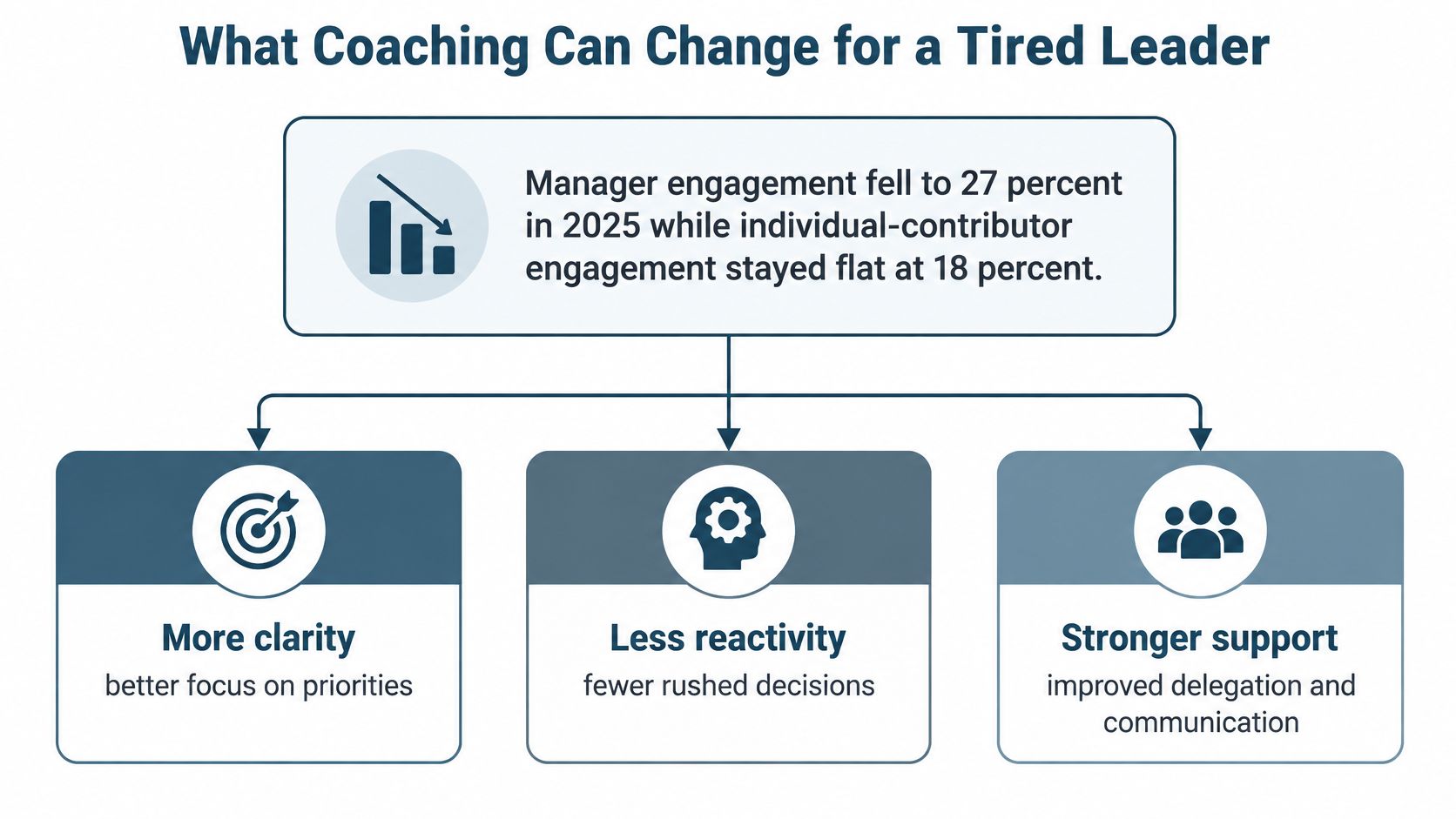
Manager engagement fell to 27% in 2025, while individual-contributor engagement remained flat at 18%, according to Julie Allen Consulting's overview of Gallup's State of the Global Workplace reporting. Its discussion of managers' burnout and interest in leaving adds an important caution: leadership development shouldn't assume that a depleted person needs more ambition.
Engagement isn't a diagnosis of burnout. It does, however, provide context for asking whether a coaching plan supports sustainable leadership or merely asks someone to perform harder.
The useful changes concern how work gets handled, not just how much gets completed.
Workload and decision ownership
Workload becomes more manageable when the leader distinguishes work requiring her judgment from work she's holding through habit. A useful exercise is to review recurring tasks and mark each for retention, delegation, renegotiation, or removal.
Delegation still needs adequate staffing and capability. Handing an overloaded colleague another assignment isn't a sustainable solution.
Decision rights address a related but different issue: who is allowed to make the call? A project manager may have delegated a task while still requiring approval for every variation, leaving the burden unchanged.
For someone moving from team member to manager, LeaveWizard's guide offers a complementary perspective on developing management skills. Coaching can focus on the personal adjustment of no longer being the person who supplies every answer.
Say a law-firm partner rewrites every associate's draft. Rather than setting a target to review faster, she could establish a review standard covering legal reasoning, client risk, and presentation, then require associates to check their work against it before submission.
Boundaries and advancement
The remaining changes should protect the leader's capacity while preserving her ambition:
Boundaries: Define what counts as urgent, who covers an absence, and when a response can wait. A protected evening or actual vacation requires an operating agreement, not just personal resolve.
Advancement: Build a clear account of client outcomes, sound decisions, and team development. Preparing that account shouldn't require taking on additional work merely to prove commitment.
Our coaching rests on the idea that success should bring greater ease and less overwhelm, not just more activity. Doing more work from burnout isn't a sustainable way up the corporate ladder.
For a related reflection on self-trust under pressure, our guide to regaining leadership confidence can help frame what you want to change without turning exhaustion into a character judgment.
The practical test is straightforward: if the plan requires more output before any recovery, it's productivity optimization, not the leadership support a depleted person needs.
Leadership Coaching in Workplace Moments
Coaching becomes easier to understand when you can see the conversation it prepares someone to have. These hypothetical scenes show different ways to preserve professional results without extending the workday.
The common setting is ordinary professional work, not a classroom exercise.

Client pressure and recognition
A lawyer facing weekend expectations. Before coaching, she replies whenever a client sends a message because she equates availability with professionalism. The coaching focus is preparing a response-window conversation and distinguishing genuine urgency from routine updates. A workable result would be agreed coverage for urgent matters and scheduled handling of everything else, without compromising client care.
An accountant preparing for promotion. She arrives with a list of hours worked but struggles to explain why she's ready for greater responsibility. Coaching helps her organize client outcomes, improvements in delivery, and the development of junior colleagues, then practice stating the compensation she wants without apologizing. The intended change is a more credible conversation, not another busy season spent collecting evidence through overwork.
Shared responsibility and owner decisions
A consultant who has become the client's only contact. Every question comes to her, including questions others could answer. Coaching focuses on introducing a deputy for a workstream and maintaining a decision log that records owners, reasoning, and unresolved issues. Our resource on team decision-making offers a related way to examine how responsibility is distributed.
The deputy also needs useful feedback, not occasional corrections after the fact. One Dynamics' feedback guide for Singapore HR teams is a complementary resource for considering that communication practice.
A business owner without a board. She repeatedly revisits a hiring choice and postpones a pricing change because she has no neutral sounding board. The coach helps her separate assumptions from information she still needs. She could leave with a hiring decision rule, a way to test the pricing change, and a commitment to stop reopening settled questions without new evidence.
For another perspective on the topic, the accompanying video is below.
These are possible applications, not promised outcomes. The useful result is a better way of working, not a longer working day.
If a situation involves harassment, discrimination, or a medical crisis, coaching isn't the appropriate venue for resolving it. Match your own week to the closest scene, then identify the specific conversation or decision you'd want help preparing.
When Coaching Is the Wrong First Move
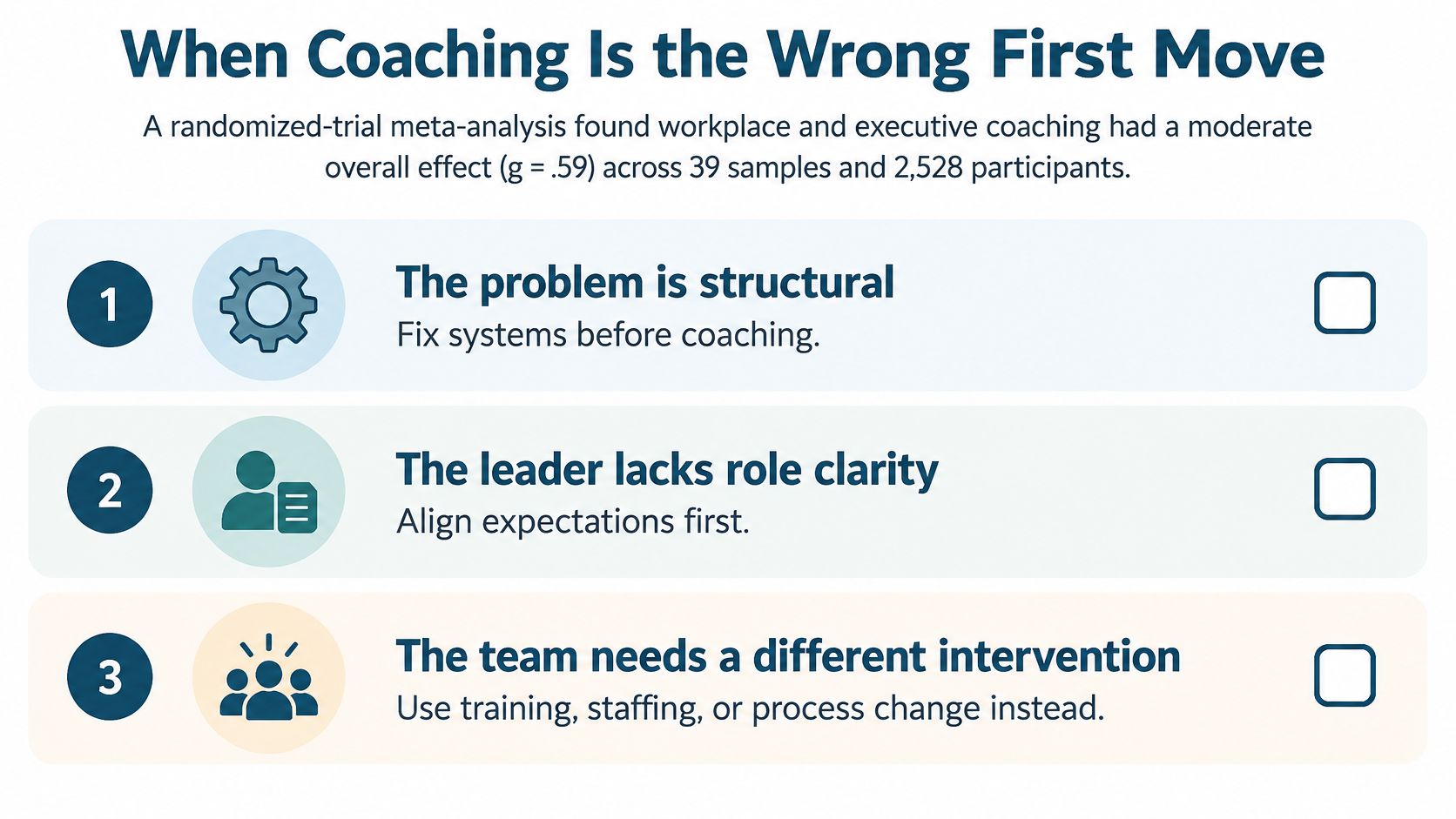
A randomized-trial meta-analysis published in Academy of Management Learning & Education found a moderate overall effect, g = .59, across 39 samples and 2,528 participants, while also identifying indications of publication bias. That supports a measured conclusion: workplace and executive coaching can improve leadership and personal outcomes, but the finding doesn't establish guaranteed business returns or an ability to repair harmful systems.
The distinction matters when an employer offers coaching in response to a problem it should address directly.
Match the response to the problem
When to coach and when to look elsewhere
Situation | Coaching can still do | Look here first or as well |
|---|---|---|
Impossible workload and no authority to change it | Clarify boundaries and what to escalate | Workload redesign, staffing or a sponsor with authority |
Promotion blocked by unclear or biased criteria | Build a clear account of impact | HR review or an organizational change to the process |
Anxiety, depression or medical exhaustion | Support recovery habits only alongside care | Therapy or medical support |
Ordinary team conflict the leader owns | Clarify decision rights and feedback | Coaching is appropriate |
Harassment or discrimination | Stop treating the issue as a coaching problem | Formal HR or legal route |
A coach can help a leader prepare a staffing request. They can't grant the budget. Likewise, practicing a promotion conversation won't correct a process that consistently applies different standards to different people.
When health symptoms need assessment, coaching should pause or operate alongside appropriate care within a clearly limited scope. A coach shouldn't diagnose symptoms or encourage a client to substitute professional development for treatment.
The employer's responsibilities remain
If an employer pays, the sponsor should help establish goals without acquiring unrestricted access to session content. The agreement should specify what can be shared, such as attendance or an agreed progress summary, and explain confidentiality limits, including any legal or safety-related exceptions.
The sponsor must also own structural fixes. Coaching shouldn't become surveillance or a way to document that an exhausted manager has failed to adapt.
Use fair measures: Fewer avoidable after-hours escalations or a completed compensation conversation can demonstrate practical progress.
Separate responsibilities: Record what the leader will change and what requires action from someone else.
Reject the wrong diagnosis: Burnout shouldn't automatically be treated as a leadership-skill deficit.
Before booking, answer this question: Is the change inside my choices, or does it require someone with authority I don't have?
Decide If Coaching Fits This Quarter
Choose leadership coaching this quarter if the change sits in how you decide, delegate, set boundaries, or explain your impact, and you can name an outcome you'd recognize in your actual work. Pause if the pressing need is workload redesign, an HR review, therapy, or medical care.
You don't need a complete career plan before starting. You do need a reason for coaching that's more specific than feeling that you should somehow be better.
Make the decision concrete
Use these checks before a first conversation:
A protected working relationship: Confirm that the work is individual and that session content won't become a performance score for your boss.
A sustainable definition of progress: Include preserved time and health, not just a larger target or more responsibility.
A subtraction as well as an addition: Name what you'll stop doing, not only the new behavior you'll practice.
Ask about credentials, relevant professional experience, session length, meeting frequency, fees, and how the engagement ends. Our guide to executive coaching cost can help you prepare the financial questions without assuming that a higher fee guarantees a better result.
For professional women and business owners who want advancement without quitting or downshifting, ambition doesn't have to mean accepting every demand. The useful question is whether this support can help you pursue your goals with more deliberate choices.
Write down the outcome you want and the condition outside your control. Bring both to an initial conversation so that fit can be judged fairly, rather than treating coaching as the answer before the problem is understood.
Our Freedom 1:1 Coaching Program at Acheloa Wellness combines burnout and executive coaching for professional women who want to advance without treating more work as the solution. Visit Acheloa Wellness to book a free consultation, bring your desired outcome and the constraint you can't change alone, and explore whether coaching is the right support.

