

Team Decision Making: How to Decide Well Together
Many attendees in a decision meeting can tell when it's going poorly. In a 2025 workplace survey of 105 respondents, 64% were dissatisfied with how meetings were conducted, and 43% said leadership did not sufficiently support a clear, consistent decision approach, according to the GAABS report on decision-making in the workplace. Neither number points to a shortage of talent in the room. Both point to a missing process.
Team decision making is the process of combining the knowledge of several individuals, evaluating options against agreed criteria, committing to one choice, and documenting who is responsible and why. That last part, the record, is where many teams fail.
The sections below build in order: why groups can beat individuals, the six stages and their owners, who holds the final call, how to gather input without flattening dissent, what a finished decision record looks like, and how to govern an AI that sits in the room.
Table of Contents
Why Teams Decide Better Than Individuals, and When They Don't
The Six Stages of a Team Decision and Who Owns Each - What behavioral integration actually means - The six stages as steps
Settling Who Makes the Final Call - Matching the mode to the risk
Gathering Input Without Silencing Dissent - Structured dissent in ten minutes - Where input breaks down
A Worked Example From Decision to Review - Communicating and reviewing the choice
Using AI as a Participant in Team Decisions - The governance questions nobody asks
Why Teams Decide Better Than Individuals, and When They Don't
In a laboratory study published in the Journal of Business Economics, researchers gave the same decision problems to individuals and to 26 teams. The teams scored a mean of 48.85, with a median of 46 and a standard deviation of 12.21. The median gain from deciding as a group ran roughly twice the individual gain (-30 versus -16 on the study's scoring), and team choices beat a random-choice model by an average of 26.01 points.
Numbers like that can make teamwork sound automatic. It is not.

The advantage carried a condition: teams won when their process let members combine information before choosing. Strip out the sharing, the integration and the evaluation, and adding people to the room raises coordination costs instead of improving judgment. A group that cannot pool what its members know is several individuals taking turns talking.
A jury that hears only the foreman's version of events reaches a weaker verdict than one whose members compare notes before voting. The same holds around a leadership table.
A decision with no named owner and no recorded reason is a conversation that ran out of time.
The failure mode is structural. A meeting can feel productive, end on a warm note, and still leave nobody accountable and nothing on paper. Six weeks later, no one can reconstruct why the team chose that path, so the next meeting opens the same question again.
A finished team decision has three parts: the choice, the written rationale (including the dissent that lost), and a scheduled review of whether the choice worked. Everyone remembers the first part. The record and the review are what turn a discussion into a decision, because they give the team something to learn from next time.
Before your next team decision, ask two questions. Does this need a team at all, or would one informed person with clear criteria decide faster and just as accurately? And if it does need a team, will the process deliver the information members are being asked to weigh? If the answer to either is no, adding people will add cost rather than judgment.
The record is also where supporting tools earn their place. Drafting the rationale and checking the evidence behind it often takes longer than the discussion did, and research and proofreading assistance can shorten that step. What no tool can do is own the outcome: a named person still signs the record and sets the review date.
The Six Stages of a Team Decision and Who Owns Each
Many people can name the decision they made. Far fewer can name the stage where it went wrong. Separate the stages and give each one an owner, an output and a known failure, and the argument stops being about who is right and starts being about which box is still empty.
Stage | Owner | Output | Typical failure |
|---|---|---|---|
1. Define the problem | Decision lead | One-sentence problem statement and scope | Solving a symptom instead of the cause |
2. Set goals and criteria | Decision lead with team input | Ranked criteria such as cost, risk and deadline | Criteria chosen after a favorite option appears |
3. Generate alternatives | Whole team, written first | Three to five options with stated trade-offs | Stopping at the first workable option |
4. Evaluate alternatives | Whole team, against the criteria | Scored comparison with cited evidence | Opinions replace evidence |
5. Make the final choice | Named decision owner | Decision plus recorded rationale and dissent | A vote that hides who is accountable |
6. Review the outcome | Decision owner | Review date and the measures to check | No review, so lessons are lost |
What behavioral integration actually means
Team decision quality depends on behavioral integration, which research on management teams defines as the extent to which members collaborate, share information and jointly participate in decisions, rather than merely being colocated in the same meeting. That study found a significant indirect effect of psychological safety on team effectiveness through behavioral integration: safer climates increased members' willingness to speak, collaborate, share knowledge and take ownership of decision-relevant experience. Four people in a room who each hold a private view are not an integrated team. Four people who have each put evidence into the same document are.
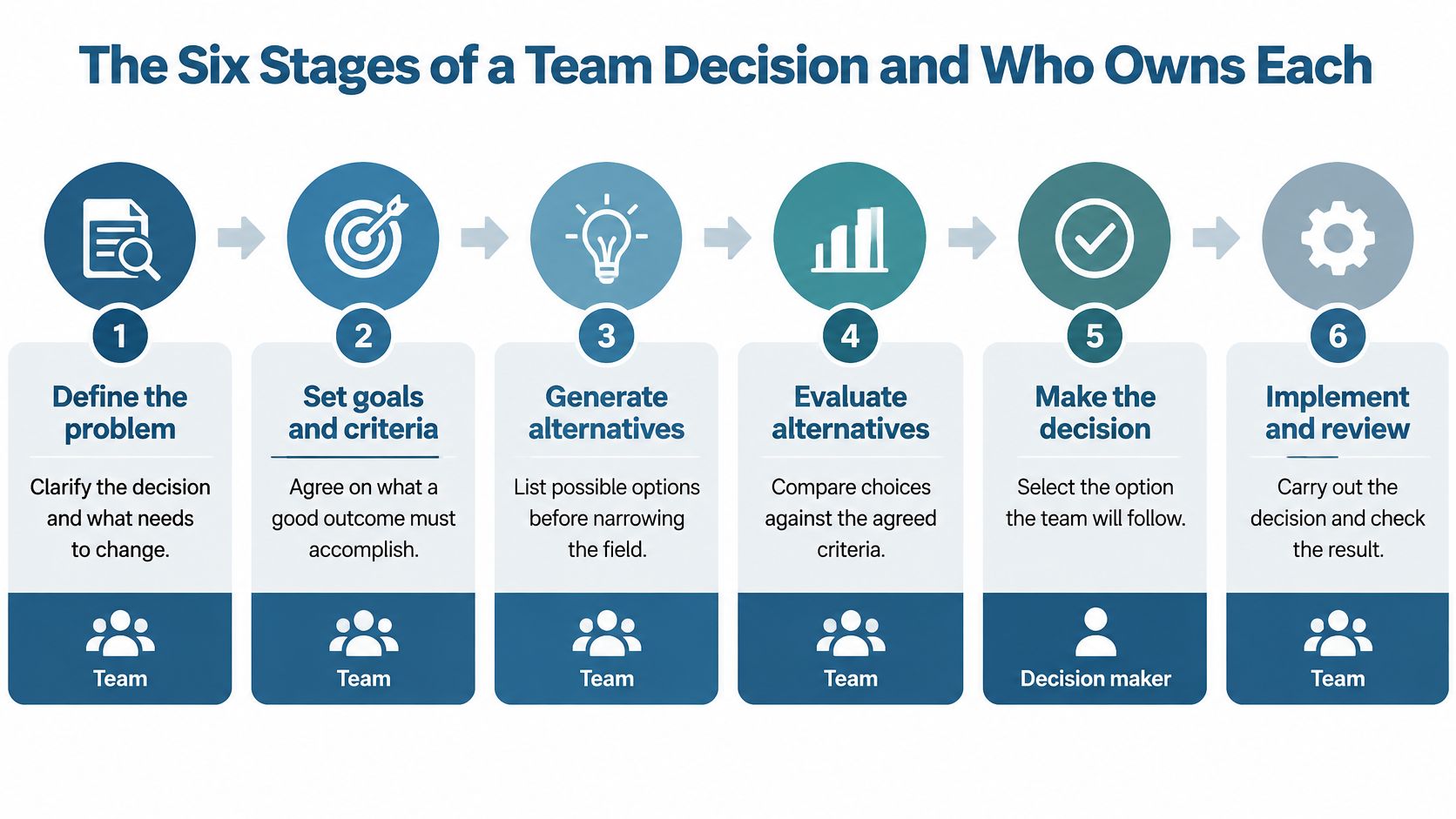
The six stages as steps
Define the problem in one sentence before anyone proposes a solution. A leadership team opening with "our competitor cut prices" has already chosen its answer. The problem statement should name what's changing, such as margin erosion in mid-market accounts.
Agree the criteria first. Cost, risk, reversibility, deadline, ranked in order. Criteria written after a favorite option appears get reverse-engineered to fit it.
Collect written alternatives from every member. Three to five options with stated trade-offs. Writing first stops the loudest voice from setting the frame.
Score the options against the criteria, with evidence attached to each score. An argument that survives a scoring sheet is a different animal from one that survives a room.
Name the decision owner and record the rationale and the dissent. "We voted" hides accountability, and a vote can decide something without anyone owning the result.
Set the review date before the announcement. Choose the two or three measures you'll check and the date you'll check them.
The stage logic transfers directly to how you hand work over, which is why delegating a decision well means passing the criteria and the deadline along with the task. Teams that write the criteria and the options down before the debate align faster before engineering starts building, because the argument moves to the evidence instead of the personalities.
Which of these six does your team skip most often? For most groups it's stage five or six, and both omissions only surface months later.
Settling Who Makes the Final Call
Every decision has an owner whether or not the team names one. Leave it unnamed and the role defaults to whoever speaks last, whoever is most senior, or whoever has to live with the consequences.
Mode | Who makes the final call | Works best when | Main risk |
|---|---|---|---|
Leader decides after consultation | One named leader | Speed matters and the leader holds the accountability | Input feels cosmetic if it is visibly unused |
Consensus | Whole group must agree | Full commitment is needed to implement | Slow, and one strong objection can stall it |
Majority vote | Most voters | Options are equal and easy to reverse | Hides dissent and losing members disengage |
Delegated to one person or sub-team | One person or small group | Expertise sits clearly in one area | Others feel uninformed unless the record is shared |
Advisory with explicit owner | Named owner decides, team advises against stated criteria | Expertise is mixed and accountability must be clear | Needs discipline to name the owner upfront |
Rank is a poor proxy for judgment. In 2024, 70% of UK employees said they would trust a person with data over someone with a higher job title when making important decisions, according to SurveyMonkey's Workplace Trends study. Your team already believes the evidence should outrank the org chart. The process should match that belief.
Matching the mode to the risk
Write a three-part owner statement before the discussion starts: who decides, by when, and which input is binding versus advisory. Put it in the meeting invitation so nobody has to guess.
Then pick the mode by consequence. Reversible, low-cost choices can be delegated or voted on and moved past in minutes. Decisions touching staffing, client risk or compensation need a named owner who states the criteria used and the input that changed their mind. Say a team of four is choosing a shared project tool. One person owns the call, the team agrees to a two-week trial as the evidence base, and the owner decides on day fifteen using a stated criterion such as migration effort against missing features.
Leaders who carry these calls regularly often work through the pattern in executive coaching and leadership development rather than learning it mid-crisis.
The test is simple. Before the first word is spoken, can everyone in the room say who owns this decision?
Gathering Input Without Silencing Dissent
Teams rarely fail because nobody knew the answer. They fail because the person who knew it stayed quiet while the room agreed.
Safety is measurable, not aspirational. In a study of management teams, psychological safety had a statistically significant positive correlation with task performance of r = 0.51 and with individual satisfaction of r = 0.70, both reported at p ≤ 0.01, according to research published in the International Journal of Environmental Research and Public Health. The same analysis found a significant indirect effect on task performance through behavioral integration of 0.51, with a 95% confidence interval of 0.3683 to 0.6872.

In plain terms, members have to believe they can raise a concern, admit a mistake, share half-finished information and challenge the prevailing view without being punished for it. That isn't comfort. It's an information condition.
Structured dissent in ten minutes
Before the vote, go around the table. Each person states one risk, one contrary interpretation, or one piece of missing evidence. No agreeing, no building, no "great point."
Practical rule: If a member has nothing to add, ask what evidence would change their view. Silence usually means the question hasn't been asked properly.
The same discipline applies to yourself as the leader. Speak last, and say in advance which evidence would move you. A leader who speaks first gets agreement, not input.
Where input breaks down
Failure | Warning sign | Fix |
|---|---|---|
Silence | Quiet members agree in the room and object later | Collect written views before any discussion starts |
Premature consensus | The group agrees within minutes of the question | Ask each member for one risk or contrary interpretation |
Hierarchy dominance | The senior voice speaks first and others defer | The leader speaks last and says which evidence would change their view |
Avoidance disguised as dissent | Objections are vague or repeat without new evidence | Ask what evidence would change the objector's view |
Endless debate | The same objections return in every meeting | Set a deadline and use a disagree-and-commit checkpoint |
Safety without a review habit produces comfortable teams that repeat the same mistakes kindly. Building real psychological safety at work means pairing candour with a place to use it.
A Worked Example From Decision to Review
Say a nine-person consulting firm is deciding whether to move its largest client from hourly billing to a fixed fee. The partner group has argued about it twice and adjourned both times.
The fix is a one-page decision record, built in the meeting, in this order:
Decision owner and deadline. The managing partner owns it and decides by the 14th.
Problem statement. Realisation on this client has dropped for three consecutive quarters, and scope has grown without a change order.
Criteria in priority order. Margin protection first, client trust second, team workload third.
Options considered. Stay hourly with a tighter scope clause, fixed fee at the current average, fixed fee plus a defined change-order rate.
Evidence used. Twelve months of time entries, the two change orders rejected last year, the delivery team's estimate of hours per phase.
Dissent recorded in the dissenter's own words. One partner expects scope creep to erase the margin gain.
Review date and measures. Day 90, checking realised margin, hours per phase and the number of out-of-scope requests.
Communicating and reviewing the choice
Send the record to everyone affected within one business day. Explain what changes for each group and why, and hold a 48-hour window for questions before anything starts. That window is where quiet objections surface, and it's cheaper than discovering them in month two.
The dissenting partner's concern becomes a review metric rather than a grudge. At day 90 the team compares predicted margin with actual margin, predicted hours with actual hours, and asks the four questions that turn a decision into learning: what did we predict, what happened, which assumption failed, and what changes next time.
That loop is what makes candour pay off. In a study of 54 decision-making teams comprising 241 business students, team-level emotional intelligence improved decision performance through increased psychological safety, and a related analysis reported psychological safety was positively associated with team decision-making performance (β = 0.529, p < 0.05), as reported in Team Performance Management. Safety alone isn't enough, though. The same body of work, looking at 104 field sales and service teams, found that psychological safety affected effectiveness indirectly through team learning behavior and team efficacy rather than directly, which is the argument for making the review a standing item instead of a good intention.
If you record meetings anyway, transcription and summary tools reviewed by AI Tool Seekers can capture the raw material, but the seven headings above are the part that has to be written by the people who own the call.
Your task now is small: take your next real decision and fill those seven headings on a single page before the meeting starts.
Using AI as a Participant in Team Decisions
Most guidance on group decisions still assumes an all-human room. That assumption is already out of date. Microsoft's 2025 Work Trend Index, a global survey of 31,000 knowledge workers across 31 markets, found that 28% of managers were considering hiring AI workforce managers, while 32% planned to hire AI-agent specialists within 12 to 18 months.

Emerging research describes these groups as hybrid teams, in which an AI system can contribute to the team's shared, or transactive, memory, particularly in complex, knowledge-intensive work. That means an AI can hold part of what the team knows. It does not mean the AI holds accountability.
The governance questions nobody asks
Three questions remain unanswered in many teams that use AI in decisions. Who owns the final call when a recommendation from a model shaped the discussion? How is disagreement with the model recorded? What must a human verify independently before the group commits?
The productivity case is real. In an experiment involving 215 people across 81 teams, teams with centralized AI knowledge made more accurate decisions than human teams in a hidden-profile task, the same Microsoft Work Trend Index research reports. Note what that suggests: AI helped by closing information gaps, not by being more objective than people. The same research cautions teams against relying on social validation of AI output and recommends checking original sources and organizational data.
A five-step protocol keeps the boundary clean:
Name the human owner. Every decision influenced by a model has one accountable person, stated in the record.
Log the AI input and its sources. What was asked, what came back, where the underlying facts came from.
Record dissent from the model. If a team member thinks the recommendation is wrong, that goes in the record in their words.
Verify key claims against source data. Especially figures about clients, contracts and money.
Keep confidential information out of prompts unless someone with authority has approved it.
Which AI input in your last significant decision had no named owner? If you can't answer quickly, the governance is missing, not the tool.
Confirm Who Owns Your Next Team Decision
Everything above reduces to one action you can take before your next meeting: write the owner statement.
Three lines. Who decides. By when. Which input is binding and which is advisory. Then place the decision in one of the six stages, pick a decision mode that matches its risk, and put the review date in the calendar before the announcement goes out. Keep the owner statement in the meeting invitation so the person holding the call is visible from the first line.
That's the whole discipline. It costs five minutes and prevents the most common failure in team decision making, which is a group of capable people leaving a room without agreeing who was accountable for what they just chose.
There's a quieter cost too. When a leader carries consequential decisions alone, the pressure follows them home in the evening, long after the decision itself was sound. Acheloa Wellness offers one-on-one coaching for leaders working through that load, starting with the work hurdles and the mindset that brought you there and then following a five-pillar process. It's one route among others, alongside a peer review group or a mentor, and it isn't required.
The test for this week is the same one from the start: can everyone in the room say who owns the decision before the first word is spoken?
If you're ready to stop carrying every call alone, Acheloa Wellness works one-on-one with women lawyers, accountants, consultants and business owners on the decisions and workload that follow them home. We start with the hurdles in front of you and the habits that got you here, then build a way of working that keeps your results intact with less of your evening gone. Visit Acheloa Wellness to book a free consultation and bring one decision you've been holding by yourself.

