

Executive Coaching Business: A Guide for Owners
You've closed the laptop, but you're still weighing a hiring decision. A client message pulls you back in, a proposal needs your approval, and tomorrow's calendar leaves no room to think. You're responsible for the business, yet the decisions that matter most keep getting pushed into your evenings.
Executive coaching can give those decisions a proper place to be examined. For an owner, its value isn't just completing more goals. It's making sound calls without requiring more of your time, attention, and recovery to keep the business running.
Table of Contents
What Executive Coaching Covers for Business Owners - Define the scope before you buy - Check whether your problem fits
Decisions and Pressures Coaching Can Address - Work on the dependency before the symptom - Keep the operational limits visible
Measuring Whether Coaching Is Working - Build a dashboard you'll actually maintain - Avoid reassuring but weak conclusions
How to Run a Coaching Engagement Step by Step - Make each cycle observable - Use records that already exist
The Hidden Load Owners Carry Alone - Audit care work without devaluing it - Give isolated decisions a review point
Choose a Coach and Book Your First Step - Ask questions that reveal the working relationship - Bring a decision, not a polished presentation
What Executive Coaching Covers for Business Owners
Executive coaching is a structured, one-to-one conversation that helps a leader make better decisions, change specific behaviors, and carry less of the load. You bring a real business problem. The coach helps you examine your assumptions, weigh consequences, and commit to an action you can evaluate.
It isn't the same as therapy, consulting, or mentoring. Therapy treats clinical conditions; a consultant may diagnose an operational problem and deliver a solution; a mentor shares relevant experience. A coach helps you develop your own judgment and follow through, rather than becoming the person who decides for you.
For an owner, that can mean examining whether a difficult employee needs clearer expectations, whether a client relationship is still commercially sensible, or whether your approval is necessary.
Define the scope before you buy
The global executive coaching market was valued at USD 8.1 billion in 2025 and is projected to reach USD 15.2 billion by 2032, according to Stratistics MRC. Market size isn't a quality standard. You still need to understand what a particular coach offers and how it fits your situation.
An executive coaching business also has its own acquisition pressures. For owners evaluating that commercial side, Ever Outbound Inc.’s resource on commission-based lead generation for coaching firms is relevant to sourcing prospects, not evidence of coaching effectiveness.
Check whether your problem fits
Coaching can suit owner-operators in billable-hour firms, partners carrying client responsibility, and solo professionals building a practice. Start with these questions:
Postponed decision: Am I avoiding a call because I need information, or because I'm uncomfortable with its consequences?
Repeating workload: Does the same pattern keep consuming my evenings?
Named skill gap: Can I identify a behavior I need to improve, such as giving direct feedback?
If you need technical answers, hire the appropriate specialist. If you need help evaluating options and changing how you lead, coaching may fit.
Decisions and Pressures Coaching Can Address
Pressure | What the coach examines | First practical move |
|---|---|---|
Hiring, firing or restructuring | Who owns the decision and what information is missing | Write the decision, the options and the deadline on one page |
Workload and constant availability | Client response norms, meeting load and after-hours habits | Track hours across a normal working cycle and mark work that can be batched or declined |
Pricing and compensation | How revenue, margin and time per client are tracked | Draft a one-page account of the revenue you handle and the risk you carry |
Delegation and team ownership | Which tasks only the owner can do | Sort current tasks into keep, delegate and stop |
Decisions with no peer check | Whether there is a sounding board for large calls | Name a pending decision you would test with an outside adviser |
Recovery and boundaries | Evenings, weekends and time off | Protect a recurring block and note its effect on results |
Start with the pressure that costs you the most hours or sleep, not necessarily the newest request in your inbox. Urgency can reflect somebody else's preference. A recurring interruption may deserve more attention than a loud but isolated problem.
The rows connect. Constant availability may reflect unclear authority rather than demanding clients alone. If employees can't approve routine changes, your response-time boundary won't hold because the team still needs you to keep work moving.
Practical rule: Don't set a boundary around a responsibility until somebody knows how that responsibility will be handled.
Work on the dependency before the symptom
Say a consulting firm owner answers client messages late into the evening, approves every proposal, and avoids raising fees. Starting with pricing might seem commercially obvious, but the owner may lack the capacity to prepare or hold that conversation.
A coach could first examine proposal approval rights and client response expectations. The owner might authorize standard proposals within agreed commercial limits, while reserving unusual terms for review. Clients would receive clear guidance on routine responses and genuine emergencies.
That creates space to examine fees using actual delivery effort and margin, rather than frustration. Our guide to how to delegate can help turn a general intention to hand work over into a clearer transfer of responsibility.
Keep the operational limits visible
Coaching can help you confront a missing finance function. It can't perform that function merely by improving your confidence. A firm without reliable accounts still needs accounting support; an employment decision may require legal advice before action.
The same distinction applies to capacity. If contracted work exceeds what the team can deliver, better personal habits won't resolve the mismatch. You may need different commitments, staffing, pricing, or service scope.
Bring the single most costly pressure to your first conversation, along with a recent example. That gives the coach something concrete to examine rather than a broad request to make leadership easier.
Measuring Whether Coaching Is Working
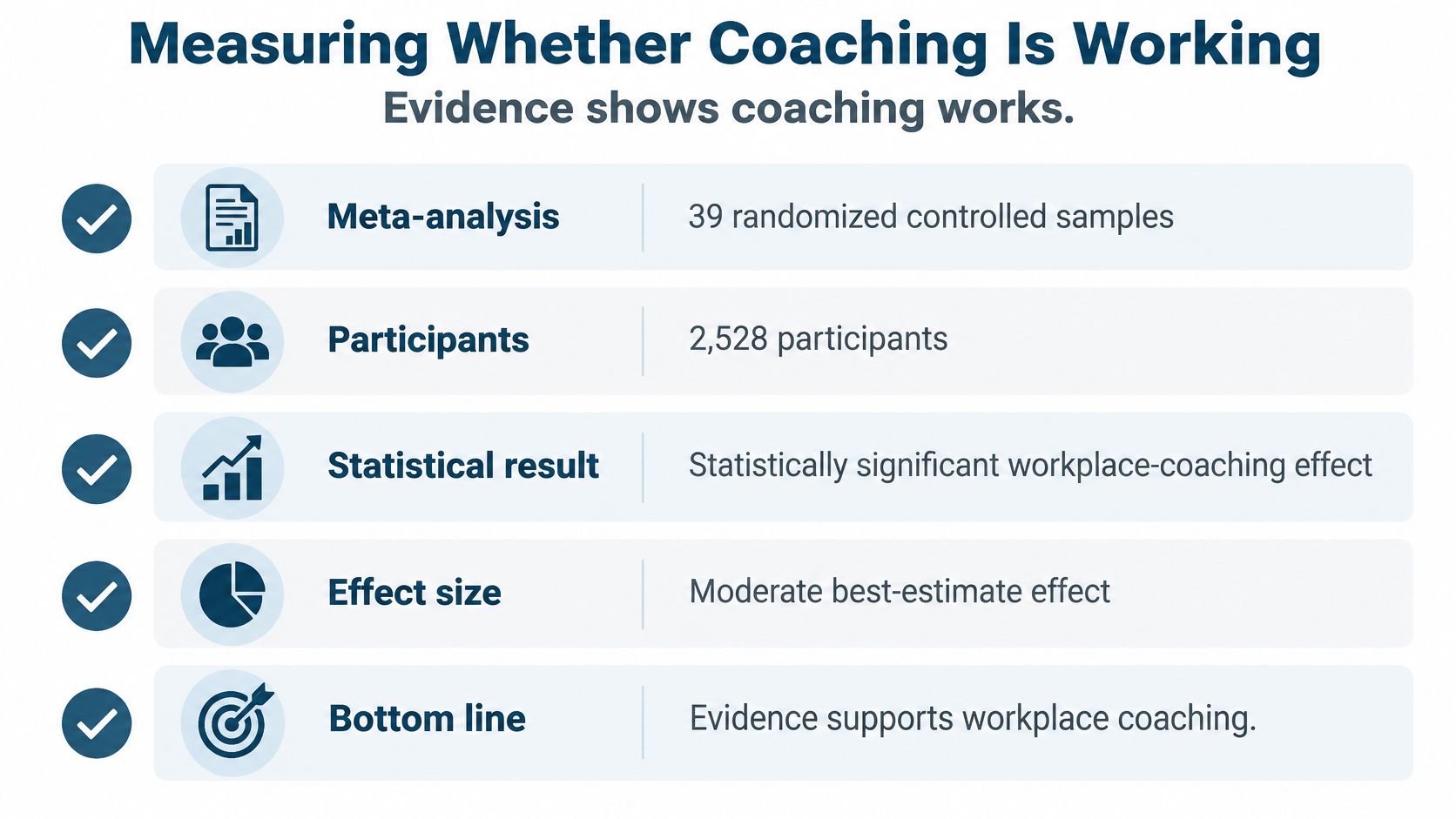
A meta-analysis published in Academy of Management Learning & Education examined 39 randomized controlled samples involving 2,528 participants and found a statistically significant workplace-coaching effect, with a moderate best-estimate effect size of g = 0.59, while warning that publication bias may inflate observed benefits.
That supports taking coaching seriously, not assuming every engagement will work. Testimonials can describe an individual's experience, but they don't establish what will change for you.
Use the evidence as a starting point, then measure your own engagement.
Build a dashboard you'll actually maintain
Leading indicators capture actions you can influence directly. Lagging indicators show whether those actions improve the conditions and results you care about.
Indicator type | Examples | How to record it |
|---|---|---|
Leading | Boundary followed, delegation count, confidence in hard conversations | Weekly self-log on the same scale used at intake |
Leading | Recovery time, protected blocks kept, after-hours contacts | Calendar and message count reviewed each week |
Lagging | Workload sustainability, self-reported stress, performance results | Baseline at intake, a midpoint review and a follow-up after the program ends |
Lagging | Promotion, pay outcome or retention where available | Recorded in dated notes, with the outcome treated as influenced by several factors |
Choose a small set you can maintain consistently. Include both a business result and a measure of what achieving it costs you.
For example, faster proposal turnaround isn't sufficient if you're still reviewing every proposal during dinner. Conversely, fewer evening messages aren't an improvement if clients can't get decisions and deadlines slip.
Avoid reassuring but weak conclusions
Self-report matters, especially for stress and recovery, but combine it with calendars, message records, completed actions, or appropriate workplace feedback. Record missing entries instead of assuming silence means improvement.
An immediate end-of-program review can capture relief without showing whether change lasts. A later check matters, particularly after a busy period tests your new working arrangements.
Separate contribution from causation: A promotion may reflect coaching, performance, sponsorship, and an available role.
Keep clinical outcomes distinct: Coaching progress isn't proof that a mental health condition has been treated.
Ask about incomplete outcomes: Dropouts and unanswered follow-ups belong beside improvement figures, not outside the report.
When weighing executive coaching cost, consider the measurement and follow-up included, not just access to sessions. Be cautious about universal success promises. A coach should be able to explain how you'll distinguish useful conversation from sustained change.
How to Run a Coaching Engagement Step by Step
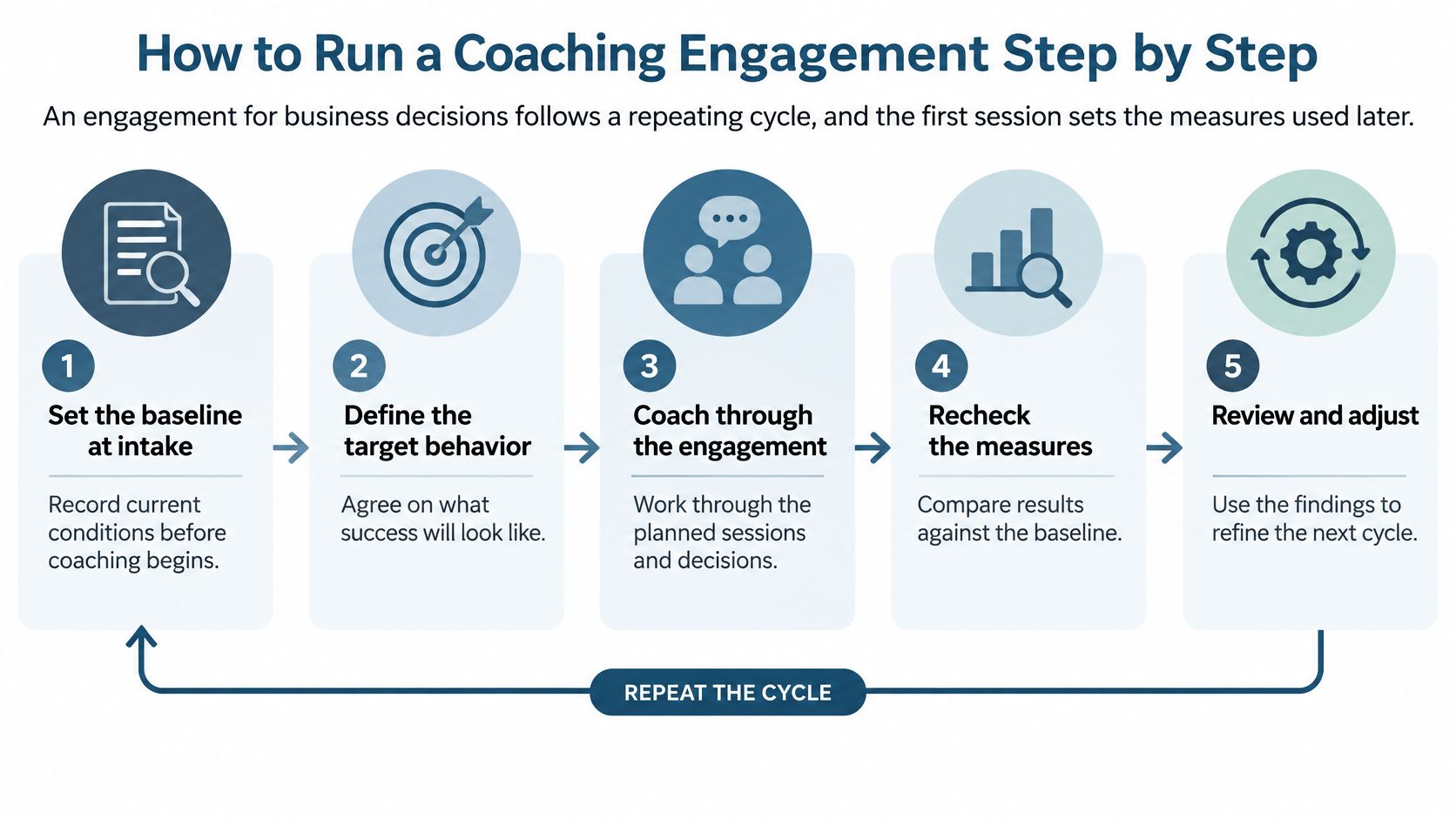
An engagement for business decisions follows a repeating cycle, and the first session sets the measures used later. Each conversation should connect to something you'll do differently outside the session.
A randomized controlled study of executive coaching combined feedback, a leadership workshop, and four individual sessions over 10 weeks, with outcomes assessed at baseline, week 10 and week 20. The coached executives showed greater goal attainment than the wait-list group, alongside improvements in resilience and workplace well-being.
Make each cycle observable
Record the baseline before changing anything. Capture work hours, after-hours contacts, missed breaks, and whether you follow your intended boundaries, because you need a reference point for comparison. The common slip is reconstructing the starting position from memory after you already feel better.
Turn the priority into a specific target. For example, replace being less overwhelmed with resolving a hiring decision by an agreed deadline, so you can identify the information and conversations required. Avoid choosing a target that relies entirely on somebody else's behavior.
Agree on indicators you can check. Select a manageable mix of actions and outcomes, giving each a count, a consistent rating, or a yes-or-no record. The mistake is recording activity, such as attending sessions, without checking whether your working behavior changes.
Run a bounded experiment between sessions. Test a protected stop-time, transfer a defined approval, or prepare a written account of your commercial contribution before a fee discussion. Keep the experiment narrow enough to interpret; changing everything at once makes it hard to know what helped.
Review completion and obstacles before adding new work. Examine what happened, including exceptions, because an uncompleted experiment can reveal a missing resource or unclear agreement. Adjust the design when appropriate rather than treating every difficulty as a failure of commitment.
Set the follow-up before the engagement ends. Compare your later working conditions with the baseline, allowing enough time for ordinary pressures to return. The common slip is ending with a positive conversation but no agreed point for checking whether the changes held.
The process is iterative rather than a straight path from problem to permanent solution.
Use records that already exist
You don't need a complicated reporting system. Your calendar, task manager, and time records can provide enough detail to test a practical question.
For billable-hour businesses, separate client delivery from unpaid administration and avoidable rework. BlokNotes' guide explains how to set up client codes for invoicing, a useful operational step when you need to connect time records with client work. Tracking creates visibility; deciding what to change remains the coaching work.
Progress should leave evidence in your working week, not just in your session notes.
Look for completed experiments, indicators moving in the intended direction, and fewer routine decisions waiting for your approval. If the records don't move, investigate the obstacle before buying more conversation.
The Hidden Load Owners Carry Alone
Delegating formal tasks doesn't remove every responsibility you carry. You may still absorb team frustration, anticipate conflict, reassure clients, and repeatedly explain decisions to people who weren't involved. Caregiving commitments don't disappear when the workday overruns, either.
A quieter calendar can still leave you exhausted.

Chief's coverage of the 2025 Women in the Workplace findings reports frequent burnout among around six in ten senior women, approximately 10 percentage points above male peers. Those figures concern senior women, not business owners specifically, but they make it unwise to equate visible leadership success with sustainable working conditions.
Audit care work without devaluing it
The aim isn't to stop caring about people. It's to distinguish useful leadership support from responsibilities you've absorbed without agreement.
Log the invisible work: During an ordinary working week, note reassurance, conflict smoothing, repeated explanations, and the interruptions each creates.
Map decision rights: For recurring decisions, identify who proposes, who decides, and who needs to be informed. Don't leave everyone assuming you're the final checkpoint.
Remove a small, explicit set: Reassign recurring reassurance to the appropriate manager, or replace repeated explanations with an accessible decision note.
Prepare a relational boundary: Offer a date to discuss a concern, ask for options before reviewing a problem, or clarify when an issue requires escalation.
Our explanation of the mental load can help you name responsibilities that don't appear on a task list. Treat the audit as a way to find patterns, not a verdict on your generosity or competence.
Use this video as a pause before considering which responsibilities need a different owner.
Give isolated decisions a review point
Without a board or peer structure, arrange a standing review with an outside sounding board. Bring the reasoning, risks, and unresolved assumptions, rather than asking for reassurance after you've decided.
You can remain accountable without being the only person allowed to think through the problem.
Choose a Coach and Book Your First Step
Before booking, name a pressure you want to address and an indicator that would show meaningful progress. A first conversation becomes more useful when you can describe a specific decision and what it's currently costing you.
Don't choose solely on warmth or an impressive biography. You need enough trust to speak openly, plus a working method that can withstand uncomfortable questions.
Ask questions that reveal the working relationship
Do you work with owners making decisions like mine? Ask about the types of hiring, pricing, client, or restructuring questions they help examine. Relevant scope matters more than a promise to coach anyone.
How do you establish a baseline and review progress? Listen for a clear method rather than an assurance that you'll feel the difference.
What happens between sessions, and how can I reach you? At Acheloa Wellness, our coach is available between coaching sessions. Clarify how that support will work for your needs.
Which outcomes won't you promise? A responsible answer should distinguish support for your actions from control over promotions, revenue, or other people.
What would the first month involve? Ask how the coach would approach your actual problem, including what preparation and action they would expect from you.
What does the engagement cost, how long does it run, and what does it include? Request the price, session count, and inclusions in writing before the consultation ends.
For another perspective on selection, the Expert Author Community coaching book from Expert Author Community (EAC) offers a resource to consider alongside your own questions. Reading about coaching can't replace assessing how a coach responds to your situation.
Bring a decision, not a polished presentation
At Acheloa Wellness, we provide one-on-one burnout and executive coaching for professional women and business owners. We meet each client where they are and provide coaching and tools, with an emphasis on advancement and sustainable performance without requiring them to quit or downshift.
A free consultation offers a low-commitment way to test fit before committing to a program. Bring a short decision note containing the options, the missing information, the pressure you want to reduce, and the measure you want to improve.
You don't need to solve the problem before the call. You need enough detail to assess whether the proposed approach would help you work through it.
Acheloa Wellness offers one-on-one burnout and executive coaching to help professional women and business owners examine difficult decisions while addressing workload and recovery. Write your pending decision, its pressure on your working life, and a useful progress measure on a page, then visit Acheloa Wellness to book a free consultation and bring that page to the conversation.

