

Executive Coaching Cost in 2026 and How to Judge It
Published executive coaching fee benchmarks from Coachful put a typical one-hour session at $200 to $500, with highly experienced specialists charging approximately $500 to $1,500 per hour. AxioBench estimates the average coaching engagement at $10,600 (coaching statistics). These figures offer a starting point, not a verdict on whether a particular quote is fair.
The lowest hourly rate can be the more expensive choice if the coaching ends when the call does. For someone buying coaching because work is spilling into evenings or a promotion feels out of reach, an isolated hour may leave the underlying workload unchanged. A package with preparation, accountability, and between-session support may cost more upfront but address more of the problem. Compare what each fee covers, including what happens between sessions, before dividing the total by the number of calls.
Table of Contents
Executive Coaching Cost Ranges for 2026 - Where the Global Averages Sit - How to Read Each Band - One Conversion You Can Copy
What an Executive Coaching Fee Actually Buys - The Scope Inventory Every Proposal Must Name
Factors That Move the Price Up or Down - Coach Background Comes First - Format and Added Labor Come Next - Who Pays Changes the Ceiling
Worked Examples of Return on a Coaching Fee - Where a Return Could Actually Appear
When Workload Makes Coaching the Wrong First Buy - Two Piles of Problems
Executive Coaching Cost Ranges for 2026
A $6,000 coaching package can work out to $1,000 per session, yet that figure alone does not show whether the price is reasonable. Start with typical ranges, then compare what each option includes and how the fee is structured.
Published executive coaching fee benchmarks from Coachful place a typical one-hour session at $200 to $500, with highly experienced specialists charging approximately $500 to $1,500 per hour. These hourly rates help you orient your budget. Packages are harder to compare because their scope can include work beyond the live sessions.
Where the Global Averages Sit
The 2025 International Coaching Federation Global Coaching Study summary reports an average fee of $234 for a one-hour coaching session, based on 10,035 respondents. The 2023 International Coaching Federation Global Coaching Study reported an average one-hour fee of $244 globally, based on data collected in 2022. In the United States, a 2024 survey of 122 executive coaches by the ICF Los Angeles chapter found that approximately 75% charged between $200 and $500 per hour.
Averages are useful for checking whether a quote is in the broad market range. They combine coaches with different experience, locations and specialties, so they are not a price guarantee for a particular buyer or program.
How to Read Each Band
Delivery | Typical cost | Usual scope | How to read it |
|---|---|---|---|
Typical one-hour session | $200 to $500 | Live coaching hour | Common individual rate |
Specialist one-hour session | $500 to $1,500 | Senior or niche expertise | Hourly rate, not a program total |
ICF 2025 global average hour | $234 | One-hour average, 10,035 respondents | Broad market benchmark |
ICF 2023 global average hour | $244 | One-hour average from 2022 data | Earlier benchmark |
2024 Los Angeles coach survey | About 75% at $200 to $500 | 122 executive coaches | Regional survey finding |
Three-month leadership sprint | $3,000 to $8,000 | About six sessions | Package price, not six separate hours |
Six-month engagement | $8,000 to $20,000 | About 12 sessions plus assessment | Longer individual program |
Average engagement, 2024 estimate | $10,600 | Full engagement | AxioBench industry estimate |
Corporate per executive | $10,000 to $50,000 | Interviews, assessment, reporting | Employer-sponsored scope |
For budgeting, distinguish a package total from an hourly rate. A three-month sprint with about six sessions is typically $3,000 to $8,000; a six-month engagement with roughly 12 sessions plus assessment is about $8,000 to $20,000. The 2024 AxioBench industry estimate put the average executive coaching engagement at $10,600, within that six-month range. Corporate engagements can cost $10,000 to $50,000 per executive when they include stakeholder interviews, assessments and organizational reporting. To compare coaching with another kind of advisory service, compare HR consulting rates for 2026.
One Conversion You Can Copy
A three-month package quoted at $6,000 costs $2,000 per month. If it includes six sessions, that works out to $1,000 per session before accounting for preparation or between-session contact. The number is higher than the usual $200 to $500 hourly band, but the comparison is incomplete until you know what support the package includes.
Practical rule: Match the quote to a row in the table before judging its price.
A $6,000 package and $6,000 spent on separate sessions buy different scopes. Compare what each fee covers before deciding which offers better value.
What an Executive Coaching Fee Actually Buys
Treat the invoice as a bundle, not a timer. The live hour is the visible part, but the work that changes your week often happens before and after it. If you only count minutes on a call, you'll misprice almost every serious proposal.
Buying only the live hour is like paying a specialist for the visit and getting no chart, no follow-up, and no plan between appointments. You'd leave with a conversation and handle everything else alone. Coaching bought that way can feel supportive without producing a measurable change.
The scale of the field makes scope harder to read, not easier. The latest ICF Global Coaching Study summary surveyed 10,035 participants across 127 countries and estimated global coaching revenue at $5.34 billion, up 17% from the prior study, while the number of coach practitioners reached 122,974, up 15% since 2023. A large market gives you choices. It doesn't give you a standard package.
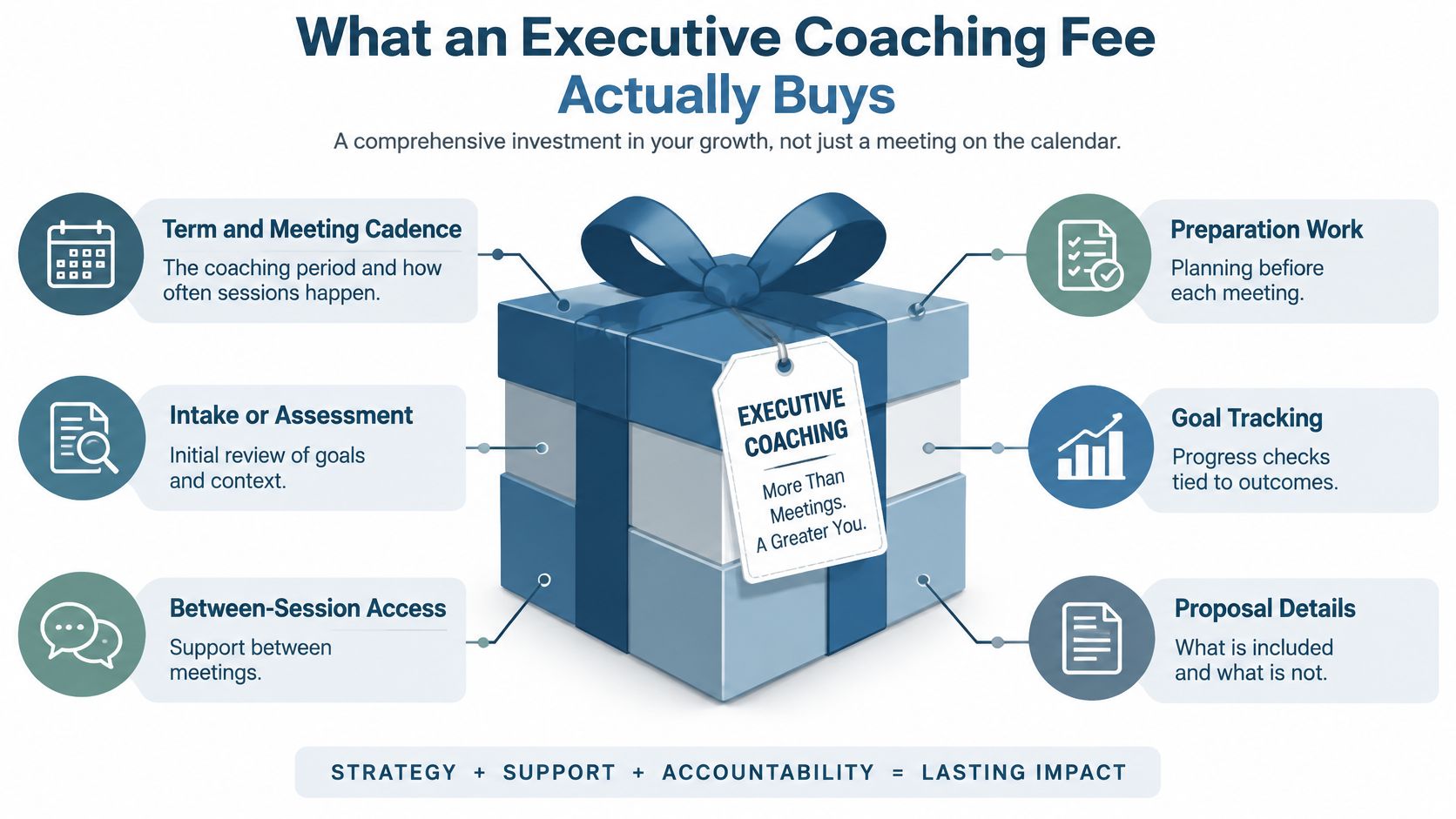
The Scope Inventory Every Proposal Must Name
Ask for these fields in writing before you compare two quotes:
Term and meeting cadence: How long the engagement runs and how often you meet.
Preparation work: What the coach reviews, plans, or prepares before each session.
Intake or assessment: How goals, workload, and starting conditions are documented.
Goal tracking: Which one or two measurable objectives you'll check and when.
Between-session access: Whether you can reach the coach, how, and within what response window.
Confidentiality and cancellation: What stays private, what a sponsor sees if your employer pays, and what happens when you reschedule.
Now contrast two offers. Coach A charges a modest hourly fee, and the work ends when the call ends. Coach B charges a package whose live hours look expensive until you count preparation, accountability between sessions, and rehearsal for a promotion or compensation conversation. Coach B's effective hourly rate drops once that labor is visible, and the outcome you're buying is clearer.
That distinction matters in our work at Acheloa Wellness. Coaching is one-on-one, and the coach meets each client where they are and provides coaching and tools, and the coach is available between coaching sessions. If you're unsure what that support should cover day to day, what an executive coach does in a one-to-one engagement sets out the role in practical terms.
A quote that won't name term, cadence, asynchronous access, intake work, cancellation rules, and a measurable objective can't be compared with any published band. Ask the coach to state the full package fee and divide that figure by months and sessions yourself. The package total is the number you're committing.
Factors That Move the Price Up or Down
Most quotes move for predictable reasons, and the order matters. Start with who's delivering the work, then look at what's included around the sessions. This session example shows the one-to-one format most buyers picture first.

Coach Background Comes First
Years spent coaching senior clients raises a fee, and so does a niche that matches your stakes. A coach who understands deadline-driven work in law, accounting, consulting, or finance brings context a generalist has to learn on your time. Proof of similar work, such as helping clients prepare compensation cases or lead teams under billable pressure, supports a rate inside or above the common hourly band.
Brand language alone doesn't. Ask what the coach has handled that resembles your situation, including client demands, team size, and the career decision in front of you. Specific answers justify a premium. Vague authority doesn't.
Format and Added Labor Come Next
A single hour stays near the hourly row. Add an assessment, stakeholder interviews, and written reporting to a sponsor, and you've moved toward corporate scope, even if the session count barely changes. Each added deliverable is labor, and it should appear as a named line in the proposal rather than a higher unexplained total.
Cadence and access move price more than most buyers expect. Weekly sessions over six months cost more than a monthly check-in, and genuine between-session contact is work even when it isn't on the calendar. If a coach reads your draft promotion narrative, responds before a difficult client call, or checks whether a boundary held, you're buying that time too.
This short video is a useful pause point to think about what a working coaching relationship looks like between formal sessions.
Geography and delivery still shift quotes, but remote work has narrowed the gap. A remote specialist can cost as much as a local generalist, because you're paying for fit and experience rather than office rent. Don't assume video sessions should be discounted.
Who Pays Changes the Ceiling
An individual buyer usually shops the three-month and six-month package range, because the fee comes from personal income. An employer can fund a larger engagement because the organization is buying retention, leadership capacity, or readiness for a bigger role. The same coach may quote both buyers differently if the sponsored version adds interviews and reporting, and that difference is legitimate when the scope is spelled out.
Two edge cases catch people out. A short, focused sprint before a promotion conversation can be the right expensive month, because the outcome has a deadline and a clear payoff. A cheap open-ended retainer can become the costly option if it has no end date and no outcome to check.
Cheaper formats exist, including group programs and self-guided material. They lower the invoice but usually reduce individual attention, so score them on the same scope fields before choosing on price.
If two proposals differ by more than the scope difference, ask what labor is missing rather than assuming the lower number is the better buy.
Worked Examples of Return on a Coaching Fee
Return figures only help when you translate them into outcomes you can observe. Start with the dollar math on a $6,000 engagement, then decide whether the modeled benefit is plausible in your job. None of these benchmarks promises your personal result.
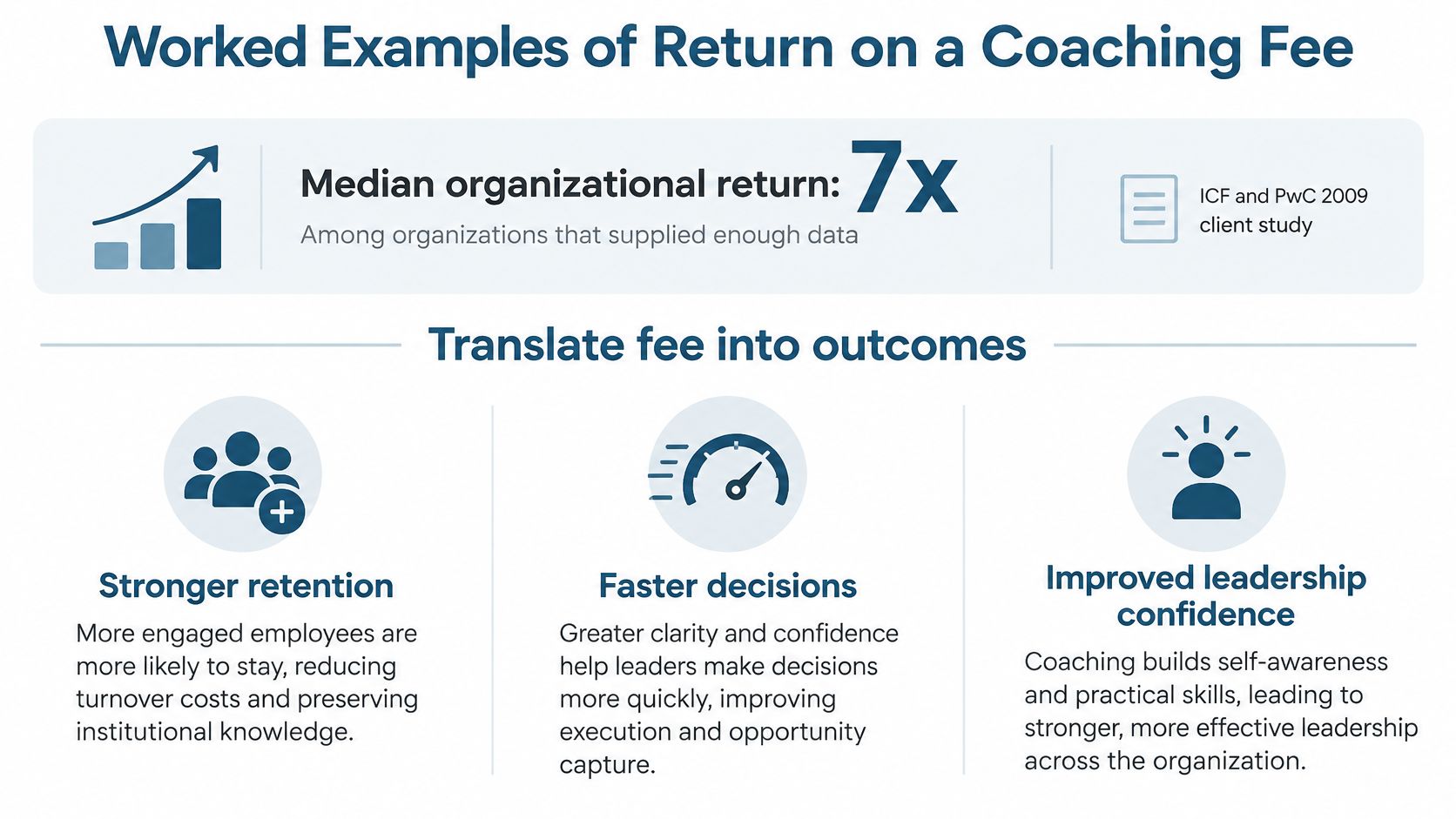
The global coaching study conducted by the International Coaching Federation with PricewaterhouseCoopers in 2009 surveyed 2,165 coaching clients across 64 countries. Among organizations that supplied sufficient information to calculate financial return, the reported median organizational return was 7 times the coaching investment, while the median individual return was 3.4 times the investment. The same study reported that 86% of companies that tracked return recovered at least the amount they had spent. Only 189 respondents, about 9% of the total sample, provided the underlying gain-and-spend figures needed to calculate ROI, so treat those medians as a reference rather than a universal rule.
An older benchmark points in a similar direction with a smaller base. The Manchester Inc. study from 2001 covered 100 executives and reported an average return of 5.7 times the amount invested in coaching, based on participants' self-reported business and behavioral outcomes, with 77% of participants experiencing improved working relationships. A 5.7-to-1 return is roughly 470% net gain after subtracting the initial cost, but those results came from reported outcomes rather than a randomized controlled trial.
A third figure uses a different formula, so keep its label intact. A Metrix Global analysis summarized by Stratos Coaching reported 788% ROI when productivity and employee-retention effects were included. That's an ROI percentage built from specific effects, not a guaranteed multiple you can apply to any fee.
Benchmark | Reported result | Implied on $6,000 | Main limit |
|---|---|---|---|
ICF/PwC 2009 organizational median | 7 times investment | About $42,000 modeled benefit | Only 189 of 2,165 gave gain-and-spend data |
ICF/PwC 2009 individual median | 3.4 times investment | About $20,400 modeled benefit | Same limited ROI subsample |
Firms that tracked return | 86% at least broke even | Fee recovered, not a profit promise | Applies to companies that measured |
Manchester Inc. 2001 | 5.7 times investment | About $34,200 modeled benefit | 100 executives, self-report, not a trial |
Metrix Global with retention | 788% ROI | Set by your baseline costs | Includes productivity and retention effects |
Where a Return Could Actually Appear
On that $6,000 fee, a 7x benchmark implies about $42,000 of modeled benefit, a 3.4x benchmark implies about $20,400, and a 5.7x benchmark implies about $34,200. The useful question is where money like that could plausibly show up for you. Candidates include avoiding one costly resignation on your team, recovering billable capacity you're currently losing to rework or overload, delegating cleanly enough to free senior hours, or landing a compensation outcome you couldn't frame before. If you want to test the capacity claim with real numbers, understanding the output per hour ratio gives you a simple way to value recovered hours.
Keep money outcomes separate from wellbeing outcomes in your own tracking. Record baselines before coaching starts for weekly hours, after-hours work, utilization or revenue contribution, retention risk, promotion readiness, and self-rated exhaustion. Recheck at 30, 60, and 90 days, and write three cases for each measure. A conservative, expected, and upside case keeps you honest about attribution, since boundary improvements often show up first as fewer excessive hours and better recovery, with financial effects arriving later through focus, retention, and steadier performance.
When Workload Makes Coaching the Wrong First Buy
A better personal routine doesn't always justify the fee. If the conditions producing your overload stay fixed, coaching can end up training you to tolerate a workload that should change. That risk is not evenly shared.
Gallup's 2025 global findings reported that female manager wellbeing declined by seven percentage points, and that manager training combined with active encouragement increased manager thriving from 28% to 50%. Separate Gallup data report that 31% of women say they very often or always feel burned out, compared with 23% of men. Those figures don't make coaching useless. They tell you to check whether support around you has to move at the same time.
Two Piles of Problems
Some problems are coachable on your own:
Delegation choices: What you hand off, what you keep, and how clearly you set the handoff.
Promotion and pay preparation: How you describe your impact and ask for the outcome.
Evening protection: How you close the workday and respond when work pushes back in.
Recovery after deadlines: How you rebuild capacity instead of carrying depletion into the next cycle.
Other problems won't yield to a coaching invoice alone. A client book that requires constant availability, a billable target that consumes the whole week, or a manager who rewards after-hours responses, all sit partly outside your control. Paying for resilience inside those conditions is the hidden cost most price guides skip.
Use a short diagnostic before you commit. If you have no authority over the demand, pair any coaching with a direct manager conversation about expectations, or decline coaching for now. Practical ideas for that conversation sit in our guide to managing workload before it manages you. If you control your calendar, as many business owners do, coaching can still pay because your decisions and boundaries are the levers.
Then set review points at 30, 90, and 180 days. Track after-hours hours, what you've delegated, and whether performance held without the old overload. If those markers don't move, the fee is purchasing support rather than change. Support can be a conscious choice, but name it as one.
How to Judge Fit Before You Commit
Use six checks in order, and don't let an attractive hourly number jump the queue. Fit comes from matching a defined result to a defined scope. Price comes last.
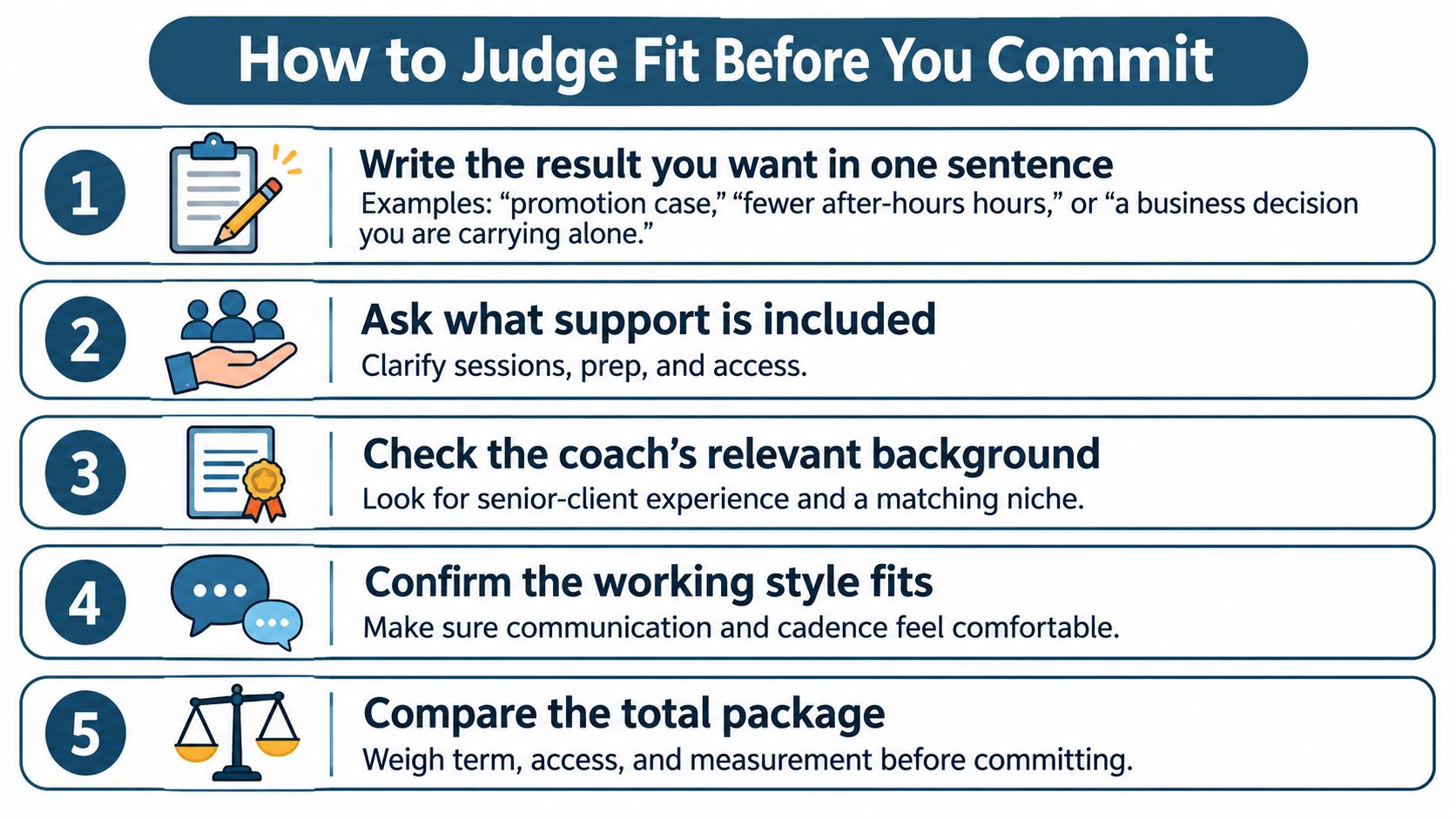
Write the result in one sentence. Say what you want, such as a promotion case you're ready to present, fewer after-hours hours, or a business decision you're carrying alone. If you can't write it, you can't judge whether coaching worked.
Sort what you control. List which problems you can change yourself and which need a manager or client to change expectations. A coach who won't discuss that split may sell you effort in the wrong place.
Score two proposals on scope. Compare term, cadence, between-session access, assessment, confidentiality, and cancellation side by side. Give each proposal a mark per field instead of reacting to the hourly figure.
Choose the payer deliberately. Self-pay keeps the agenda and the details between you and the coach. Sponsorship can fund a larger scope, but interviews or reporting may be required, which narrows what you'll say out loud.
Check the coach against your actual work. Relevant experience means deadline pressure, billable expectations, compensation conversations, and staying in the career rather than leaving it. When you're weighing providers, a structured way to assess executive coaching firms and independent coaches keeps that comparison grounded.
Book a conversation only after scope matches the result. Use the call to test candor, not to negotiate blind. If the coach can't connect their process to your sentence from step one, walk away.
Question | Self-pay | Employer-sponsored |
|---|---|---|
Who sets the agenda | You | You and the sponsor |
Typical budget | About $3,000 to $20,000 packages | About $10,000 to $50,000 per executive |
Privacy | Stays between you and the coach | Interviews or reporting may be required |
Best fit | Promotion plus burnout you don't want on file | Leadership goals the organization will fund |
Main risk | Paying without power to change workload | Less room for private recovery topics |
The payer decision matters for women whose agenda mixes advancement with exhaustion. Acheloa Wellness provides burnout coaching and executive coaching in one service, for accountants, attorneys, consultants and women in finance, including the Freedom 1:1 Coaching Program. Lauren Baptiste works with professional women and business owners who want more promotions, more money, more time off and more respect without quitting, downshifting or blowing up their career, which is why the privacy row in the table deserves a hard look before you accept sponsorship.
Reject rule: Decline a low rate that can't name an objective, and decline a high rate that can't say what happens between sessions.
Compare Scope Then Book a Free Consultation
Your next move is a comparison, not a commitment. Line up two or three proposals and drop any quote that won't state term, cadence, access, assessment, confidentiality, and cancellation terms. Add one measurable result you expect at 90 days so every coach is pricing the same target.
That discipline helps beyond coaching, too. If you're weighing adjacent support for a board or executive move, seeing how SeatSignal compared with CV writers lays out different services side by side is a good reminder to compare scope before you compare fees. Different services solve different problems, and the cheapest label rarely tells you which one you need.
If your remaining choice is self-funded and your goal is advancement without leaving the career you've built, a free consultation is the low-risk way to test manner and fit before any package fee. Prospective clients can book a free consultation with Lauren Baptiste, the coach behind Acheloa Wellness. Use that call to ask how your work hurdles would be identified, what support exists between sessions, and which observable result would show the engagement is working.
Leave with one of two things. Either you get a scoped proposal you can price against the 2026 bands with confidence, or you get a clear no and your money stays in your pocket. You aren't hunting for the cheapest hour. You're buying a defined scope matched to a result you can watch change.
If executive coaching cost only makes sense to you when burnout, boundaries, and advancement are handled together, Acheloa Wellness offers one-to-one coaching built for exactly that combination, with a free consultation to test fit before you commit to a package. Bring your one-sentence result and your scope questions, and leave with a proposal you can judge on outcomes rather than on an hourly number. Start at Acheloa Wellness and book the conversation that helps you decide clearly.

