

Executive Coaching Austin: How to Choose the Right Coach
The worldwide count of coach practitioners reached 109,200 in 2022, the first time the total passed 100,000 and a 54% increase over the 2019 estimate, while global coaching revenue reached $4.564 billion, up 60% across the same three years, according to the International Coaching Federation's 2023 Global Coaching Study. Leadership coaching, executive coaching, and business and organizational coaching were the leading specializations. Supply has never been thicker, and neither has the noise.
That's the actual problem with executive coaching in Austin. A search returns dozens of practitioners with near-identical websites, most of them plausible, and no shared standard for what an engagement should include, what it should cost, or how you'd know it worked. The field is unregulated. Anyone can print a site and call themselves an executive coach by Friday.
So this isn't a list of names. It's a buyer's guide: which format fits which problem, how to separate burnout coaching from advancement coaching, what to ask before you pay, and which numbers tell you the work is landing. Read it as a filter, not a directory.
Table of Contents
Executive Coaching Options in Austin at a Glance - Reading the table in the right order
Burnout Coaching or Executive Coaching - Two problems that get sold as one - Three people who land in different places
Protecting Advancement While Cutting Unsustainable Workload - Three moves that hold your position - A worked example
How to Vet an Austin Coach Before You Commit - The question that reveals the most
Executive Coaching Options in Austin at a Glance
Austin professionals end up choosing among five setups, and the setup matters more than the coach's logo. The same city search returns a career strategist, a burnout specialist, an owner's sounding board, a peer cohort, and an employer-funded program. Those five behave very differently once you're inside them.
Option | Best for | Typical structure | Format |
|---|---|---|---|
One-on-one executive coaching | Leaders preparing for promotion or a larger role | Private sessions focused on leadership goals | In person or video |
Burnout-focused one-on-one coaching | Professionals with constant deadlines and availability pressure | Sessions on boundaries, recovery and workload design | In person or video |
Business-owner advisory coaching | Owners without an internal board for decisions | Ongoing sounding-board sessions on leadership and business choices | Usually video |
Group or cohort coaching | Leaders who value peer learning and shared accountability | Scheduled sessions with a small group | In person or virtual |
Employees whose organization funds support | Structure set by the employer | In person or virtual, as the employer sets it |
Reading the table in the right order
Start with the Format column, not the price. Several of these run perfectly well by video, and plenty of strong coaches don't live in your metro at all. Acheloa Wellness, for one, serves clients internationally. A local-only search removes good options, and "I want someone I can meet for coffee" is a preference, not a requirement.
Then match the row to the cost you're paying. Career positioning points to the first row: you're preparing for a bigger role and need someone who'll read the politics and the expectations with you. Workload design points to the second: the job looks fine on paper and is unmanageable in practice, and the fix lives in response times, delegation and recovery rather than in a new title.
Decision isolation is the owner's problem, and it's structural more than emotional. In a 2025 survey of 1,424 women, 42% named unclear or shifting priorities as a major workplace challenge and 35% cited communication breakdowns, per the Conferences for Women report. An owner with no board to test decisions against burns real hours resolving ambiguity that a second perspective settles in ten minutes.
Match the cost, not the label. A leader who is exhausted and also up for promotion usually needs the workload work first. Advancement built on an unsustainable week doesn't hold.
The employer-sponsored row deserves its own caution. When someone else sets the structure, the goals drift toward whatever the organization wants measured rather than what you need changed. Ask who defines success and who sees the notes before you accept a slot.
Confirm current formats directly with each provider rather than trusting a directory listing. Then move to the harder split underneath the format question, which is whether the problem is burnout or advancement.
Burnout Coaching or Executive Coaching
Austin has the density to support both. Opportunity Austin's workforce statistics count 1,223,139 workers across all occupations in the metro, including 246,576 in management, business and financial occupations. The Federal Reserve Bank of Dallas, cited in the same dataset, reports professional, scientific and technical services employment up 35.5% from December 2019 through December 2024.
That concentration means hundreds of thousands of people carrying client responsibility, revenue targets and promotion decisions in the same week. It also means a coach can be useful in two completely different ways, and confusing them costs money and months.
Two problems that get sold as one
The World Health Organization's ICD-11 defines burnout as a syndrome resulting from chronic workplace stress that has not been successfully managed, expressed through three dimensions: energy depletion or exhaustion, increased mental distance or cynicism toward the job, and reduced professional efficacy. The WHO classifies it as an occupational phenomenon rather than a medical condition, which is a useful boundary. It tells you the lever is your work system, not your character.
Burnout coaching therefore works on workload, availability expectations, role conflict, decision burden and recovery routines. Executive coaching works on advancement: scope, visibility, leadership presence, the next role and the results that justify it. Same profession, different target.
Three people who land in different places
The lawyer dreads Sunday evenings and can name why: her availability has no edges. Advice about executive presence misses her completely. She doesn't need to lead better on Monday. She needs Monday to stop arriving on Sunday afternoon.
The consultant two years from partner has the opposite problem. Her results are strong and her sponsorship is thin, so she needs a plan for the visibility that gets discussed when she isn't in the room. Sending her to a stress-management program would be an insult dressed as help.
The owner is the third case, and the hardest. Every decision routes back to her because no structure exists to route it anywhere else. Coaching here is part operating-system design, part confidential sounding board, and almost none of it is motivation.
One rule separates coaching from clinical care. If what you're describing looks like depression, anxiety, disordered sleep, or something that doesn't lift after a genuine week off, a qualified healthcare professional should be involved. A responsible coach says that in the first conversation instead of signing you up for six months. For a closer look at how this work is structured, see our breakdown of what a burnout recovery coach actually does.
The test: is the problem in the work system, the career direction, or both? Coaching answers the first two. When the answer is clinical, coaching supports the treatment rather than replacing it.
Protecting Advancement While Cutting Unsustainable Workload
From 2022 through 2025, an average of 29% of women in leadership roles reported burnout, compared with 19% of men in leadership roles, according to Gallup. That ten-point gap explains why "just do less" is useless advice for most of the professional women I work with. They hear it as a request to lower their ambition and accept the consequences.

Reducing an unsustainable workload is a design problem, and design problems have specifications. Here are the three moves that protect the case for promotion while you cut the hours that aren't buying you anything.
Three moves that hold your position
Define service levels out loud. Clients, partners and direct reports all operate on whatever responsiveness you've implied. Write the standard down: which requests get same-day turnaround, which get 24 hours, which get a scheduled slot. Predictability reads as competence. Silence reads as chaos.
Separate visibility from accessibility. They are not the same currency, and conflating them is what keeps capable women answering email at 10 p.m. Choose the three rooms, deliverables or updates where being seen moves your case, and protect those fiercely. Everything else can be handled less immediately.
Document impact in numbers before the conversation. Walk into a promotion or comp discussion with a one-page record of what you delivered, not a narrative about how hard you worked. The people deciding are comparing evidence, and evidence you supply beats evidence they have to recall.
A worked example
Say a senior accountant moves client replies from same-day to a 24-hour standard. She tells her two largest clients the change in advance, gives them a phone number for genuine emergencies, and keeps the standard for a full quarter. Then she writes a one-page impact note: engagement outcomes, turnaround on filed work, the two issues caught because she wasn't answering in a hurry. That note is what she brings to the review conversation.
If the bottleneck is capacity rather than willingness, a remote executive assistant hiring guide for founders walks through how to scope the first delegated tasks and test them before committing to a hire.
Owners can run the same logic at a larger scale: delegate one recurring decision category each month, with written escalation criteria so the team knows exactly what comes back to you and what doesn't. The goal isn't to disappear from your business. It's to stop being the operating system.
What to say to a client: "Starting this month I'm holding a 24-hour response standard for anything that isn't urgent. If something truly can't wait, call me and I'll pick up. Everything else gets a considered answer the next business day."
This is the work I do with professional women and business owners who want more promotions, more money, more time off and more respect without quitting, downshifting or blowing up a career. A boundaries workbook we put together covers the first three steps in more detail. The signal that coaching worked isn't a calmer calendar. It's a stronger promotion case.
How to Vet an Austin Coach Before You Commit
No licensing body governs this profession, so the vetting is yours. Six checks, run before you pay for anything, will separate a practitioner from a salesperson.
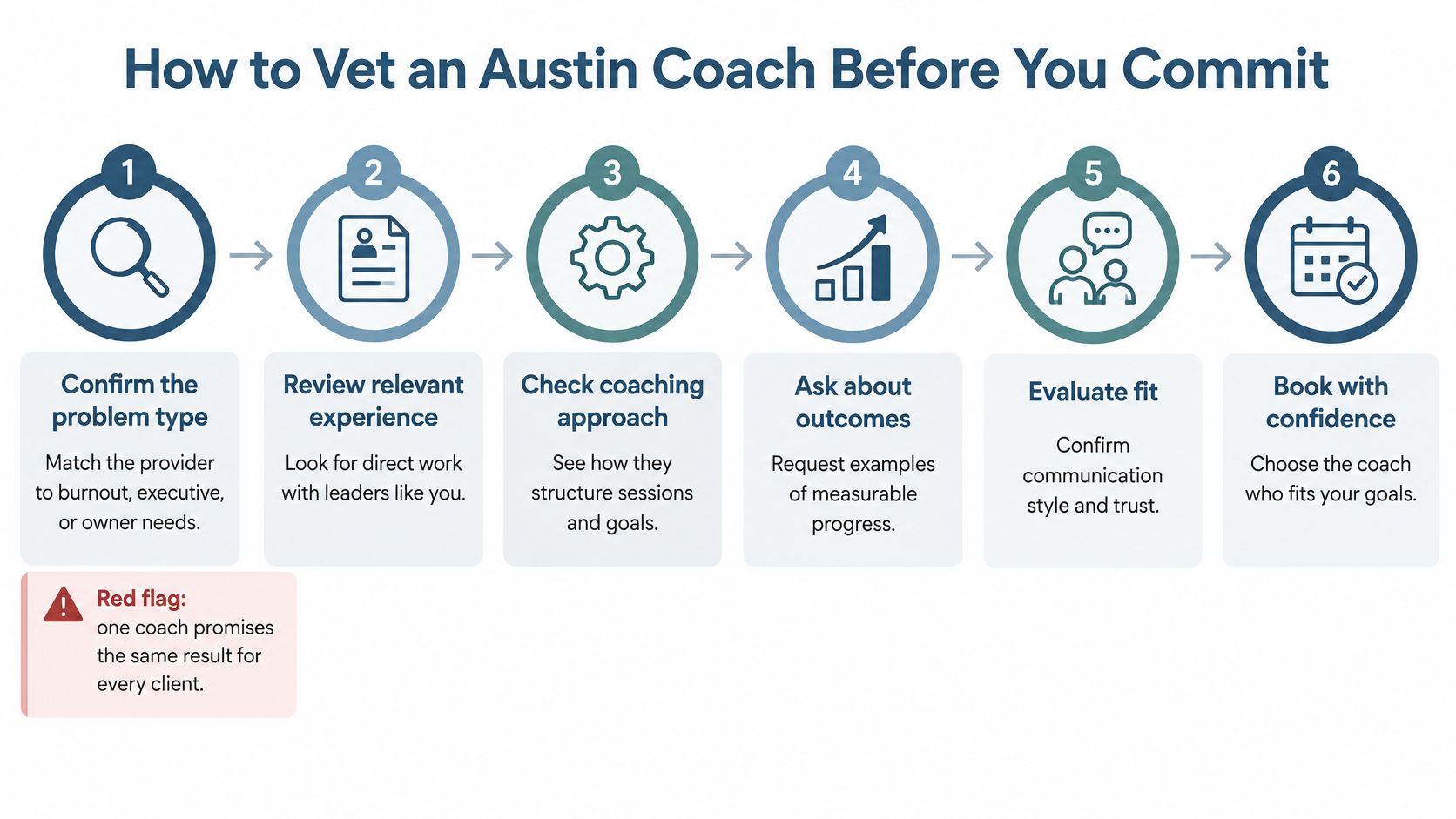
Name the problem before you shop. You should be able to say whether you need burnout work, advancement work, or owner advisory work. A coach who promises the same transformation for every client has told you they don't diagnose. That's the first red flag.
Check the background against your field. Billable-hour work has its own physics: utilization targets, client demands, the strange guilt of a non-billable hour. Ask directly whether the coach has worked inside legal, accounting, consulting or finance environments. Then ask which credentials they hold, such as an ICF accreditation, and whether those are current. No verifiable background is a pass.
Ask what happens between sessions. Access is the difference between coaching and a monthly meeting. How quickly are messages answered, is that included, and what counts as an emergency? Vague answers here usually become silence later. At Acheloa Wellness the coach is available between sessions, and that's the standard to hold everyone else to.
Get structure and price in writing. Confirm whether the work is one-on-one or group as advertised, what tools and assessments come with it, the full fee, the package terms, and the cancellation policy. Pressure to buy a package before any real conversation is the signal to walk. Our breakdown of what executive coaching costs and why explains which variables move the number.
Ask what the intake involves. Expect forms, surveys or assessments, and application responses, and expect to hear how that information is used and stored. Intake that reaches for health details beyond your work variables is overstepping. Coaching intake should collect workload, role, hours and boundaries, not a medical history.
Ask how the first month runs. Good coaching starts with the hurdles in front of you and the mindset that got you there, then builds small wins before bigger changes. We work exactly that way. What you're listening for is sequencing, not inspiration. A promise of promotion, or a blank look when you ask how progress gets measured, ends the conversation.
The question that reveals the most
Ask every provider to describe a client whose situation resembled yours and what changed, in behaviors, not feelings. A practiced coach answers with specifics: fewer evening interruptions, a delegated decision category, a compensation conversation that finally happened. A vague coach answers with adjectives.
Measuring Whether Your Coaching Is Working
Boundary work isn't a wellness preference. It's a leadership-system variable that determines whether you can psychologically detach from work at all. Leadership research summarized by IMD found that respect for employee boundaries was the most important of three examined forms of leadership support for enabling evening detachment and improving well-being before the next workday.
That gives coaching a causal chain you can observe. Clearer boundary signals reduce ambiguity about your availability, which makes detachment possible. Detachment creates recovery. Recovery supports sustained attention and professional efficacy. Each link is measurable, which is why progress shouldn't rest on how you feel in week six.
Metric | How to measure it | Review frequency | Sign of progress |
|---|---|---|---|
After-hours work messages | Count messages sent or received after your set end time | Weekly | Downward trend across the first month |
Evenings without work contact | Percentage of evenings with no work messages or calls | Weekly | Rising share of protected evenings |
Vacation interruptions | Number of times you were contacted or logged in during planned time off | Each break | Zero or fewer interruptions each break |
Recovery rating | Self-rated energy or sleep score from 1 to 5 | Weekly | Steady or improving scores |
Decisions delegated | Count of decisions successfully handed to others | Monthly | Rising count with no drop in quality |
Record the baseline before the first session. One week of real counts beats any recollection of how bad it usually is.
Two cautions. Read a single bad week as noise, not failure, because one crisis week tells you nothing about a trend across six. And keep watching the metrics your manager already tracks, revenue, delivery, client retention, because the point is to prove the change is sustainable rather than a quiet drop in performance.
Decide Your Format and Book a Consultation
The wrong sequence costs months. Pick a provider before you've settled format and problem focus and you end up comparing personalities instead of services. Work the order this article has built: format from the options table, focus from the burnout-versus-advancement split, provider through the six vetting questions.
Name the one problem costing you the most time and energy right now. Write it in a single sentence you'd say out loud to a stranger. "I'm drowning" fails the test; "I work every evening and still miss deadlines" passes.
Shortlist two or three providers whose format and focus fit that sentence. Include remote coaches, since a practice serving clients internationally can work with Austin professionals without an office visit. Run each name through the same six vetting questions, and use the free consultation most practices offer to test fit directly. If the sentence you wrote in step one says the role itself has to go, you're describing an exit problem, and structured job search coaching is the service built for that path; executive coaching is built for staying.
Ask three things on the first call. How sessions are structured, how progress is measured, and what access looks like between sessions. A coach who answers all three without hedging has run the engagement before; one who can't hasn't standardized it.
Expect the work to be incremental. A credible engagement starts with small wins and scales them, so the first month should feel manageable rather than heroic, and the results show up in behavior over weeks rather than in a single session. Anyone who promises a promotion on a fixed timeline is guessing. What coaching can deliver is a stronger position inside the career you already have, built on changed working patterns instead of a resignation letter.
If you're carrying a workload that has stopped being sustainable and a career you'd rather keep, Acheloa Wellness combines burnout coaching and executive coaching in one service for professional women, business owners, accountants, attorneys, consultants and women in finance. Lauren Baptiste works with clients on boundaries, workload, and promotion and compensation conversations without asking anyone to quit or downshift. Visit Acheloa Wellness to book a free consultation and start with the problem that costs you the most.

