

Executive Coaching for Women: Leadership, Pay and Burnout
Women held just 6% of CEO positions globally in Deloitte's 2024 boardroom research, as summarized by the World Economic Forum. That's not a gap women can close by working harder. Executive coaching for women earns its place when it helps you distinguish between a skill you can strengthen, a role you can renegotiate, and a workplace you should stop trying to repair alone.
Table of Contents
Why Advancement Stalls and How Coaching Responds - Define the problem before buying support
How Executive Coaching Works for Women Leaders - Make practice part of the working week
Building Visibility for Promotion Without Constant Availability - Make your contribution easy to advocate for
Preparing Evidence for Compensation Conversations - Build an ask that can be evaluated - When added responsibility hasn't changed your pay
Setting Boundaries That Protect Recovery and Standing - Agree the exception before protecting the evening
Telling Burnout Causes Apart Before You Choose a Fix - Test whether the role can become sustainable
Measuring Whether Coaching Is Working - Establish a baseline you can revisit
Deciding Whether Coaching Fits Your Next Move - Evaluate the working relationship - Commit to a decision, not a promise
Why Advancement Stalls and How Coaching Responds
Women represented 41.2% of the global workforce but held only 28.8% of top leadership positions, according to the World Economic Forum's 2025 Global Gender Gap analysis. Education and experience matter, but they don't automatically translate into executive authority.
The wrong response is to assume every stalled woman needs more confidence. A technically excellent accountant might need clearer promotion criteria. A lawyer might already demonstrate leadership but lack an advocate in partnership discussions. A business owner might need to stop personally approving decisions her team could make.
Leadership work happens through discussion, judgment, and shared responsibility, not individual output alone.

Define the problem before buying support
Executive coaching for women is focused, one-on-one work on a specific professional objective. Establish confidentiality terms at the outset, particularly when an employer pays. Coaching should create room to examine difficult decisions without confusing development support with performance reporting.
For lawyers, accountants, consultants, finance professionals, and business owners, coaching fits where greater effort no longer produces greater progress. It can help you explain your contribution, exercise judgment, and negotiate working conditions. It can't create an available promotion or force a manager to act fairly.
Start by identifying your main concern:
Visibility: Do decision-makers understand the business value you create?
Pay: Can you substantiate the scope and value of your role?
Boundaries: Have you agreed what you will deliver and when you're available?
Burnout: Would exhaustion persist even if you communicated perfectly?
Choose the concern that most constrains your next move. Don't turn every workplace frustration into a personal development assignment.
How Executive Coaching Works for Women Leaders
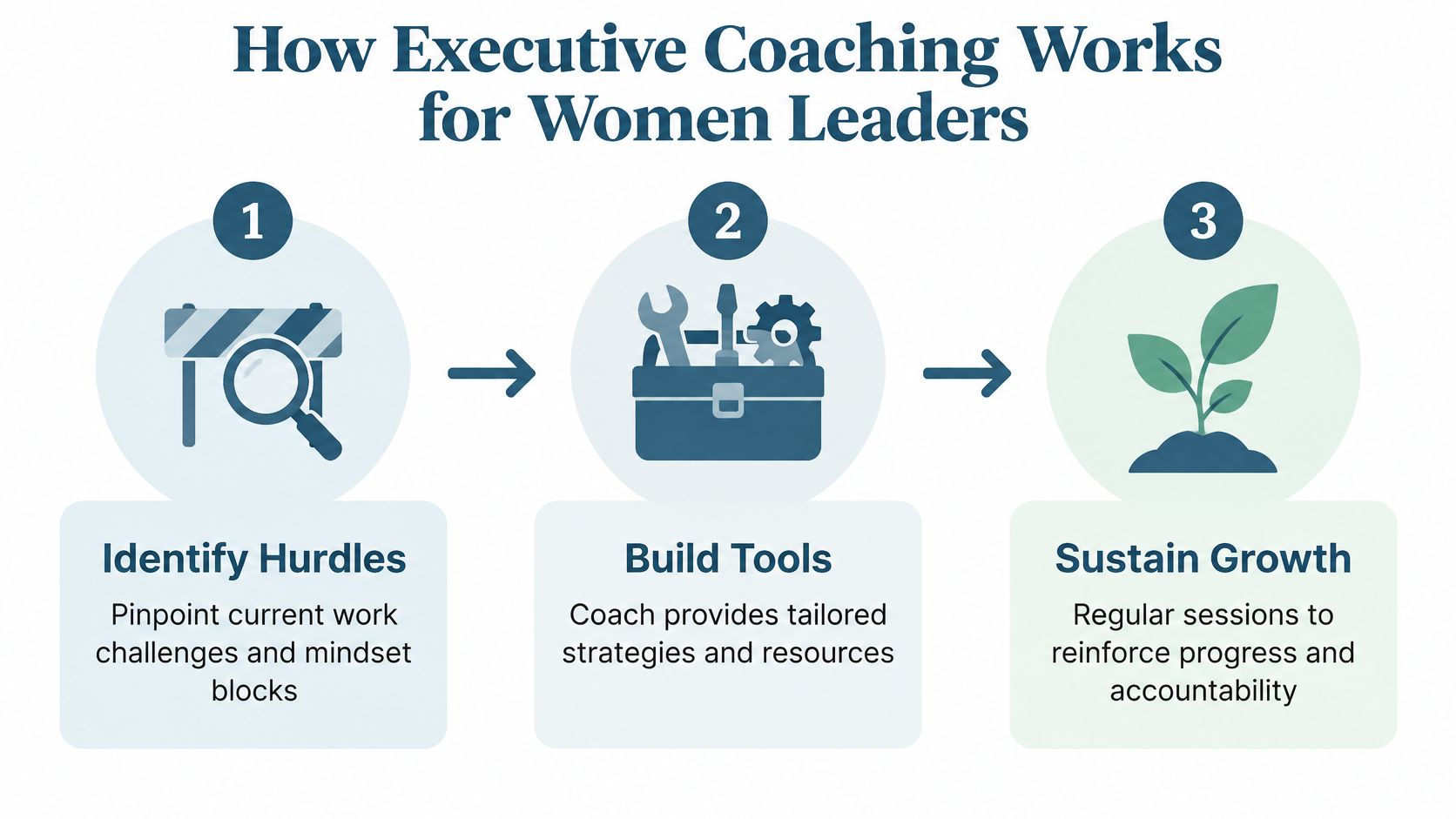
A productive engagement starts with the work already on your desk, not a generic picture of an ideal executive. Bring the difficult client email, the decision you have postponed, the meeting where you stayed silent. Those situations give a coach something concrete to examine.
At Acheloa Wellness, that examination begins with your work hurdles and the mindset that produced them. Coaching is one-on-one, with tools matched to where you are, and follows a five-pillar process aimed at your next role without sacrificing time with your spouse. Early sessions target small wins that scale, so the work builds momentum without demanding a complete professional reinvention.
Make practice part of the working week
Change happens between sessions, inside real conversations. Use this rhythm:
Name the stall precisely. Replace "overwhelmed" with the recurring situation and what it costs you.
Choose one behavioral target, such as assigning ownership instead of rescuing a project.
Test it at work in a real conversation or decision, not an imagined future opportunity.
Review what changed, including the other person's response, and adjust the next attempt.
The coach stays available between sessions, so a difficult Thursday does not have to wait for a scheduled call. Clarify how that contact works before you begin.
What Executive Coaching Targets for Women
Concern | What coaching works on | First practical step |
|---|---|---|
Leadership growth | Decision-making, delegation, executive presence and team leadership | List weekly decisions and mark those you could delegate |
Compensation conversations | Articulating impact and building a clear case for pay | Start a monthly outcome log with documented measures |
Boundaries | Renegotiating deadlines, availability norms and after-hours work | Write down communication windows you could defend for a month |
Burnout | Recovery planning, workload reduction and deciding what to change | Track hours and energy before making changes |
Coaching changes what you control: your behavior, your evidence, your agreements. It cannot add headcount to an understaffed team or close a caregiving gap at home. When the stall is structural, the work still pays off by making that distinction visible sooner, so you can decide whether to change your approach, renegotiate the role, or leave.
Life circumstances that affect what you can sustain belong in the planning conversation. For readers managing menopause alongside a demanding role, staying on track through menopause applies accountability principles to keeping new habits in place when energy is less predictable.
Before your first session, list your most draining recurring tasks, the decision you are avoiding, and the professional outcome you want. Bring evidence of your actual week, not your aspirations.
Building Visibility for Promotion Without Constant Availability
Only about one-third of mostly remote women had received a promotion in the prior two years or benefited from a sponsor, compared with more than half of mostly on-site women, according to McKinsey and LeanIn.org's 2025 Women in the Workplace study. That association doesn't establish that remote work caused the difference. It does justify asking how your organization recognizes contribution when leaders don't routinely see you.
The answer isn't permanent online availability. It's a deliberate system for making your impact legible to people who influence advancement.
Make your contribution easy to advocate for
Maintain a promotion evidence log. Record the problem, your decision, the outcome, and supporting documentation. Include work that improved others' performance, not only your own deliverables.
Build a sponsor map. Identify senior people with access to promotion discussions. Note who knows your work firsthand and who would need exposure before advocating for you.
Prepare for hybrid meetings. Circulate a concise recommendation beforehand, contribute when decisions are being shaped, and document ownership afterward.
Agree availability norms. Explain when colleagues can reach you and how urgent matters should be escalated.
A useful flexibility statement connects working arrangements to delivery: I can protect focused analysis time remotely and attend planning discussions on-site. Let's agree the outcomes and response expectations you'll use to assess performance.
Say a mostly remote senior accountant wants a manager role. She identifies potential sponsors, records how she resolved reporting problems, and prepares a written summary showing where she already coordinates colleagues. She asks her manager which remaining responsibilities would demonstrate readiness, rather than waiting for someone to notice her effort.
Practical rule: Make your judgment visible, not just your presence.
For consultants, a promotion preparation guide can help translate that approach into the expectations of a demanding firm. Match your evidence to the next role rather than producing a longer list of completed assignments.
Professional presentation is a supporting detail, not the strategy. If you're updating a leadership biography or speaker profile, AiHeadshots' executive headshot posing and lighting tips address that narrow task. A polished photograph can't replace a sponsor who understands your results.
The decisive question is whether someone can explain why you're ready when you aren't in the room.
Preparing Evidence for Compensation Conversations
A compensation discussion can stall because your employer won't pay fairly. It can also stall because you've described your workload without showing how your responsibility has changed. Prepare for both possibilities.
Your case should connect scope, contribution, and the adjustment you're requesting. Don't rely on being busy, loyal, or indispensable. Those descriptions leave the decision-maker too much room to interpret your value.
Build an ask that can be evaluated
Assemble your outcome record. Review completed work and attach documented measures where available: revenue influenced, hours recovered, cases closed, clients retained, or responsibilities absorbed. Distinguish your contribution from the team's overall result.
Gather relevant market information from salary surveys and recruiter conversations. Compare actual responsibilities, location, and organizational context, not titles alone. A broad salary range is a reference point, not proof that your employer owes a particular amount.
Write a concise ask. State the scope you now carry, the evidence supporting your contribution, and the compensation adjustment you want. Avoid diluting the request with apologies or an extended account of personal expenses.
Prepare responses to likely objections. For a budget objection, ask who can authorize an exception or when a decision can be made. For a readiness objection, request observable criteria rather than accepting an undefined demand for more experience.
Decide your acceptable alternatives. Consider a documented promotion review, development funding, or a change in responsibility. Know which alternatives have real value to you and which merely postpone the issue.
Coachful's pay raise discussion framework can help organize your preparation. Use a framework to sharpen your own argument, not to deliver a script that sounds detached from your work.
When added responsibility hasn't changed your pay
Consider a finance manager who takes responsibility for an additional team. Her strongest case isn't that she's exhausted. She documents the expanded reporting line, the decisions she now owns, and how her current responsibilities compare with the relevant role band.
If an immediate adjustment isn't approved, she asks for a review date, a named decision-maker, and written criteria. She also clarifies whether she'll continue carrying the expanded scope during the delay.
A delayed decision is only useful when someone owns it and the conditions are explicit.
Rehearse the ask aloud with a peer. Ask them to challenge the evidence and interrupt with an objection, so you can practice answering without abandoning your request.
Setting Boundaries That Protect Recovery and Standing
Qualitative research on leadership coaching for women points to gains in self-awareness, work-life-balance strategies, and leadership development. Boundaries are where those gains get tested. A boundary only holds if it works inside your actual responsibilities, including the people who rely on your judgment.

Agree the exception before protecting the evening
Consider a litigation associate who wants to stop monitoring routine messages throughout the evening. Before changing her behavior, she asks the supervising partner to separate genuine urgency from work that can wait until morning.
They agree that imminent filing problems require a call. Routine updates go into a morning summary. She confirms the arrangement in writing, including who covers matters when she's unavailable.
She has replaced an unspoken expectation with an operating agreement. The distinction matters: a private resolution is easy for others to ignore, while a documented agreement gives both sides terms to honor.
Apply the same discipline elsewhere:
Clarify ownership: Record what you're responsible for and what another person must approve.
Renegotiate capacity: When a deadline moves forward, identify what must move back or receive additional staffing.
Escalate constraints: Give the decision-maker a clear choice among scope, timing, and resources.
Protect recovery: Put nonworking periods in your calendar and agree coverage where necessary.
A boundaries workbook can help you turn a general intention into language you can use with colleagues.
The following video covers the same ground in another format.
Pair a leadership objective with a sustainability objective. For example, prepare to lead a client engagement while reducing routine evening work. Assess both, so stronger performance doesn't come at the cost of more unpaid availability.
Know what this work can and cannot fix. Coaching sharpens the language of the ask, the timing, and the evidence you bring. It cannot make colleagues honor an agreement they choose to ignore. If an agreed arrangement is repeatedly breached, ask the responsible leader to enforce it. Your communication may need refinement, but accountability for enforcement belongs to management.
Telling Burnout Causes Apart Before You Choose a Fix
In a 2026 survey of 212 women leaders in Milwaukee, caregiving demands were the leading workplace issue for 43%, followed by burnout at 39%, according to TEMPO's findings published by Urban Milwaukee. These are local survey findings, not a diagnosis of every woman's experience. They do underscore why time-management advice is an inadequate response to unsupported responsibilities.
Before choosing a fix, examine what happens when you make a reasonable request. The organization's response is evidence.
Boundary Problem or Structural Problem
Signal | Points to a boundary problem | Points to a structural problem |
|---|---|---|
Workload after priorities are clarified | Drops once you agree what matters most | Stays high even after priorities are agreed |
Response to delegation | Tasks move and the load eases | Tasks return because no one else has capacity |
Caregiving responsibilities | Flexible scheduling is available but unused | Flexibility is refused or punished when used |
Manager and sponsor support | Support exists and you haven't asked for it | Support is absent after clear requests |
Job security | Worry centers on perceived performance without corroborating evidence | Worry is grounded in restructuring, freezes, or unclear roles |
These are prompts for investigation, not definitive categories. Personal habits and structural problems can coexist, and anxiety about performance doesn't automatically mean your concern is unfounded.
Test whether the role can become sustainable
Select a targeted change. Remove an assignment, narrow decision authority, arrange coverage, or renegotiate a deadline. Avoid an experiment that only asks you to become more efficient.
Document the workload and risks before and after the change. Record postponed work as well as completed work.
Assess support through action. Did your manager reassign responsibility, provide resources, or defend the agreement?
Set a review date and keep the experiment bounded. Don't allow temporary relief to become another indefinite promise.
Define exit criteria beforehand. Examples include repeated refusal to staff essential work, retaliation for agreed flexibility, or continued deterioration in your ability to function.
You don't have to choose immediately between coping better and resigning. You do need a test that can produce a decision.
If symptoms extend beyond work or affect everyday functioning, seek a qualified healthcare professional. Our discussion of burnout versus depression can help you prepare questions, but it doesn't replace clinical assessment.
Coaching can support a role negotiation or an orderly departure. It cannot supply missing childcare, reverse restructuring, or make chronic understaffing sustainable.
Measuring Whether Coaching Is Working
A 2023 meta-analysis published in Academy of Management Learning & Education, covering 37 randomized controlled trials, 39 samples, and 2,528 participants, found statistically significant improvements in leadership and personal outcomes from workplace and executive coaching, with somewhat larger effects for female coachees and no strong dependence on engagement length. The authors also found larger effects for self-reported outcomes than observed outcomes.
The practical conclusion is straightforward: measure changed behavior, not just satisfaction with sessions. Feeling understood matters, but it isn't sufficient evidence that your working life has improved.
Establish a baseline you can revisit
Choose indicators that match the objective. Don't track everything just because it fits into a spreadsheet.
Indicators to Track Across a Coaching Engagement
Indicator | Baseline measure | Evidence source |
|---|---|---|
Decision turnaround time | Average days from request to decision | Calendar and project records |
Delegation frequency | Tasks handed to others each month | Task tracker and manager review |
Stakeholder-rated leadership behavior | Peer and manager rating on a fixed scale | Structured feedback from relevant colleagues |
After-hours work | Hours worked after your agreed stopping time | Time log or calendar data |
Self-reported recovery | Weekly energy rating using consistent anchors | Self-report, checked against after-hours data |
Record the starting position before introducing substantial changes. Use the same definitions when reassessing, and include an ordinary working period rather than comparing a quiet week with a deadline crisis.
Then build a review routine:
Reassess consistently: Review the same indicators at agreed intervals.
Add external evidence: Ask a manager, peer, or team member about the behavior you're changing.
Check contradictions: If energy ratings improve but evening work increases, investigate rather than declaring success.
Adjust the intervention: If the target behavior hasn't changed, examine whether the obstacle, practice, or support was misidentified.
For example, more delegated tasks don't necessarily mean better delegation. Confirm that colleagues received authority, understood the expected outcome, and weren't routinely overruled.
Don't dismiss subjective recovery because it can't be measured perfectly. Treat it as important information, then check whether your calendar and others' observations support the same conclusion. Continue coaching because it helps you make useful changes, not because a longer engagement sounds more substantial.
Deciding Whether Coaching Fits Your Next Move
Write a sentence naming your main stall: visibility, pay, boundaries, or burnout. Be specific enough that another person could recognize progress. Wanting to feel more confident is less actionable than wanting to present your promotion case without waiting for your manager to initiate it.
Choose coaching when you have a meaningful behavior or decision to work on. Choose role redesign when responsibility and resources don't match. Consider leaving when the organization repeatedly refuses reasonable changes and staying carries unacceptable costs.
These choices aren't judgments about your ambition. They're decisions about where your effort has a credible chance of producing the life and career you want.
Evaluate the working relationship
Acheloa Wellness is an option, not the only route. Our approach combines burnout and executive coaching for professional women, and follows a 5-pillar process after identifying current hurdles and mindset. The relevant question is whether that approach suits the problem you need to solve.
Ask any prospective coach:
How will you identify the underlying problem? Look for attention to your responsibilities, workplace conditions, and choices, not an automatic confidence diagnosis.
How will we judge progress? Expect an explanation of what you'll practice and what evidence you'll review.
What happens if the obstacle is structural? A credible coach should be willing to support a difficult organizational decision rather than continually assign you more self-improvement.
Clarify who pays, which sessions are included, how fees are structured, and what happens if you need to pause. If your employer funds the work, establish what information the sponsor receives and what remains confidential.
Commit to a decision, not a promise
A coach shouldn't guarantee a promotion, a pay increase, or an accommodating manager. Those outcomes involve other decision-makers. What you should expect is disciplined support for actions within your control and honest evaluation of the response.
Your next action is to write that sentence naming the stall and bring it to a first conversation. Include what you've already tried and what would need to change for the engagement to be worthwhile.
Acheloa Wellness offers one-on-one burnout and executive coaching for professional women who want to advance without allowing work to consume their personal lives. Visit Acheloa Wellness to book a free consultation, and bring your stall statement so we can discuss whether your next move calls for a new skill, a different role arrangement, or a broader career decision.

