

Boundaries Workbook: How to Plan Healthier Work Limits
It's late, and you're answering another client message before you close your laptop. Say you're a senior associate: your hours are recorded, tomorrow's deliverables are unfinished, and you still need to sort out something at home. You're responsive, but you never quite feel caught up.
A useful boundaries workbook doesn't start by telling you to be more assertive. It helps you separate habits you can change yourself from demands that require a manager's decision, a client agreement, or a different staffing plan.
Table of Contents
Map Your Boundary Problems in One Audit - Choose a reversible first change
How to Complete the Workbook in Four Passes - Move from evidence to a test - Define what finished means
Track Burnout Signals Against the Three Dimensions - Interpret changes without diagnosing yourself
Sort Personal Limits From Contractual Obligations - Match the first move to the authority
Protect Recovery Without Losing Visibility - Make contribution visible before reducing access - Negotiate the exposed parts
Scripts for Peers, Managers and Clients - Remove promises you can't maintain
Escalate Repeated Violations Without Escalating Conflict - Follow a factual escalation sequence - Know when another script won't help
Set Your First Boundary Change This Week - Put support around the change
Map Your Boundary Problems in One Audit
Start with the work you're doing, not the schedule you wish you had. Complete this audit in one sitting before drafting messages or changing your availability.
For each row, record the warning sign you've noticed this month, answer the question in writing, and mark how often it happens. Use your calendar, sent messages, and time entries to check your memory.
Boundary audit by problem area
Boundary Area | Warning Sign | Audit Question | First Change |
|---|---|---|---|
Workload | Taking work home most evenings | Which tasks could drop, move, or wait a week? | Remove one recurring task from the weekly list |
Availability | Replying to messages within minutes at any hour | Who actually expects a reply, and by when? | Set a response window for each channel |
After-hours work | Checking email before bed or on weekends | What breaks if I open it on Monday instead? | Turn off push notifications after a set evening time |
Delegation | Doing tasks below your level because they're faster | Who could own this after one training session? | Hand off one task this month |
Recovery | Vacations interrupted or cancelled | What do I need to return rested? | Block one protected day on the calendar |
Scope and decisions | Carrying team or client decisions alone | Which decisions belong to someone else? | Name one decision owner in writing |
Choose a reversible first change
Treat the final column as a candidate action, not permission to ignore an obligation. Removing a report that nobody uses is different from dropping a required client deliverable. Mark each action mine to change or agreement needed.
Start the smallest workable test within a week. You might stop preparing duplicate meeting notes, batch routine email replies, or reserve a day off with named coverage. Don't begin by withdrawing from every channel at once.
Practical rule: A useful first change removes a demand or changes how it gets handled. It doesn't merely push the same work into a later evening.
There's a cost to most fixes. Delegation requires instruction and review; a response window requires others to plan ahead; protected leave requires coverage. Write that cost beside the proposed change so you can discuss it openly.
As a workbook prompt, circle any area where you count warning signs at least three times during a week. Those rows deserve attention first, but they aren't a clinical score or proof that you've failed.
How to Complete the Workbook in Four Passes
Use the workbook as a working document, not a questionnaire you finish and file away. A spreadsheet works well because you can give each demand its own row and add columns for authority, risk, action, and outcome.
Allow roughly two weeks for an initial experiment, rather than treating that period as a deadline for solving your workload. Complete the inventory and decisions first, then let the selected changes run long enough to observe normal work.
Move from evidence to a test
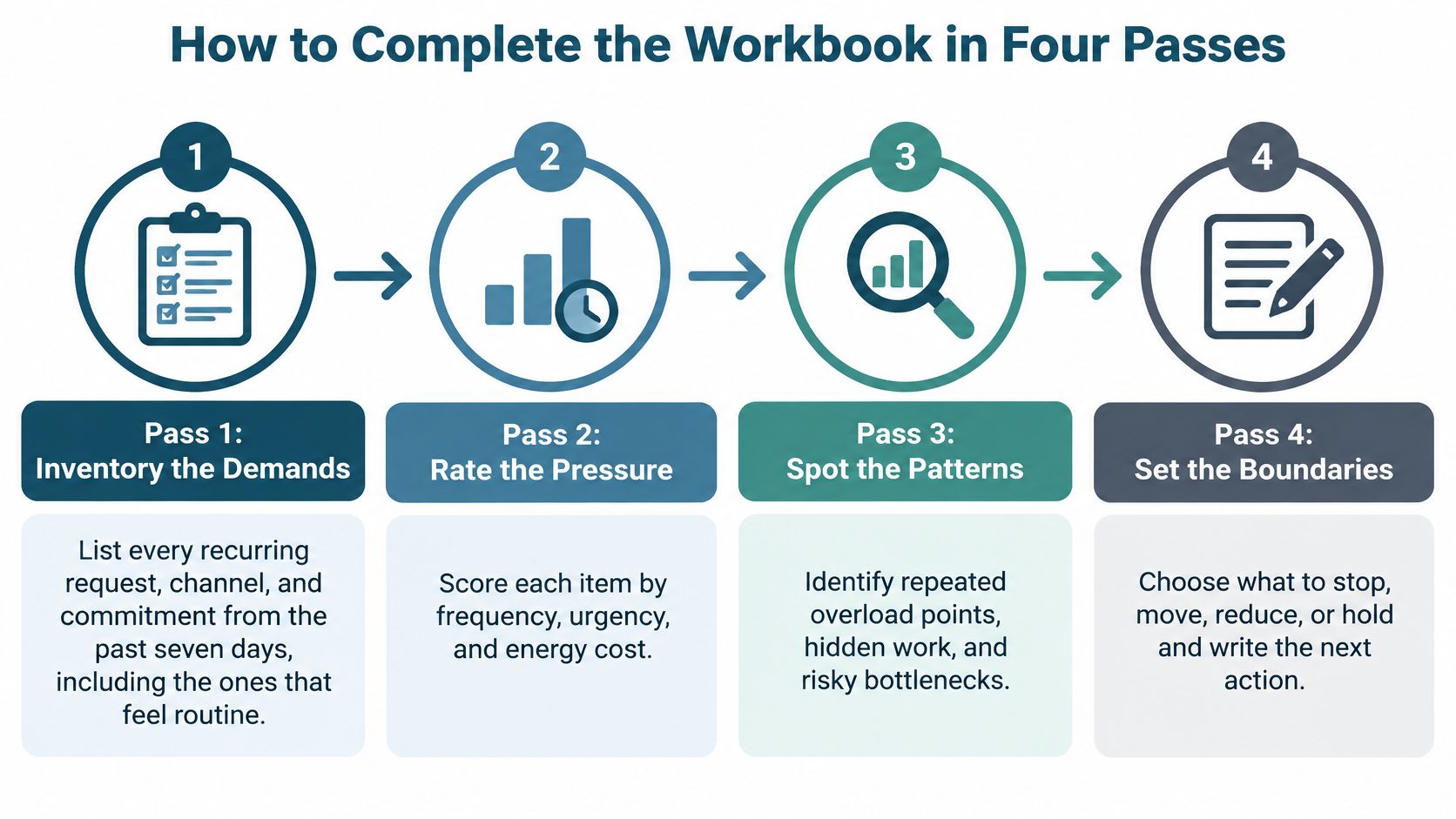
Inventory the demands. List recurring requests, communication channels, and commitments from the past seven days, including late messages and routine favors. Start here because familiar work is easy to overlook; the common mistake is jumping straight to a refusal script before you know what consumes your time.
Rate the pressure and risk. Note frequency, urgency, and energy cost, then assess each proposed limit against career impact, power differential, client sensitivity, and reversibility. Mark uncertain items and read the risk-audit table under Protect Recovery Without Losing Visibility before deciding; don't confuse an irritating request with a safe one to decline.
Find the patterns and decision owners. Sort each demand into personal preference or external obligation, using the contract, handbook, or manager's written expectations as evidence. Consult the who-can-change table under Sort Personal Limits From Contractual Obligations, then return to your worksheet; the common slip is treating an unwritten custom as either binding policy or something you can safely disregard.
Choose and test the boundaries. Identify a candidate change for each problem area, but activate only the changes you can track without confusing the results. Run a proposed two-week trial and record what happened, who objected, and whether work disappeared, moved to someone else, or accumulated.
The process graphic gives you a compact version to keep beside your worksheet.
Define what finished means
A completed boundaries workbook should leave you with a short list of active limits, named owners, and a review date. Keep proposed changes separate from agreed changes so you don't mistake an intention for an operating arrangement.
If your worksheet ends with better wording but the same volume of work, you haven't yet solved the capacity problem.
Record the trade-off explicitly. If a manager removes an internal assignment to protect client work, note what won't get delivered. If delegation initially takes longer, distinguish the training cost from the ongoing workload.
Track Burnout Signals Against the Three Dimensions
Track exhaustion, mental distance from work, and reduced professional efficacy, rather than relying only on whether you had a difficult day. The WHO's ICD-11 framework, effective January 1, 2022, classifies burnout as an occupational phenomenon linked to chronic workplace stress that hasn't been successfully managed, rather than a medical condition, as described in the APA's Work in America topline document.
Use the following measures as personal observation tools, not diagnostic cutoffs. Keep the scoring method consistent so your entries are comparable.
Burnout dimensions and the boundary to test
Dimension | Signal to Track | Weekly Measure | Boundary to Test |
|---|---|---|---|
Energy depletion | Waking tired after a full night's sleep | Mornings rated 1 to 5 for energy, averaged weekly | Protected evenings with no work checks |
Mental distance | Growing cynicism about clients or colleagues | Number of days you dread opening email | A fixed daily shutdown time |
Reduced professional efficacy | Work taking longer than it did last year | Hours needed to finish a standard deliverable | A calendar cap on deliverable hours |
Interpret changes without diagnosing yourself
For energy, note sleep disruption and unusual demands alongside the score. For mental distance, distinguish a difficult matter from persistent dread across assignments. For efficacy, compare similar deliverables and flag changes in complexity; an hours cap should trigger a scope or staffing discussion, not rushed work.
Say a manager's morning energy falls during a hypothetical three-week stretch of checking email at 9 pm. She tests a fixed shutdown time and records both morning energy and any missed operational needs. That comparison helps her decide what to adjust, but it doesn't establish a medical cause.
Our guide to signs of burnout at work can help you describe what you're noticing. For a complementary discussion of recovery, The Sleep Consultant offers burnout prevention for busy executives.
As a review rule, revisit your audit if a dimension worsens across three consecutive weekly entries. Seek clinical assessment when exhaustion persists, affects functioning, or extends across life outside work; this workbook can't determine the cause.
Sort Personal Limits From Contractual Obligations
Women performed 76.2% of global unpaid care hours in 2018, according to the International Labour Organization, a reminder that available time isn't merely a matter of personal scheduling.
For every proposed limit, ask who has authority to change this? Write the answer before deciding how firmly to communicate it. You can change a notification setting yourself, but you can't unilaterally rewrite a client engagement.
Who can change each type of limit
Limit Type | Who Can Change It | First Move | Escalate To |
|---|---|---|---|
Personal preference | You | Adjust your own calendar and notification settings | Nobody; document the change |
Client service terms | Client and engagement lead | Propose written response times at kickoff | Engagement partner |
Manager expectation | Your manager | Ask for priorities in writing before accepting new work | Manager's manager or HR if ignored |
Firm or company policy | Policy owner, often HR | Check the handbook and any availability guidelines | HR or the policy owner |
Legal or regulatory duty | Compliance or legal counsel | Confirm the requirement before negotiating | Compliance or legal counsel |
Match the first move to the authority
Personal preferences don't need a policy argument. If you prefer checking routine email between meetings, adjust your workflow, provided no established duty requires otherwise. If that change affects coverage, it has moved beyond a purely personal decision.
For client service terms, propose response windows at kickoff and include an emergency route. If an existing agreement promises faster service, bring the mismatch to the engagement partner before testing a slower response.
A manager expectation needs a priority decision. Ask which assignment should move when new work arrives, then confirm the answer in writing. Escalate if the manager repeatedly demands incompatible outcomes without making that choice.
For company policy, check the actual wording and ask the policy owner to resolve ambiguity. Don't assume that a colleague's practice establishes an entitlement or obligation.
Legal and regulatory duties require confirmation from the appropriate adviser. You may be able to negotiate staffing, sequencing, or coverage even when the underlying deadline can't move.
Don't negotiate a regulatory deadline as though it were a preference, or defend a preference as though it were company policy.
Record the source others need to follow: your communicated working arrangement, the engagement terms, the manager's decision, or the relevant policy. That record makes disagreement specific. Instead of debating whether you're committed enough, the parties can identify what was agreed and who can amend it.
Protect Recovery Without Losing Visibility
Switching off can feel straightforward until a promotion discussion approaches or a senior client praises someone else's instant replies. You need a plan that protects recovery without leaving important stakeholders unsure about your contribution.
That tension deserves more than notification advice. In its Q4 2025 survey, Gallup found that 31% of women, versus 23% of men, said they very often or always felt burned out.
The late-working professional below illustrates the situation you're trying to change, not a standard of commitment to preserve.

Make contribution visible before reducing access
Strategic visibility means documenting outcomes rather than relying on your online status to demonstrate value. Before leave, send a concise status note covering completed work, open decisions, owners, and the emergency route. For review conversations, maintain an impact log of decisions improved, client issues resolved, and responsibilities carried.
Delegate visibly by naming the new owner in the relevant thread. That gives the colleague authority and prevents stakeholders from continuing to route everything through you.
Risk audit for a proposed limit
Criterion | Question to Ask | Low Risk Looks Like | High Risk Looks Like |
|---|---|---|---|
Career impact | Could this limit affect a promotion or pay decision? | Visible only to peers | Visible to whoever decides your review |
Power differential | Who holds the authority to respond? | A peer or equal | A senior stakeholder or client executive |
Client sensitivity | Does the client depend on speed for a deal or deadline? | Internal deadline only | Live matter with a court, deal or filing date |
Reversibility | Can you undo this next month without cost? | Easy to adjust or roll back | Hard to undo once others have planned around it |
These are screening prompts, not guarantees. Peer-facing changes can still affect reputation, and an internal deadline can support an external commitment.
Negotiate the exposed parts
Say an accountant wants to stop Sunday replies during busy season. She rates client sensitivity high, but reversibility risk low because a short trial is easy to undo. Rather than disappearing, she agrees with the engagement manager on a Monday 8 am response window, named Sunday coverage, and exceptions for filing-critical requests.
The cost is coordination and possibly shared coverage. If nobody can cover an actual service requirement, the engagement lead must decide whether to change staffing or service terms.
Use this video as a discussion prompt while considering what sustainable availability would require in your role.
Choose recovery deliberately too. Our guide to the seven types of rest offers a way to consider what your protected time needs to contain.
High-risk limits need written agreement first and a trial second. A careful rollout doesn't guarantee a favorable response, but it makes the operational trade-off explicit.
Scripts for Peers, Managers and Clients
Use a short message that states the limit, explains the operational reason, and offers a workable alternative. The examples below are adaptable message text, not quotations from a source.
Peer: I'm offline after my agreed working hours so I can disconnect. Please put routine requests in the project channel; coverage-critical issues should go to the named on-call colleague.
Manager: I can deliver the client report or the audit by Friday, but the remaining work exceeds capacity. Which should move? Please confirm the priority in the assignment thread.
Client: Our agreed response window for standard requests is one business day so we can schedule the work reliably. For a filing or deal deadline, email the matter lead and copy me.
Direct report: You'll own this deliverable after Tuesday's review so decisions don't bottleneck with me. Bring it back if the proposal changes the budget or exceeds your authority.
Remove promises you can't maintain
Don't announce that you're offline and then promise an immediate personal response to every urgent message. Define who determines urgency and who provides coverage. Our guidance on managing client expectations can help you prepare that conversation.
For help expressing the personal limit itself, Be Your Best Self & Thrive Counseling, PLLC offers boundary-setting guidance for work-life balance.
Send proposed wording for a high-risk change to the person with authority before using it. You want an agreement, not a polished announcement of terms nobody approved.
Escalate Repeated Violations Without Escalating Conflict
An isolated slip usually calls for clarification. Repeated requests outside an agreed arrangement require a record and a decision, not progressively sharper messages.
For this workbook, use three breaches in a month as a documentation prompt, not a legal threshold. Don't wait for a count when the issue involves safety, harassment, retaliation, or compliance exposure.
Follow a factual escalation sequence
Log the request and consequence. Record the date, channel, requester, task, and agreement affected. Include whether you responded and what moved as a result, while keeping client-confidential material in approved systems.
Restate the arrangement directly. Write to the person involved, identify the agreed response window or workload plan, and clarify the correct route. Ask whether they're requesting an exception or a permanent change.
Bring options to your manager. If the pattern continues, present the log with workable choices, such as moving a deliverable or adding a second reviewer. Ask for an owner and a decision rather than asking the manager to make everyone respect your time.
Use the appropriate authority. If the manager doesn't act, approach HR or the policy owner with the agreement and record. Seek legal or compliance guidance for contractual or regulatory exposure rather than treating HR as the answer to every issue.
Know when another script won't help
A common mistake is escalating an ordinary misunderstanding before restating the limit. That can turn a solvable coordination problem into an argument about conduct. Direct clarification isn't required when doing so would be unsafe or inappropriate.
Decision point: If the role requires availability you can't sustain, the remaining negotiation is about role design, staffing, or whether the role still fits.
Be candid about what that may cost. Reducing coverage obligations might mean changing accounts, responsibilities, compensation arrangements, or roles. Don't promise yourself that sufficiently skillful wording will eliminate every conflict.
After an escalation, set a two-week check and ask: has the limit held? Record whether requests stopped, coverage improved, or the same demands arrived through another channel. An agreement that nobody implements still needs a decision.
Set Your First Boundary Change This Week
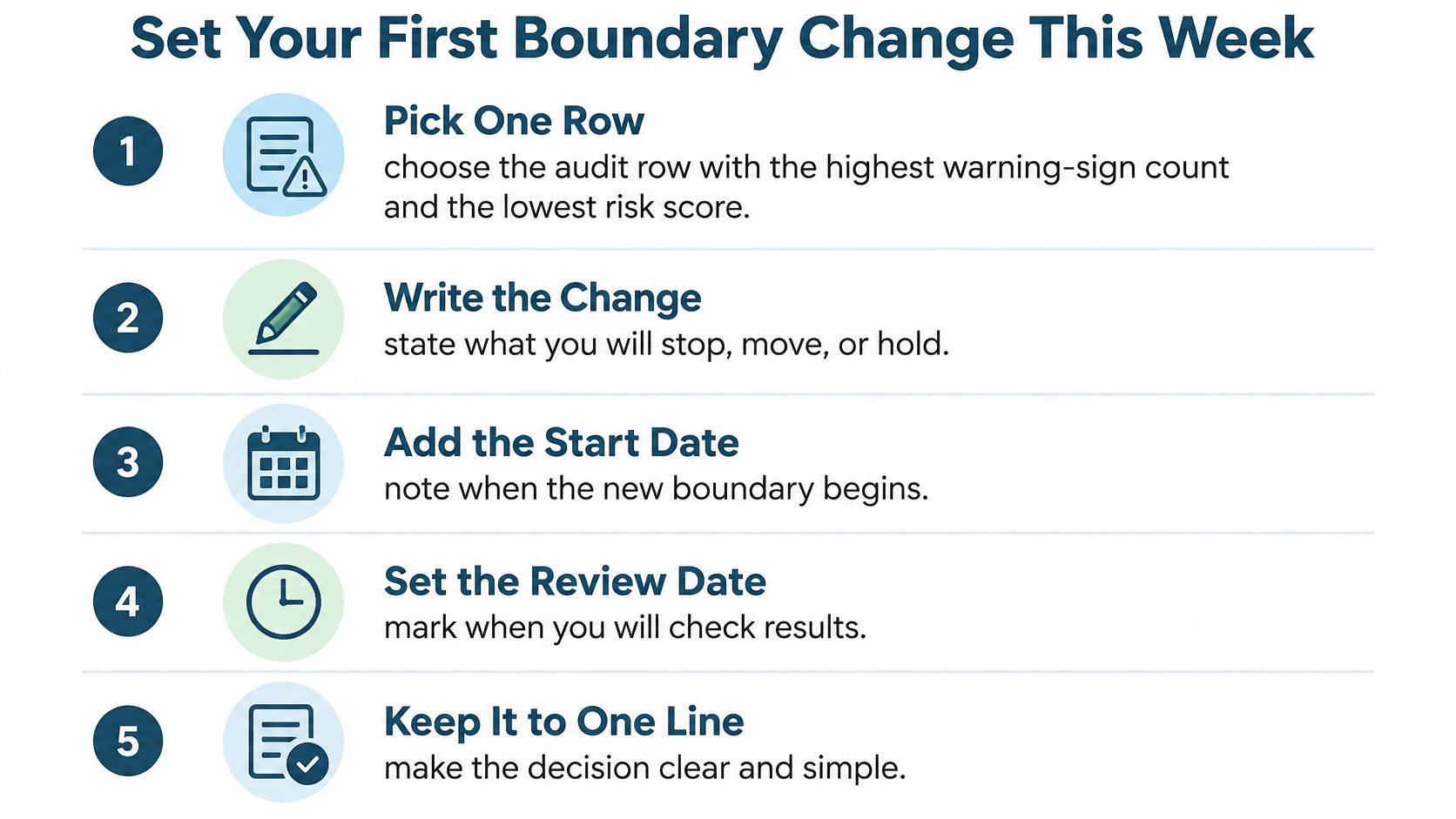
Pick the audit row with the highest warning-sign count among the changes you've rated low risk. Write one line stating what you'll stop, move, or hold, plus a start date and a review date two weeks later.
For example, a product manager whose late messages come only from internal peers might test no routine chat replies after 7 pm, beginning Monday. She tells the project lead beforehand and schedules the review before changing her notifications.
Use this checklist to turn the decision into an action.
Put support around the change
If domestic coordination consumes the time you're trying to protect, Approved Lux Personal Assistant's guidance on managing family logistics alongside your career offers another planning perspective.
For optional support, our free handout, The 3 Steps to Healthy Boundaries, provides a starting resource. Our coaching begins by identifying your work hurdles and the current mindset that got you here, then follows a 5-pillar process.
Keep the path simple: audit, complete the passes, identify authority, assess risk, and escalate when an agreed limit repeatedly breaks. At the review, decide whether to keep, adjust, or escalate the change. Put that appointment in your calendar before closing the workbook.
Acheloa Wellness offers burnout and executive coaching for professional women and business owners who want healthier work limits without abandoning career goals. Visit Acheloa Wellness to explore coaching or arrange a free consultation, and bring the workload or availability problem you want to address first.

