

Burnout Recovery Coach: What They Do and How to Choose
You close your laptop, then open it again because a client might need something. By morning, you're tired before the meetings begin, and the career you worked hard to build feels harder to sustain. You don't necessarily want to quit. You want to do good work without giving it every available hour.
Table of Contents
What a Burnout Recovery Coach Does - Work on the source of the strain
Coach, Therapist or Workplace Support Compared - Choose care before pushing through
Tracking Exhaustion, Detachment and Efficacy - Use a simple working log - Compare the result with the conditions
How a Coaching Engagement Unfolds - Intake and early relief - Skills and wider decisions
Workplace Changes Coaching Cannot Skip - Test what can actually change
Protecting Your Career When You Disclose Burnout - Decide what the request requires - Keep a factual record
What a Burnout Recovery Coach Does
A burnout recovery coach works one-to-one with you to understand how a demanding job drains you and which parts of that job can change. The work connects personal recovery with practical decisions about workload, availability, responsibilities, and career direction.
Say a corporate attorney checks email late into the night, sleeps poorly, and starts doubting her competence in meetings. A coach wouldn't recommend only a better morning routine. They'd examine who expects an immediate response, how matters are assigned, and why she feels responsible for preventing every possible problem.
That experience isn't unusual. In 2024, 52% of full-time U.S. employees at companies with at least 100 workers reported feeling burned out because of their job in the previous year, according to the National Alliance on Mental Illness and Ipsos.
Work on the source of the strain
Think of the coach as working more like a physiotherapist examining a repeated strain than someone offering symptom relief alone. It's an analogy, not a clinical credential: coaching targets working patterns and demands, and it doesn't provide medical treatment.
The World Health Organization describes burnout as an occupational phenomenon resulting from chronic workplace stress that hasn't been successfully managed, rather than a medical condition. That framing moves the conversation away from personal weakness or a supposedly defective calendar.
A useful session turns a broad complaint into something testable:
Identify the hurdle: Separate an actual client deadline from an assumed expectation of constant availability.
Examine the mindset: Notice whether over-responsibility makes delegation feel unsafe.
Choose a change: Agree on workload priorities, a response window, or protected recovery time.
Review what happened: Check whether the change reduced strain without creating an unresolved work problem.
Self-check: List the situations that shape your working week. Mark each as a demand placed on you, control you have over your work, or support you can access.
Coach, Therapist or Workplace Support Compared
These support routes address different needs, so compare their focus, format, and best use rather than looking for a single winner.
Support | Main Focus | Usual Format | Best When |
|---|---|---|---|
Burnout recovery coach | Workload, boundaries, career decisions, and performance | One-to-one sessions across an agreed engagement | Job demands and availability are the main drivers of strain |
Therapist or psychologist | Mental health symptoms and their treatment | Licensed clinical sessions | Anxiety, depression, sleep disruption, trauma symptoms, or safety concerns are present |
Physician | Medical assessment and treatment decisions | Medical appointment | Physical symptoms need diagnosis or a medication review |
Employer EAP | Short-term counselling and referral | Employer-funded sessions, with entitlement set by the plan | You need an initial contact or help finding appropriate care |
Manager or HR | Workload, schedule, and role changes | Internal conversation or formal request | Your duties, deadlines, or staffing must change |
Coaching fits practical questions such as how to renegotiate competing deadlines, stop accepting work automatically, or prepare for a career decision. You don't need to have your working life neatly organized before starting, but coaching should stay within an agreed, nonclinical scope.
Therapy and psychological care address mental health symptoms and treatment needs. The distinction isn't that therapists only discuss the past while coaches discuss the future. Both may examine current patterns; the important difference is clinical responsibility, training, and scope. Our explanation of life coaching versus therapy can help you prepare questions about that boundary.
Choose care before pushing through
A physician is the right contact when physical symptoms need assessment or medication needs review. Don't assume that exhaustion, headaches, or other changes must be burnout and therefore need no medical attention.
An employee assistance program, or EAP, can provide an accessible starting point for counselling and referrals. Read the plan's session entitlement, eligibility rules, and confidentiality terms rather than assuming every employer offers the same service. If there's immediate danger or a safety concern, seek urgent clinical or emergency help rather than waiting for a coaching appointment.
A manager or HR representative becomes necessary when the solution requires authority over assignments, schedules, or staffing. A coach can help you prepare that conversation, but can't approve a reduced caseload.
You can use more than one route. A therapist can treat symptoms while a coach helps you prepare workload changes, with coordination only through appropriate consent.
Decision rule: If the main driver is the job and there are no clinical red flags, coaching alongside a workplace conversation may be a useful start. If symptoms suggest a clinical need, start with a licensed clinician.
Tracking Exhaustion, Detachment and Efficacy
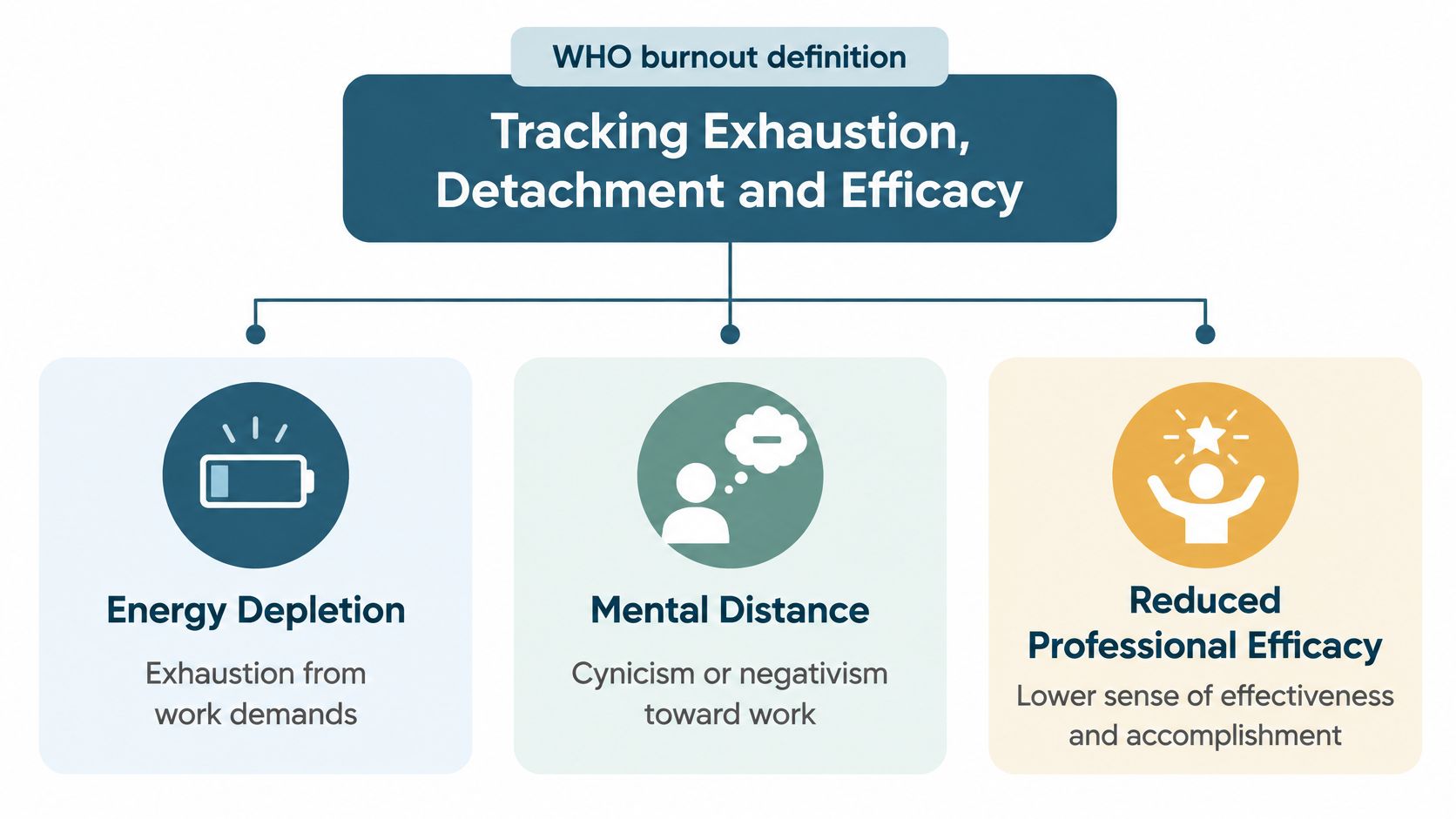
The WHO's burnout definition identifies energy depletion or exhaustion, increased mental distance from work, often expressed as cynicism or negativism, and reduced professional efficacy. Track these separately because they don't necessarily improve together.
You might feel calmer because you've stopped caring about the work. Alternatively, you might keep producing strong results while feeling increasingly depleted. A generic stress score can hide both patterns.
Use a simple working log
The following is a suggested reflection tool, not a diagnostic assessment. Use a low-to-high rating scale consistently, and add a note about deadlines, staffing, or availability expectations.
Dimension | Weekly Rating Question | Sign of Real Progress | Experiment |
|---|---|---|---|
Exhaustion | How drained do you feel by Friday, from low to high? | Energy holds in weeks with heavy deadlines | Limit after-hours availability |
Detachment | How cynical or negative do you feel about the work, from low to high? | Interest returns without workload dropping | Clarify workload priorities |
Efficacy | How effective do you feel in your role, from low to high? | Output and feedback improve, not just mood | Renegotiate role expectations |
Notice that a higher efficacy rating means improvement, while higher exhaustion and detachment ratings mean greater difficulty. Keep that distinction visible so you don't mistake movement in the wrong direction for progress.
For exhaustion, test a defined response window and an uninterrupted recovery period. Agree on how urgent requests will reach you, so the experiment doesn't rely on ignoring responsibilities.
For detachment, clarify which assignments deserve your best attention and which can wait. For efficacy, ask the person setting expectations to define what successful delivery looks like with the time and resources available.
Compare the result with the conditions
Give each experiment an agreed review date, then record the outcome before changing something else. Otherwise, you won't know whether the improvement came from your new approach or a quieter workload.
If exhaustion falls only when deadlines ease, you've learned something useful, but you haven't yet established that demanding weeks are sustainable. Look for signs you're recovering from burnout alongside evidence about how work has changed.
Draw a row for each dimension and complete the log every Friday across a short trial period. Bring the workload notes, not just the ratings, to your coaching conversation.
How a Coaching Engagement Unfolds
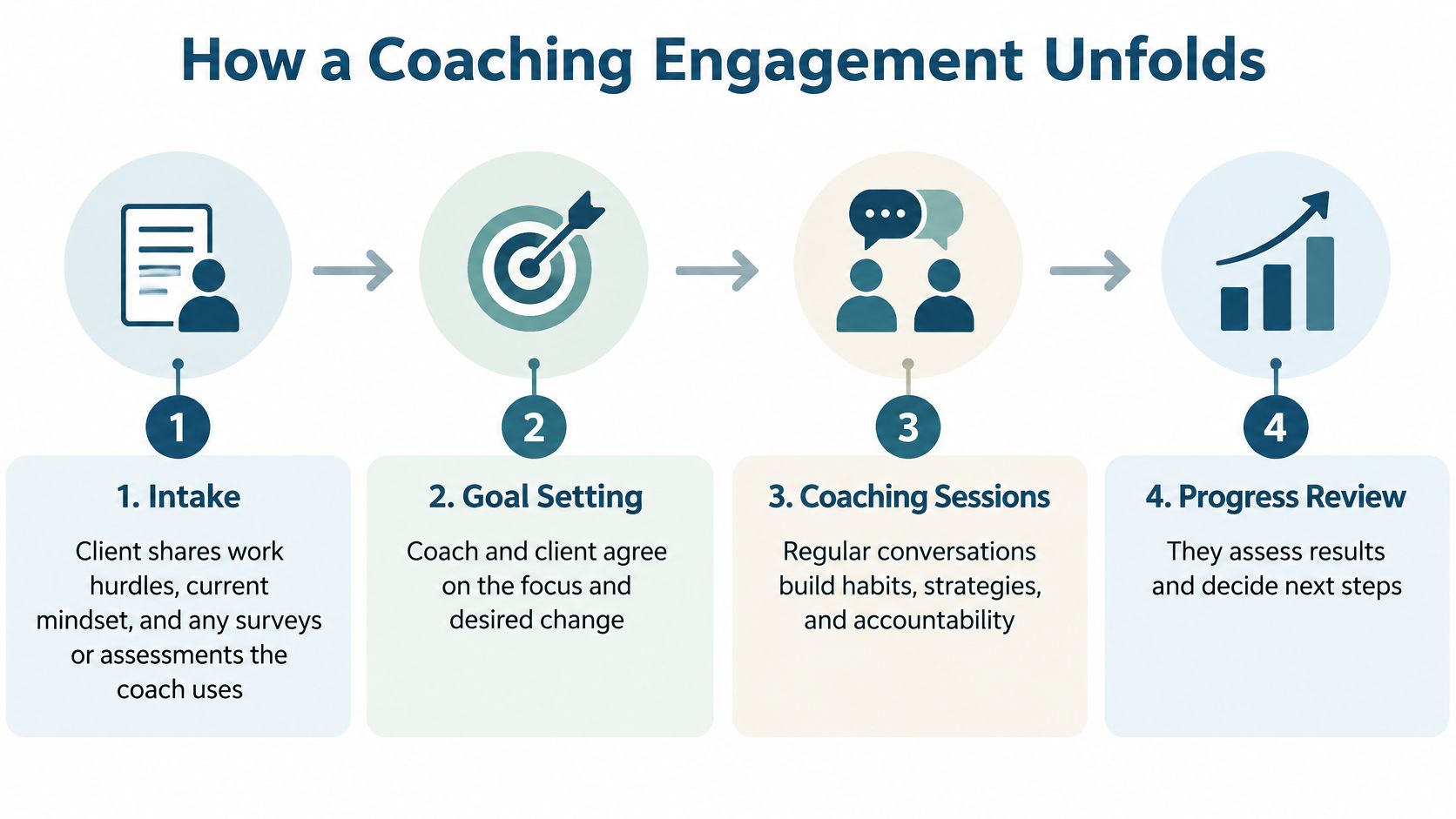
A useful coaching engagement has a direction, but it shouldn't become another demanding project. At Acheloa Wellness, we start with small wins and progressively scale up, rather than asking clients to rebuild their working lives immediately.
Intake and early relief
Intake establishes what's happening now. We begin by identifying your work hurdles and the current mindset behind them. Intake forms, surveys, or assessments may help organize the conversation, but the practical question is what you need to change first.
For an accountant facing overlapping deadlines, an initial goal might be to stop accepting new assignments without checking existing commitments. That's more actionable than a broad ambition to feel balanced.
Early changes should be modest and reversible. A fixed shutdown routine, a protected evening, or a written handoff can reveal where the main obstacles lie. If you can't finish on time because assignments exceed capacity, the answer isn't a stricter shutdown alarm.
Skills and wider decisions
Skill-building helps you respond differently under pressure. A coach might help you test the belief that delegating makes you unreliable, rehearse a workload conversation, or build a triage habit before you accept another commitment.
Useful practices include:
Cognitive reframing: Replace the assumption that everything is your responsibility with a clear account of who owns each decision.
Commitment triage: Identify the deadline, effort, and displaced priority before saying yes.
Recovery planning: Protect a realistic wind-down after demanding work instead of leaving recovery to whatever time remains.
These are coaching practices, not a substitute for clinical treatment when that's needed.
Scaling up means applying what you've learned to larger choices. That could involve decision-making authority, leadership responsibilities, promotion goals, or whether the current role can meet your needs.
Our coach is available between coaching sessions. Clarify how to use that access so a difficult client call or a failed boundary attempt can become useful material for the next conversation, rather than an isolated setback.
At a progress review, look for observable changes: fewer unnecessary after-hours messages, clearer priorities, and recovery routines you can maintain. There's no universal recovery deadline, and a credible coach won't promise that a preset number of sessions will resolve an unchanged job.
Workplace Changes Coaching Cannot Skip
In a 2025 workplace mental-health research brief, 80.7% of employees with burnout identified high workload and inadequate resources as contributors, compared with 60.3% of employees without burnout. The brief also discusses findings linking supervisor support, recognition, and procedural justice with protection against burnout.
Recovery runs on two tracks. The first is personal: rest, pacing, how you respond to demands. The second is structural: workload, staffing, who decides what. Coaching can move the first track. The second moves only when someone with authority over the work agrees to move it.
The practical question isn't only whether you can cope better. It's whether the people assigning work will change the conditions you're coping with.
A workday can look functional while requiring an unsustainable effort.

Test what can actually change
A coach cannot reassign your clients or hire the missing team member. What coaching can do is turn vague frustration into specific questions that someone with authority can answer:
Workload renegotiation: Which deliverable moves when another urgent assignment arrives?
Decision rights: What can you decide without seeking approval, and what isn't yours to carry?
Client capacity: Who can decline or defer work when the team is full?
Meeting and availability rules: Which meetings require you, and what qualifies as an after-hours emergency?
Staffing: Who will cover the work that exceeds current capacity?
Notice what these questions share: each one names a decision, not a feeling. "I'm overwhelmed" invites sympathy. "Which deliverable moves?" invites an answer. Acheloa Wellness's free handout, The 3 Steps to Healthy Boundaries, is a practical starting point for preparing that language.
Employers have their own stake in this conversation. SleepHabits' overview of building a healthier, more focused workforce covers the organizational side of wellness programs, useful context when you frame a request as a business issue rather than a personal complaint. Personal habits still need to sit alongside realistic job expectations.
Use the questions above when considering the workplace discussion in this video.
After leave, a staged return should specify an initial workload, a re-entry schedule agreed with the manager, and review points. Coordinate medical restrictions with the appropriate clinician and workplace process rather than asking a coach to set them. Coaching prepares you for the conversation; it cannot approve the accommodation.
Sustainability test: If energy returns but workload, staffing, and availability expectations remain unchanged, treat that improvement cautiously.
Watch for rising after-hours work, returning exhaustion, or withdrawal from team decisions. Those signals should trigger a review of the plan, not a demand to try harder. That is the bridge role in practice: coaching helps you read the signals and prepare the ask, while the workplace decides whether the conditions will change.
Protecting Your Career When You Disclose Burnout
Deloitte's 2025 survey of 7,500 women across 15 countries found that only 43% believed they received adequate employer mental-health support, while nearly 90% believed a manager might think negatively of them after disclosure. Those are respondents' perceptions, not a prediction of how your manager will react, but they're a reason to plan carefully.
Advice to be completely transparent overlooks employer power and the possible consequences for reputation, client assignments, or advancement. You can ask for a practical change without automatically sharing every detail of your health.
Decide what the request requires
Before disclosing, consider:
Policy: What do the employer's leave, adjustment, and reporting procedures specifically require?
Manager behaviour: How has this manager responded to previous workload or health-related requests?
Necessary information: Can you frame the immediate request around capacity, scheduling, or delivery without naming a diagnosis?
For a hypothetical client-load conversation, you might say:
I need to reduce my active client load through the end of this quarter to maintain quality. Can we agree which matters will transfer and when we'll review capacity?
This states a request, a business reason, and a review point. It doesn't guarantee approval, and it isn't a substitute for any documentation required by a formal process.
Keep a factual record
Document the dates of conversations, what you requested, the response, and any agreed changes. Follow up in writing when appropriate, using neutral language rather than interpreting motives.
Separate a boundary from a performance concern by stating what you can deliver and identifying the trade-off. If you're already missing deadlines or making errors, address those facts directly instead of presenting availability limits as the entire solution.
Ask who will receive information and why. Don't assume HR, an EAP, and a privately hired coach operate under identical confidentiality arrangements.
Check employer policies before sharing sensitive details. When compensation, partnership, job security, or formal leave is at stake, seek independent employment advice appropriate to your location.
Confirm These Points Before You Hire a Coach
Use a discovery call to evaluate how the coach thinks, not just whether you enjoy the conversation. Ask for concrete examples of their process and clear limits on what they offer.
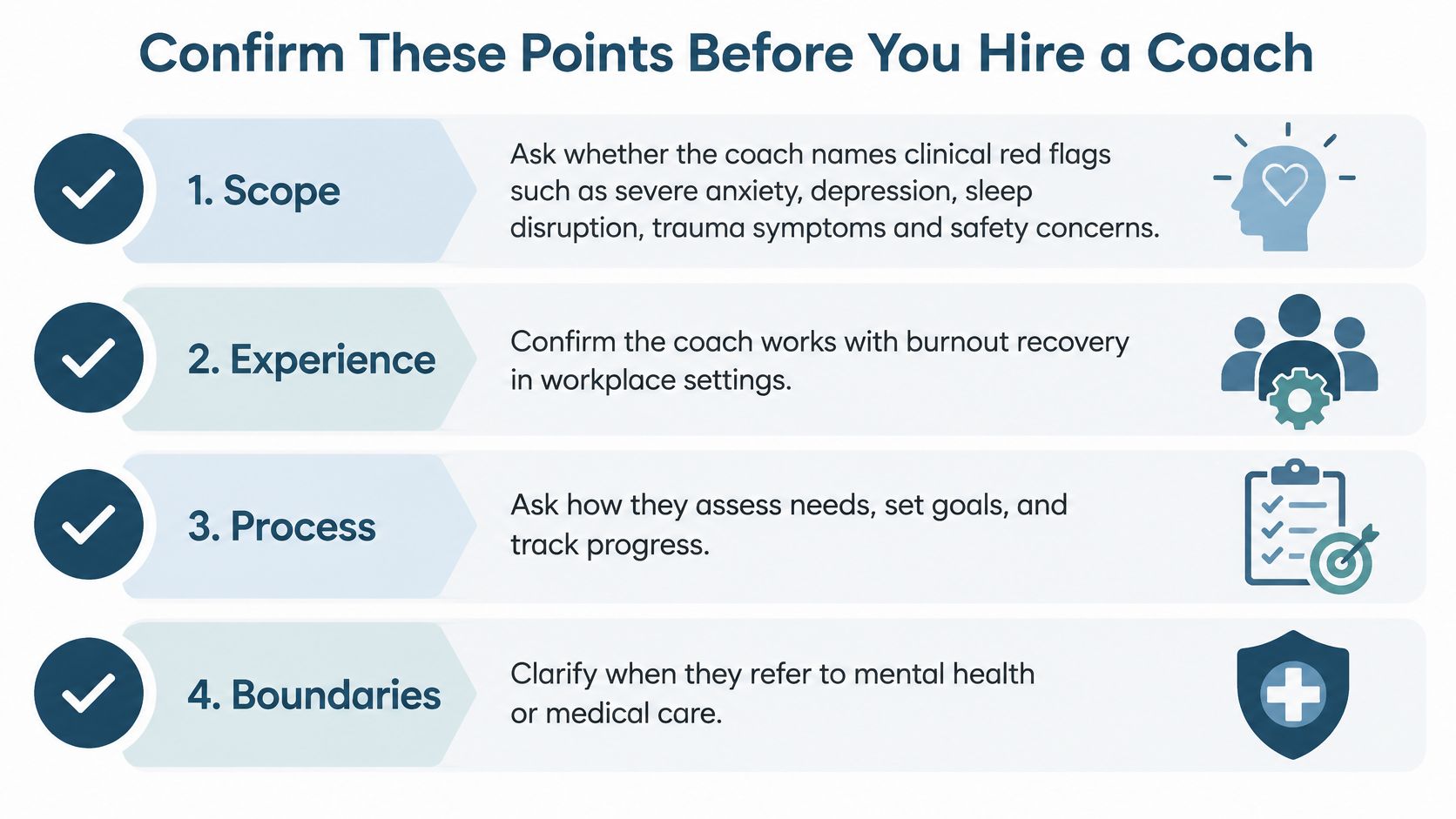
Scope. Ask what would prompt referral to clinical or medical care. Be cautious if the coach treats severe symptoms as something motivation alone can solve.
Measurement. Request an example of how they distinguish improving energy from increasing disengagement. A general question about feeling better isn't enough.
Workplace work. Ask how they prepare workload negotiations or support a return-to-work plan without claiming authority they don't have.
Confidentiality. Establish what they record, where it's kept, and what could be shared with an employer, especially if the employer pays.
Credentials. Don't infer clinical qualifications from the title burnout recovery coach. Ask about relevant training, supervision, and referral arrangements.
Career fit. Test their understanding of billable hours, client responsibility, leadership decisions, and compensation conversations. Our work with professional women and business owners includes pursuing advancement, more time off, and greater respect without making quitting or downshifting the default answer.
Cost and pace. Get the fee structure, session length, cancellation terms, and between-session access in writing before committing.
Bring your burnout-dimension tracker to the discovery call. Ask the coach to propose an initial experiment and a follow-up experiment, explain why they chose them, and name what would make them change course.
Acheloa Wellness offers individual burnout and executive coaching for professional women, including the Freedom 1:1 Coaching Program. Visit Acheloa Wellness to arrange a free consultation and discuss how coaching could connect your recovery needs with the demands of your career.

