

10 Time Management PDF Worksheets for Busy Professionals
The 4:40 pm feeling is specific. Three meetings ran long, the list you wrote at 9 am has two items crossed off and eleven added, and the only remaining slot for real work is the evening you'd already promised to someone else.
Digital work has made that structure tighter rather than looser. The Microsoft 2023 Work Trend Index, drawing on Microsoft 365 activity and a survey of 31,000 knowledge workers across 31 markets, found employees spend 57% of their working time in meetings, email, and chat, while 68% of respondents said they lacked enough uninterrupted focus time.
A free time management PDF won't fix that ratio. What it can do is force a pause long enough to see the week clearly: list the work, measure where the hours went, and decide what gets done, scheduled, delegated, or dropped. Twenty minutes of that is worth more than another app.
Below are ten worksheets, sorted by the job each does best. Most were written for students, so you'll be adapting as you go, and I'll say plainly when a PDF won't solve your problem, which sometimes means browsing open source project management software options instead.
Table of Contents
1. Choosing Therapy Task and Time Management Worksheet for Work
The burnout framing is what makes this one worth printing. Choosing Therapy publishes a free, work-focused worksheet that pairs task and schedule charts with prompts on breaks you should never skip, boundary maintenance, and working from home. It sits inside a broader work-burnout worksheet collection, so the questions assume depleted energy rather than an empty calendar.
That assumption matches what professional women report. Deloitte's 2025 survey of 7,500 women across 15 countries found 29% felt unable to switch off from work, 22% rated their mental load as too high, and 14% reported regularly working beyond contracted hours. A worksheet that asks about switching off is asking the right question.
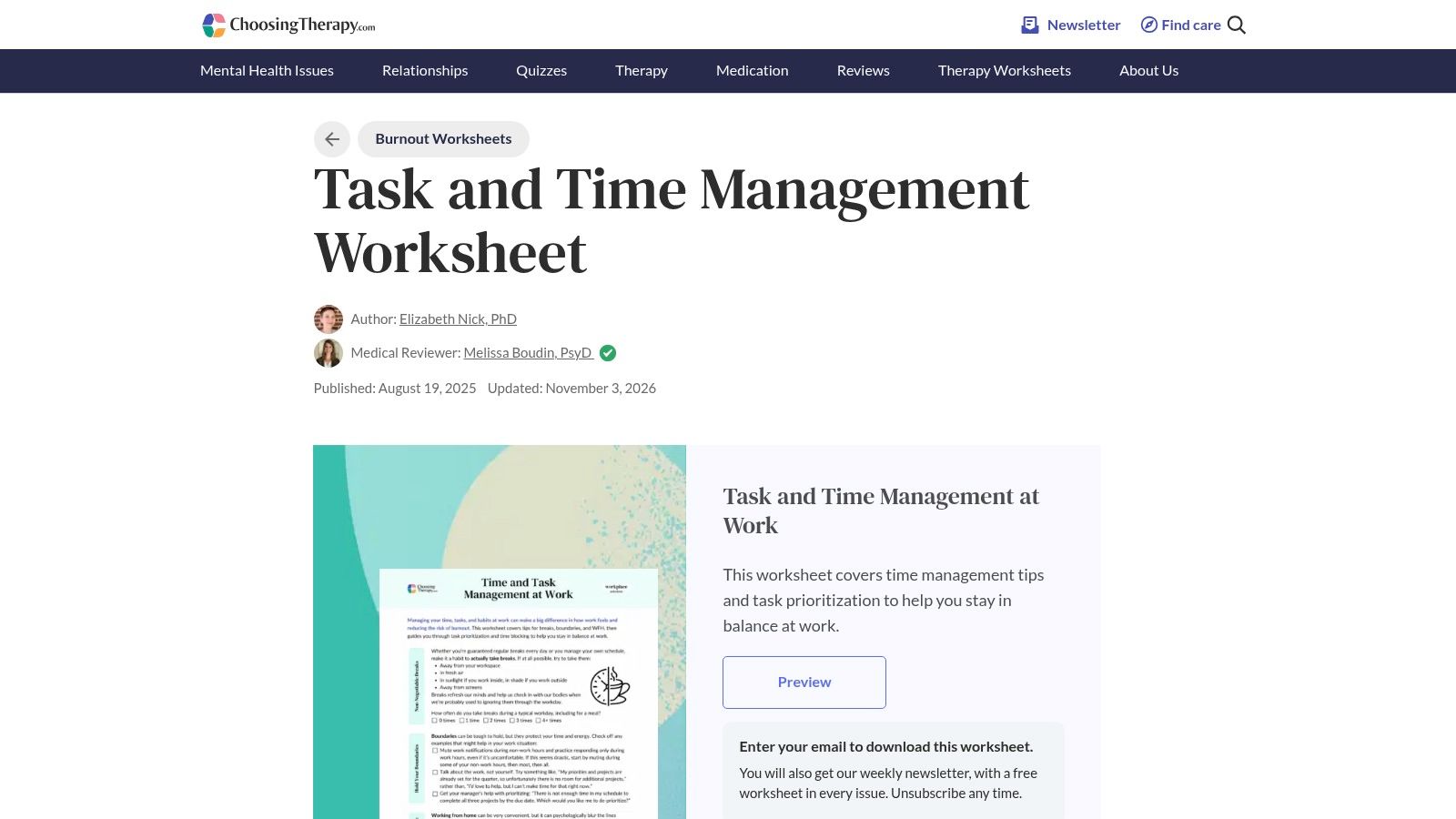
Credibility you can check: The worksheet is authored by Elizabeth Nick, PhD, and medically reviewed by Melissa Boudin, PsyD, which is unusual for a free download.
Where it falls short: It's a standalone exercise rather than coaching, and the guidance is general enough that a trial week or a month-end close will need adapting.
Practical rule: Treat the boundaries section as the main event, not the add-on. Spend ten minutes on the task chart, then fifteen on what your evenings are actually for.
If the printed page keeps falling out of your bag, pair it with one of the best apps for managing daily tasks so the evening review survives a chaotic week.
2. Georgia State University Managing Your Time Wisely
It's 5:50 pm and someone asks for one quick thing. Saying yes is the default, which is why the day never closes. Georgia State University's Office of Faculty Affairs publishes a one-page PDF built for that moment: plan and prioritize the start of the day, protect a block of focused work, decline additional responsibilities with prepared language, and leave room for personal goals.
The pressure behind those requests is widespread. In 2025, 62% of employees identified overwhelming workloads as a source of stress, according to HR.com's Future of Employee Well-being research. A one-page tips sheet won't shrink the workload. It can shorten the pause before you answer.
The useful part: It's written for faculty juggling teaching, research, and service, so the advice assumes competing obligations rather than study blocks.
The limit: It's a tips sheet, not a fillable planner, and faculty examples don't map cleanly onto client-service deadlines or the demands of running your own firm.
Print it and keep it beside the laptop for two weeks. The time management benefits that appear first when you protect a single focus block tend to be clarity, not volume.
3. Columbia Health 1440 Worksheet and Eisenhower Matrix
Two worksheets, one sequence: find out where the minutes went, then decide what deserves them. Columbia Health publishes a 1440-minute worksheet for reviewing how a day is currently spent, plus an Eisenhower matrix activity that sorts tasks by urgency and importance into do, schedule, delegate, or drop.
Fill the 1440 sheet on an ordinary Tuesday. A crisis day flatters you with drama and hides the pattern you're trying to see.
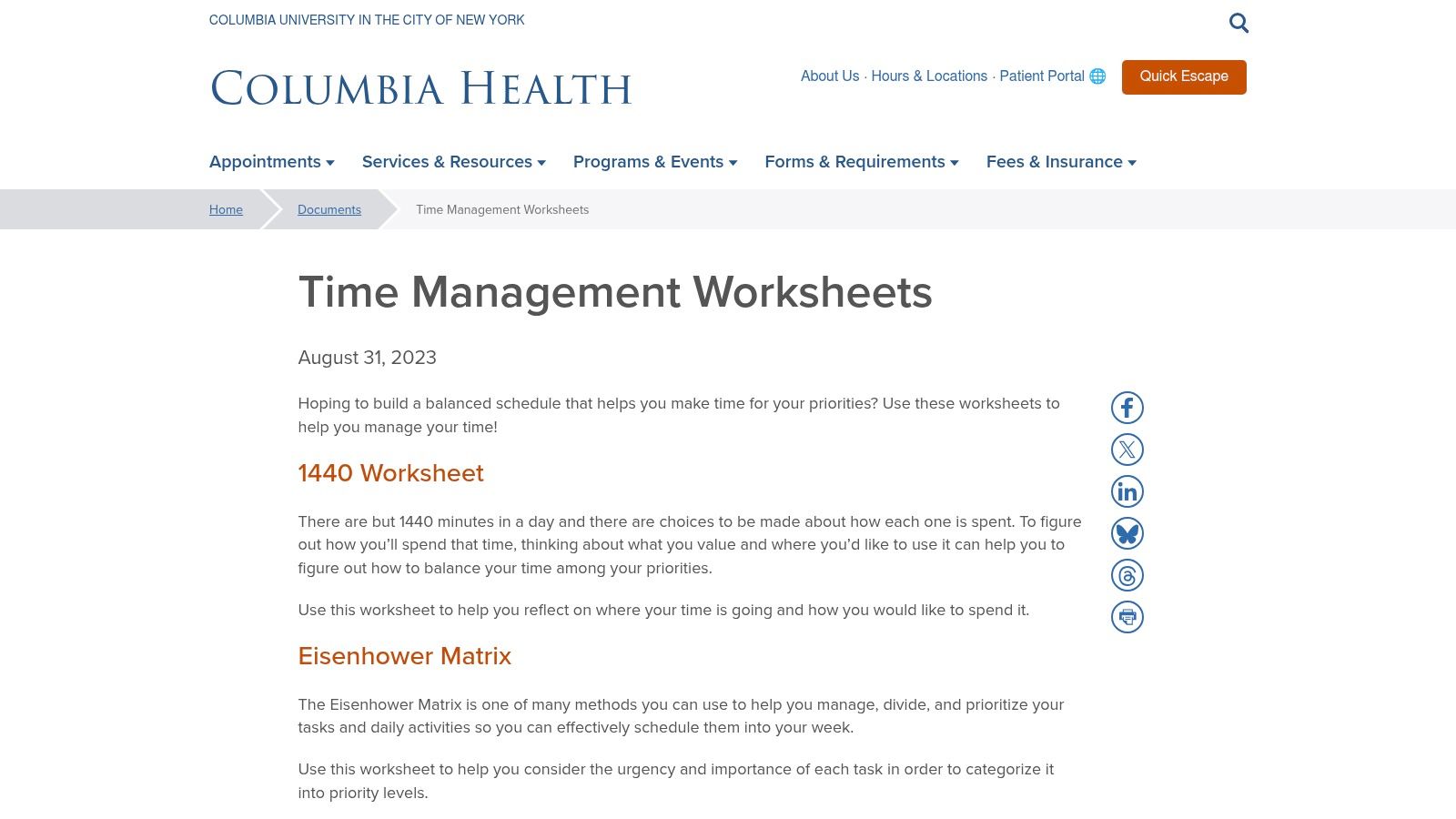
The pairing is the point. Most free PDFs hand you a matrix with nothing to feed it, or a time log with no next step. Here the audit produces the raw material and the quadrant makes the decision.
Adapt it freely: The matrix works for a household and a client portfolio at once. Run one quadrant for work and a second for everything else.
What's missing: There's no weekly schedule template and no follow-up review, so the insight can evaporate by Wednesday. The page is also written for students.
Sorting is not scheduling. A quadrant tells you what matters; only a calendar tells you when it happens.
If the quadrant is the part you keep returning to, this walkthrough of how to use a time management quadrant goes further into scheduling, delegating, and dropping the tasks you keep.
4. William & Mary Time Assessment and Time Management Strategies
Honest tracking is uncomfortable, which is why this resource starts there. William & Mary's student success office links a two-page time assessment that accounts for work, sleep, health, family, commuting, chores, and other commitments, then asks what you'd change. Alongside it sit a weekly schedule and to-do list, plus a nine-page strategies PDF on prioritization and planning.
The assessment earns its place by putting non-work commitments in the same column as billable work. That's rare, and it's where professional plans break: the hours assigned to family and recovery get treated as slack.
Strength: Several formats in one place, from a diagnostic assessment to a working schedule, all free to access.
Weakness: The examples are academic, and the assessment depends on honest recall. It won't identify the solution for you.
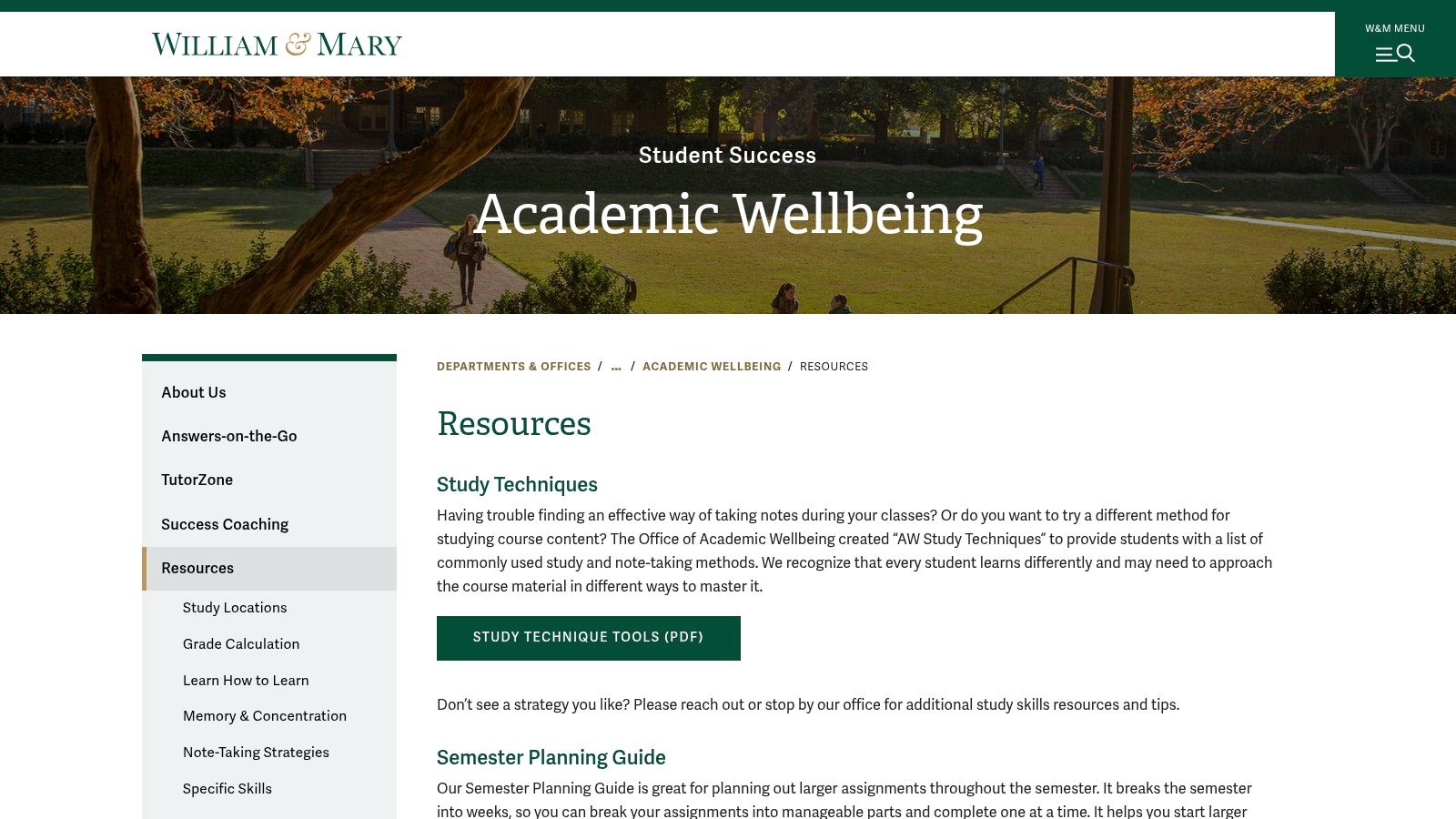
Do the assessment first and the strategies document second, or the advice lands as generic. If you want the underlying skills named plainly before you begin, this overview of time management skills with examples is a reasonable primer.
5. USC Kortschak Center Time Management Handouts
Not a single worksheet. A shelf. The Kortschak Center at USC hosts downloadable handouts covering a weekly schedule template, timeboxing, an action plan with a to-do list, time estimation, routine building, and task breakdown.
That breadth matters most for anyone whose plans collapse at the estimation stage. People rarely fail because they refuse to plan. They fail because they plan a Tuesday that assumes no interruptions.
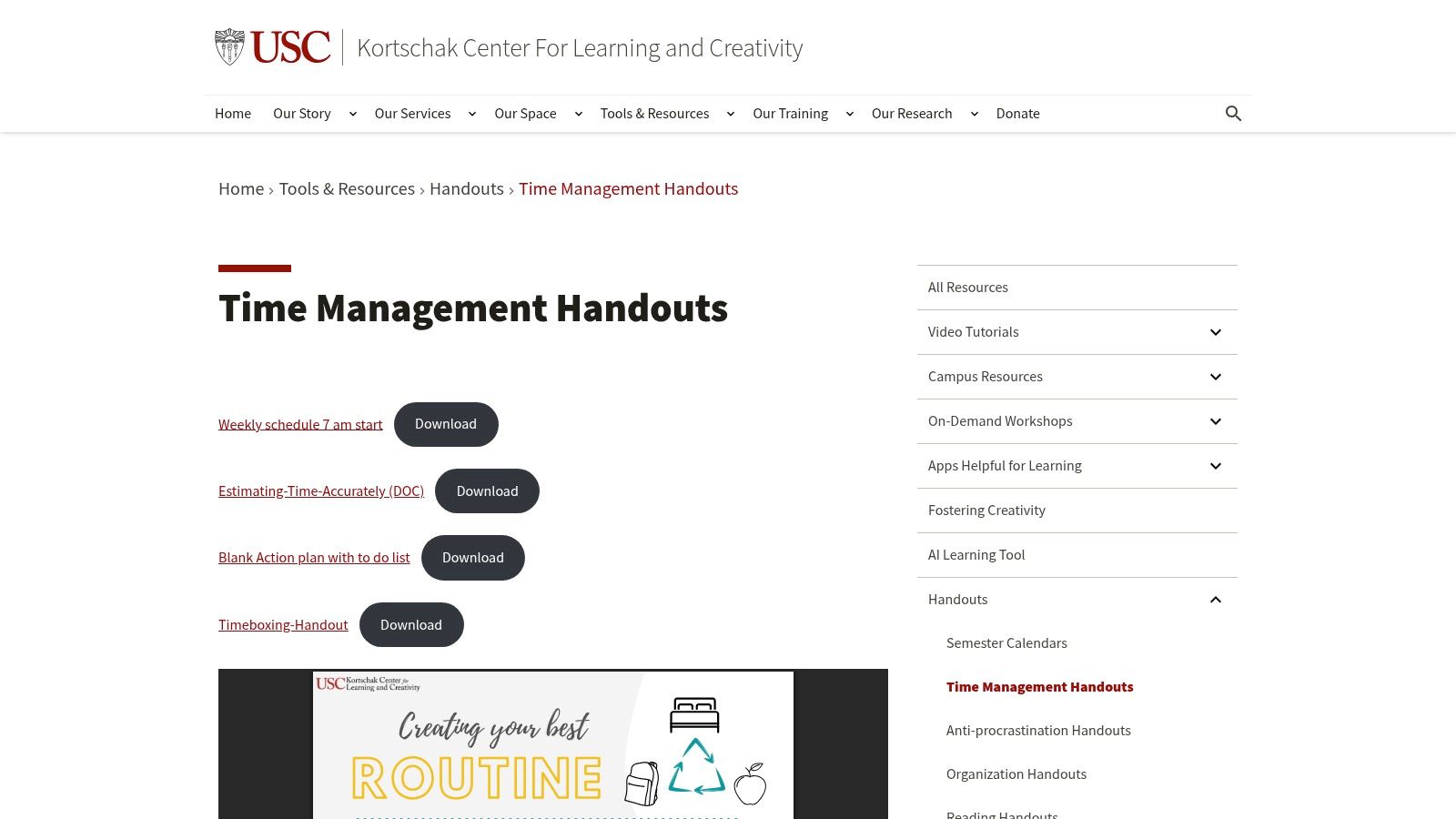
Pick two, not six: the time-estimation sheet and the task-breakdown guide. Together they turn "write the report" into something you can put in a calendar slot.
What works: Several distinct tools in one place, free, and the estimation and breakdown handouts make later planning more realistic.
What doesn't: Some downloads are Word documents rather than PDFs, and the examples assume coursework. You'll need to substitute your own deliverables.
The timeboxing handout is the one to test during a real deadline week. Give a client memo a fixed box and watch where the box breaks. That failure point is your actual capacity.
6. Sarah Lawrence College Time Management Worksheets
The review loop is what most planners skip, and it's why this set is worth a look. Sarah Lawrence's Learning Commons collects daily and weekly to-do lists, a general task list, and weekly planner and schedule templates, then tells you to set priorities and deadlines, transfer them into a calendar or task app, and revisit the plan weekly.
That last instruction is the difference between a planner and a habit. A schedule you never revise becomes fiction by Thursday.
Flexibility: Templates for a single day, a full week, or a running list, so you can match the format to the horizon you plan on.
The catch: The framing is student coaching, and these are planning aids. Nothing here addresses burnout, boundaries, or a workload that is too large.
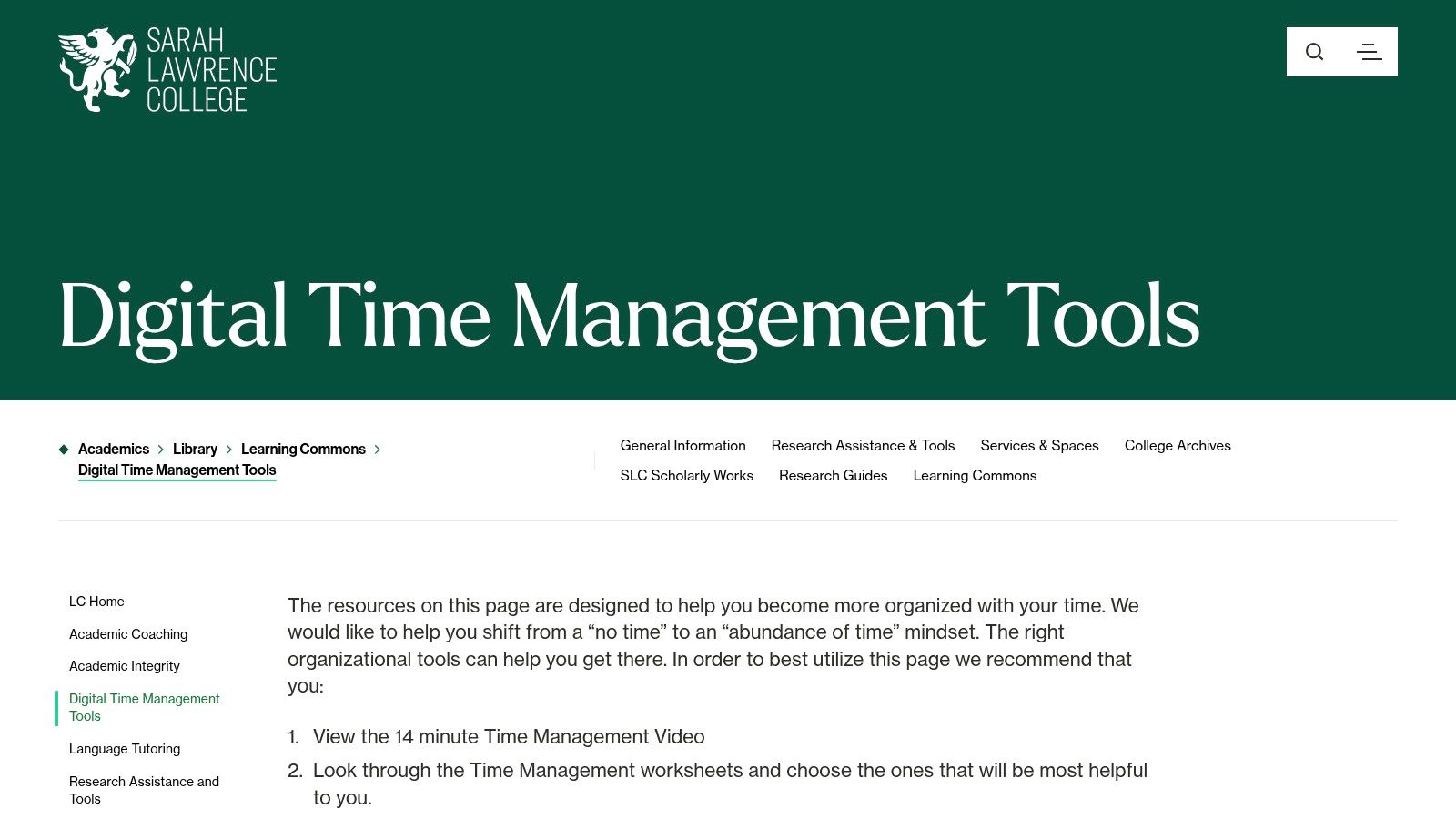
Take the weekly planner and treat Sunday's twenty minutes as fixed. Then keep the old sheets. After a month, the gap between planned and actual is the most useful data you own.
7. MyTimeManagement.com Printable Time Categorization Worksheet
Fifteen-minute blocks are the right resolution for professional work. This printable time management PDF lets you choose five to ten categories, work and personal, and log where each quarter hour went. The site recommends tracking for at least three days, ideally a week, before setting any goals.
Choose categories that reflect your real week: client-facing work, email, interruptions, internal meetings, deep analysis, and something personal like quality time with family. Then compare the log with what you would have guessed.
Strength: It exposes the gap between perceived and actual time use, which is usually larger than people expect, especially around email and interruptions.
Weakness: It needs several days of consistent logging, and it says nothing about burnout or profession-specific pressure.
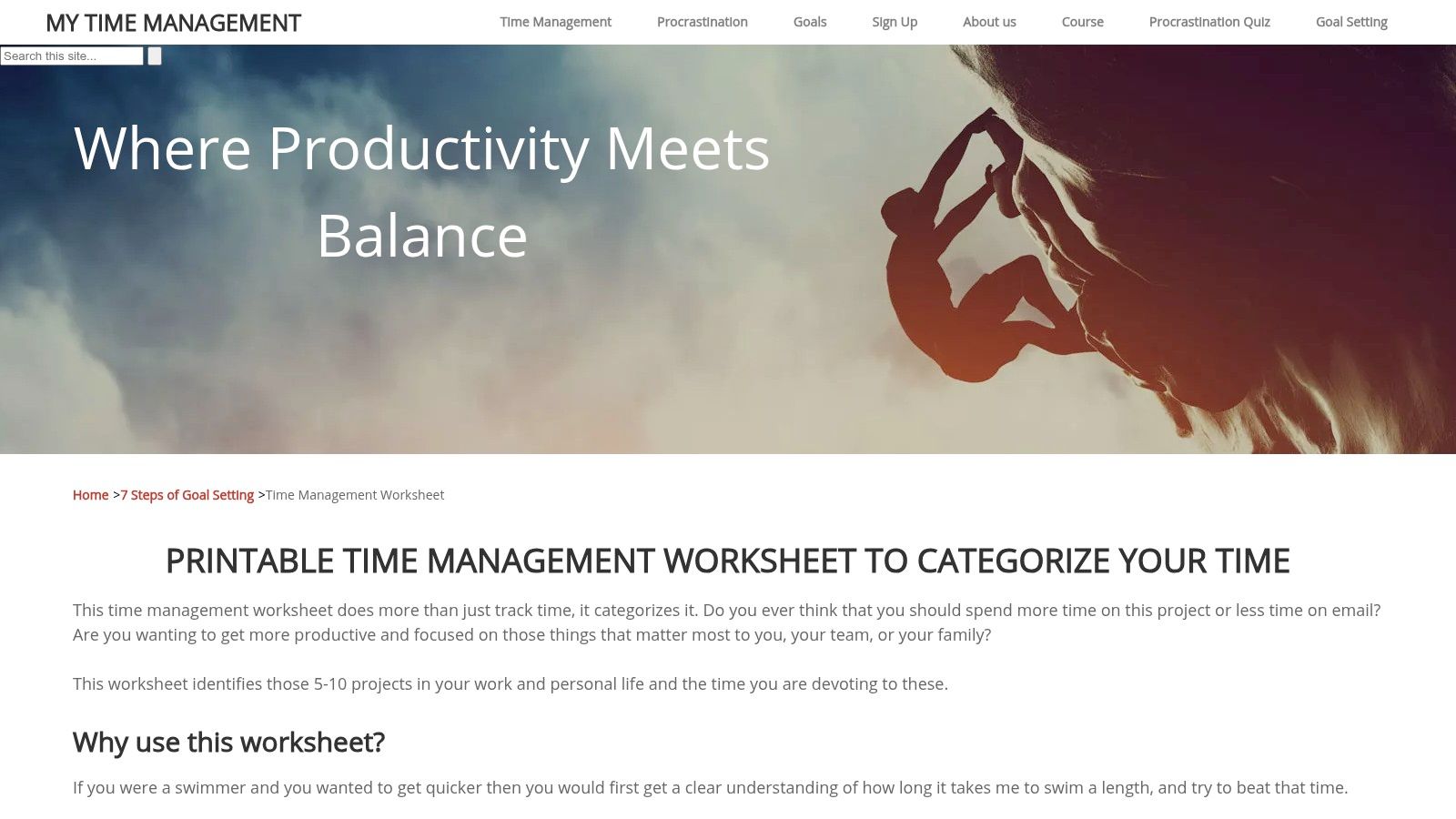
Tracking is a diagnostic, not a discipline test. If the log shows eleven hours of context switching, the fix is calendar design, not more willpower.
One caveat on how you run it. A study of 248 knowledge workers comparing self-chosen and organization-mandated tracking methods found satisfaction was lower for mandated tools than for voluntarily chosen ones. Keep this self-selected. The sample covers knowledge workers rather than a general population, so read the finding as an adoption signal, not a universal rule.
8. University of Notre Dame McWell Time Management Worksheet
Sleep is on the task list. That single design choice separates this one-page worksheet from nearly every planner circulating in professional settings. The task inventory explicitly includes sleep, meals, physical activity, and breaks, then runs what's left through an Eisenhower matrix.
A task list without sleep on it is a list of half your day.
The order matters. Capture everything first, recovery included, then sort. Skip the capture step and the matrix sorts only the work you happened to remember while stressed.
Why it's useful: One page, one sitting, and personal care counts as workload rather than an afterthought.
Where it stops: It won't help you negotiate an unreasonable deadline or decide what to hand off. It's a snapshot, not a plan.
Use it on a Sunday evening and again on a Wednesday. The difference between the two inventories tells you whether you're overloaded on paper or in practice.
9. Dayprints 7-Day Reset Workbook
Sequencing is the unusual feature here. Dayprints publishes a free ten-page workbook broken into seven short exercises: clear the backlog, plan a day inside the time you have, choose a first action with a realistic start time, then prepare for the following week. Priorities are capped at three, and the set finishes with a reusable weekly reset card.
The publisher says no account or email signup is needed, and the A4 pages can be fitted to US Letter when printing.
The good: A structured sequence rather than a blank grid, and the three-priority limit is the honest part of the design.
The trade-off: It's printable rather than a fillable form, and the same site promotes an app. The workbook stands alone, but expect a nudge toward the product.
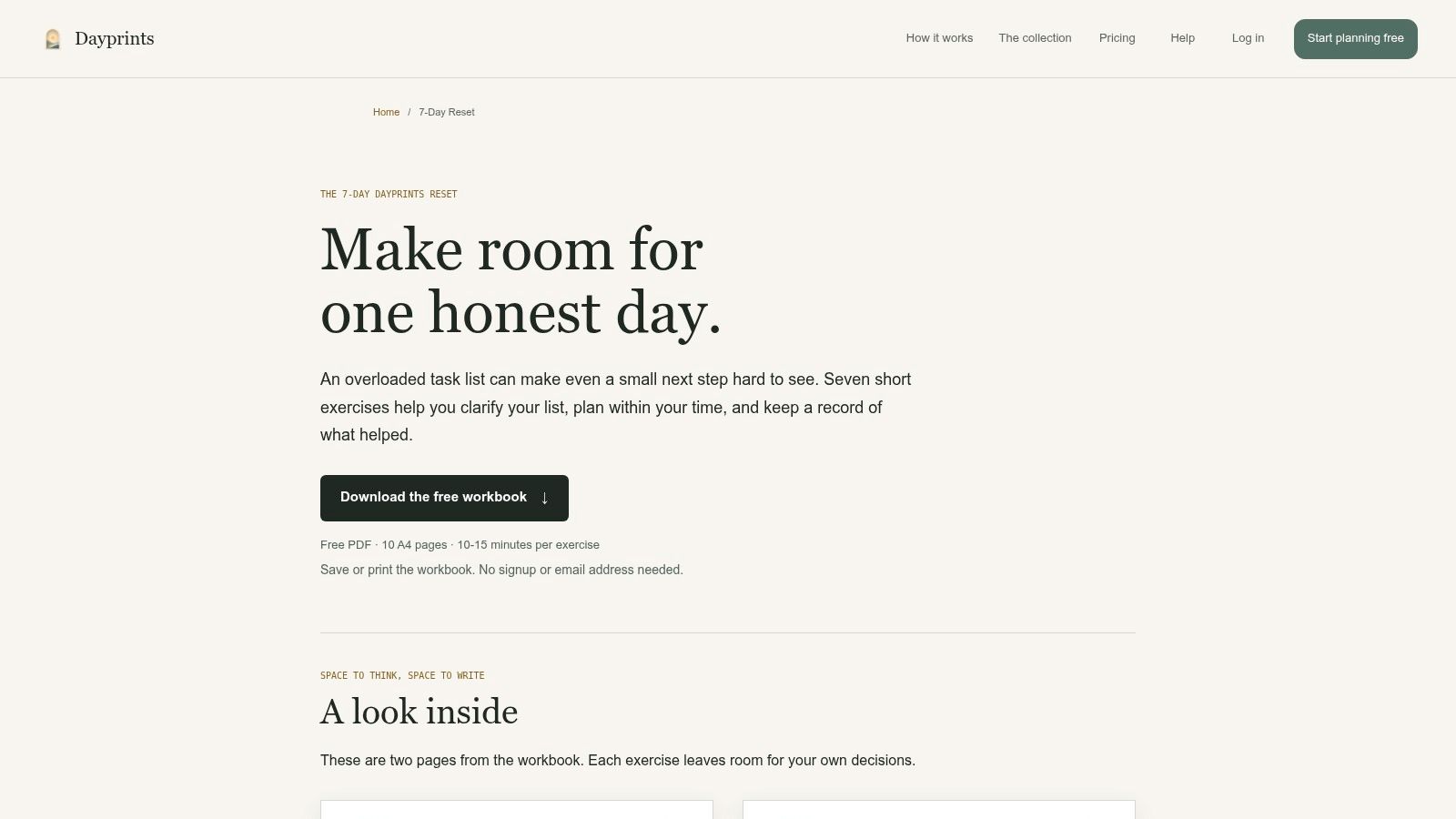
Format is not the variable that matters most. A two-week study comparing a digital task app with pen-and-paper planning among remote workers recorded a mean perceived productivity score of 18.36 (SD = 2.57) for the digital group and 17.88 (SD = 4.07) for the paper group, a difference that wasn't statistically significant. The study was small and short, so read that as permission to print without guilt rather than a verdict on either method.
Website: Dayprints 7-Day Reset workbook
10. Northern Illinois University Time Management Inventory
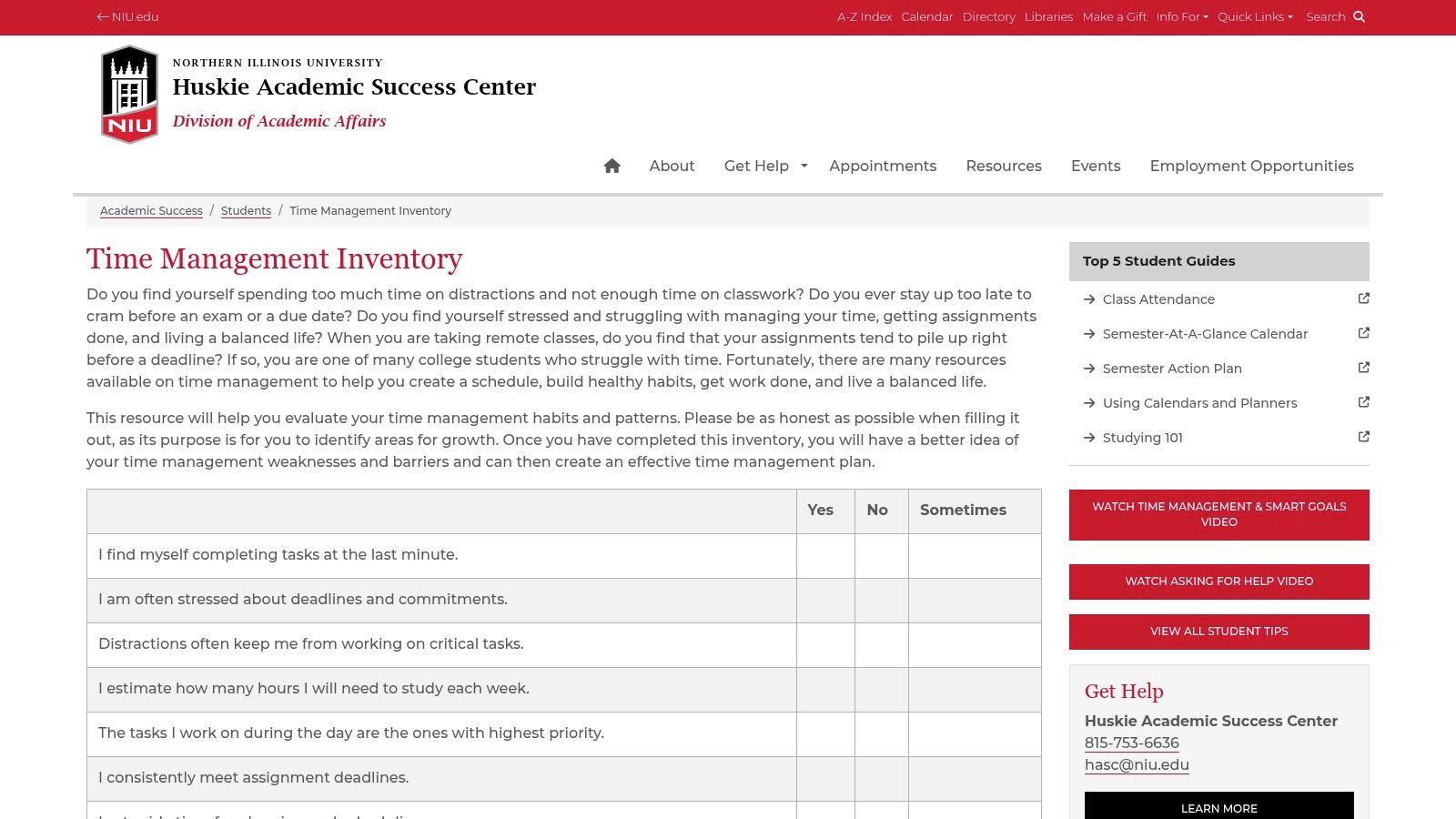
Start here if you don't yet know what's wrong. NIU's tutoring center hosts a one-page inventory with yes, no, and sometimes answers covering deadline stress, distraction, prioritization, planning, contingency time, and whether you work during your productive hours. Both a PDF and an editable Word version are linked, and the PDF credits UNC Chapel Hill's Learning Center.
Answer quickly and without editing yourself. The pattern matters more than any score.
Best use: Choosing which of the other nine worksheets you need, instead of printing all of them.
Limitation: The questions and examples lean student, and the output is a diagnosis. It isn't a schedule and it isn't a workload-reduction plan.
The evidence for planning interventions is stronger on well-being than on output. A 2024 systematic-review protocol reports that a meta-analysis of 158 studies involving 53,957 participants found time management improved well-being, particularly life satisfaction, more than job performance, and notes that a recent review identified only seven eligible workplace experiments involving 442 people, with inconsistent effects across well-being outcomes. Plan for the calmer evenings. Treat performance gains as a possible bonus.
How the ten free time management PDFs compare
Item | Primary Focus | Audience Fit | Main Limitation |
|---|---|---|---|
Choosing Therapy, Task and Time Management Worksheet for Work | Organizing work tasks and schedules while supporting breaks and boundaries | Workers managing workload and work-life balance | Standalone worksheet with general guidance |
Georgia State University, Managing Your Time Wisely | Prioritizing responsibilities, protecting focus time, and setting boundaries | Faculty balancing competing responsibilities | Tips sheet, not a fillable planner or in-depth workbook |
Columbia Health, 1440 Worksheet and Eisenhower Matrix | Reviewing time use and prioritizing tasks by urgency and importance | Students; adaptable to work and personal tasks | No full weekly schedule or follow-up plan |
William & Mary, Time Assessment and Time Management Strategies | Tracking time commitments and planning daily and weekly activities | Students balancing academic and personal commitments | Student-oriented examples; assessment does not identify solutions |
USC Kortschak Center, Time Management Handouts | Using schedules, timeboxing, task breakdown, and routine-building tools | Students seeking a range of planning tools | Academic examples may need adapting |
Sarah Lawrence College, Time Management Worksheets | Planning tasks and schedules, with regular review and revision | Students using academic planning support | Does not focus on burnout or boundary-setting |
MyTimeManagement.com, Printable Time Categorization Worksheet | Tracking time use in 15-minute intervals across selected categories | People comparing work and personal time use | Requires several days of consistent tracking |
University of Notre Dame McWell, Time Management Worksheet | Capturing tasks and prioritizing them while accounting for self-care | People seeking a quick review of tasks and basic recovery needs | Brief worksheet with little guidance on workload negotiation |
Dayprints, 7-Day Reset Workbook | Completing structured exercises to clarify priorities and plan a week | People seeking a short, guided planning reset | Printable rather than fillable; app is separate |
Northern Illinois University, Time Management Inventory | Assessing planning habits, distractions, and time-management barriers | Students identifying habits before choosing a planning tool | Not a schedule or workload-reduction plan |
Choose One PDF This Week and Test It Honestly
Pick one worksheet matched to the problem in front of you. Tracking if you can't say where the week went. Sorting if the list itself is the problem. Recovery if the evenings have disappeared. Weekly planning if Monday arrives without a shape. Print it, complete it for five workdays, then write three lines: what changed, what didn't, and what you'd need from someone else.
If the same overload returns two weeks later, stop shopping for templates. The cause is usually structural, and the International Labour Organization's working-time research makes the scale clear: it identifies the 40-hour week as the most common national standard for normal weekly hours and reports that approximately 36.1% of the global workforce works more than 48 hours per week, a proportion more than twice as high in developing countries as in developed ones. Better prioritization reduces wasted effort. It cannot absorb a schedule that's over capacity by design.
That distinction is the one worth holding onto. Time management may support well-being more reliably than it lifts performance, which argues for defining success as sustainable effectiveness rather than maximum utilization or a perfectly optimized calendar.
When the answer isn't another worksheet, it's a conversation about expectations, staffing, or role design. Acheloa Wellness provides one-to-one burnout and executive coaching for professional women and business owners, starting with a free consultation, and Lauren Baptiste is available between sessions. The free handout "The 3 Steps to Healthy Boundaries" is a reasonable thing to work through before that call.
If the worksheets keep exposing the same problem, the fix is usually the workload and the boundaries around it, not another template. Acheloa Wellness offers one-to-one burnout and executive coaching for professional women and business owners, with a free consultation and support available between sessions. Visit Acheloa Wellness to book that conversation and bring the completed worksheet with you.

