

Time Management and Prioritization: What to Do First
You sat down at 8:50 with one clear outcome: finish the client memo before noon. By 9:40 the plan was gone. A partner needed a number, a client asked for a quick call, an invite landed on your only focus block, and the memo is still a title and a blinking cursor.
That morning isn't a discipline failure, and treating it as one is why the same thing happens next week. A calendar packed with meetings and a chat window packed with questions is a workload design problem, and prioritization is what fixes it before any time management technique can help. What follows is the order I'd work in: sort the work, protect the work, decide in advance what happens when the day breaks the plan, and budget recovery as deliberately as you budget billable hours.
Table of Contents
A Four-Quadrant Table for Sorting Any Task - The two tests behind the table
Why Prioritization Comes Before Time Management - What a switch actually costs
Handling Interruptions Without Losing Your Priorities - Three questions that separate urgency from noise
Protecting Recovery as a Priority, Not a Leftover - False flexibility and the missing end of day
Common Prioritization Mistakes and How to Fix Them - What improves in a week and what takes a month
A Four-Quadrant Table for Sorting Any Task
Sorting is the step many people skip. It takes two questions per task and works on anything on your list, from a filing due today to a committee invitation you'd rather avoid.
Quadrant | Test question | Action | Typical example |
|---|---|---|---|
Important and urgent | Will missing it cause harm today? | Do now and protect the time | Client filing due at 5 p.m. |
Important, not urgent | Does it move a goal forward? | Schedule a protected block | Quarterly planning, skills training |
Urgent, not important | Does it need my specific expertise? | Delegate, batch or decline | Routine scheduling replies, status emails |
Neither | Does anything change if I skip it? | Drop or archive | Unread newsletters, optional committees |
The two tests behind the table
Importance asks whether the task moves a goal, a client relationship or an income outcome forward. Urgency asks whether it loses value if it waits a day. Those are different questions, which is why the sort demands a moment of honesty rather than a glance at your inbox.
Take a Wednesday that's already full. Three items sit on the list: a signed engagement letter a client needs back by 4 p.m. to make a filing, a 90-minute licensing course you need in nine months, and a six-email thread trying to find a meeting slot next week. The letter is quadrant one, so it gets the morning and the phone goes to messages. The course is quadrant two, and it will never happen unless it gets a block before the calendar fills, because nothing about it is loud. The scheduling thread is quadrant three: send three specific times, or hand it to an assistant with your availability attached.
Quadrant four is the quiet tax. Newsletters you haven't opened in a year, optional committees that meet to schedule meetings. Archiving isn't laziness; it's the only way quadrant two ever gets airtime.
The trap isn't laziness. It's that quadrants one and three both shout, so the day fills with them and quadrant two, where the next promotion and the next client live, never gets touched.
Run the 30-second test before you open email. Sort three tasks from today's list into the grid. If you can't answer the urgency question for one of them, you don't have a priority problem, you have a requester who never told you the deadline. Ask.
Why Prioritization Comes Before Time Management

A calendar can be completely full and the day still feels wasted. Calendars, timers and time blocks answer when the work happens. Prioritization answers what deserves the hour. Get the order backwards and you get a beautifully color-coded week spent on the wrong work.
Think of a jar, large stones, pebbles and sand. Pour the sand in first and there's no room for the stones. Pour the stones in first and the sand fills the gaps around them. Your day is the jar, and email is almost always sand. The order of loading matters more than the amount of effort.
What a switch actually costs
The price of a shared hour isn't the minutes spent on the reply. The interruption research summarized by Springer's review of task switching and interruption costs reports that workers switched activities roughly every three minutes, and that controlled interruptions averaging about 30 seconds still left participants considerably slower on the primary task once the interruption time itself was excluded.
The shape of that finding matters more than the number. A disruption during active work hurts more than one arriving at a natural break, and a switch to a different priority or across projects costs the most, because you rebuild the mental context from nothing. Answering a client mid-draft isn't a 30-second reply. It's the reply plus the several minutes of reassembly.
This short walkthrough covers the same logic from the scheduling side, which helps when you're explaining the change to a team.
Run one count this week. Track every time you change task in a day and label each switch planned or unplanned. If unplanned switches outnumber planned ones, the calendar isn't the problem and neither is your willpower.
How to Build Your Weekly Priority Plan
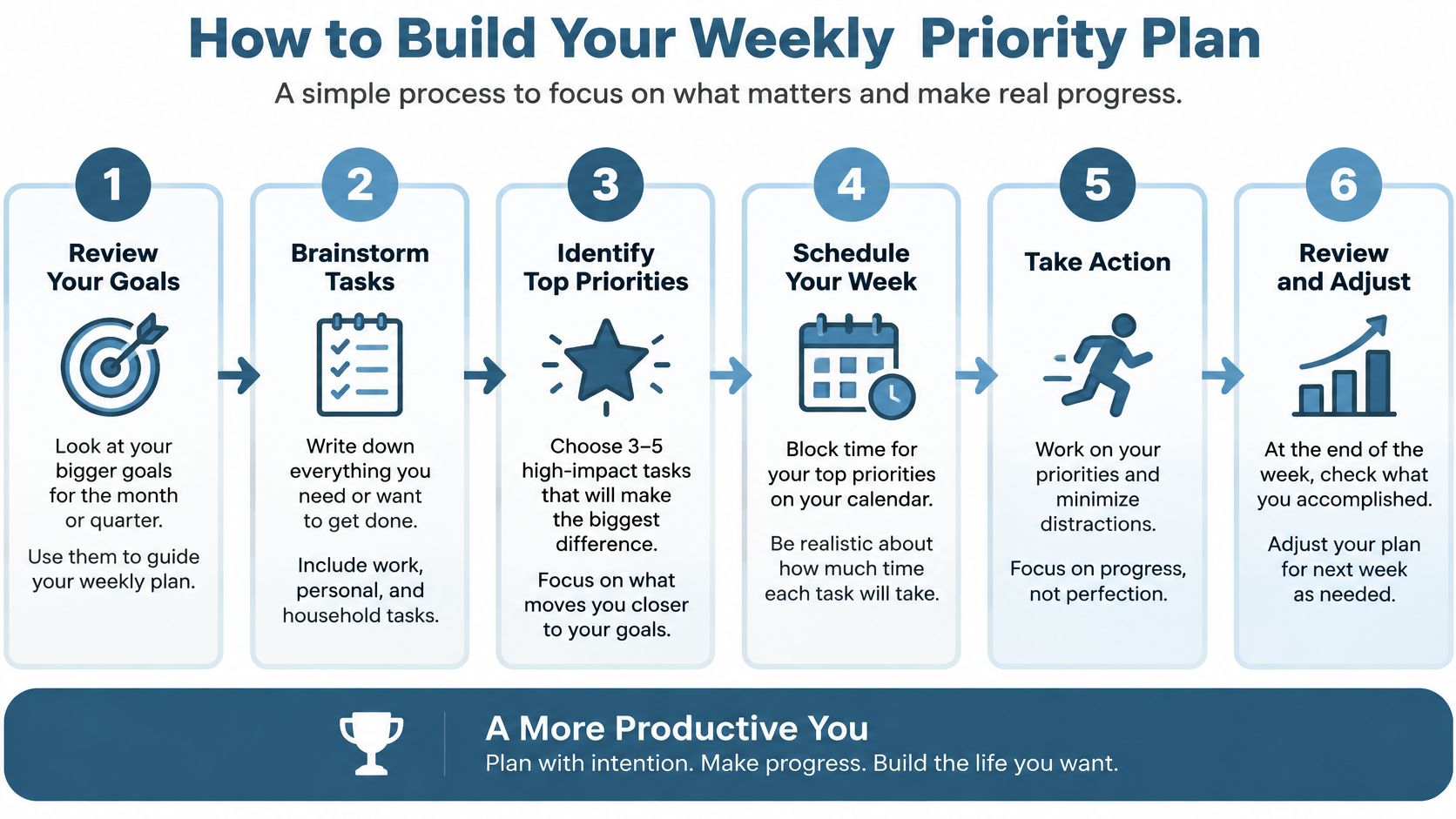
A weekly plan is a short list of outcomes plus the rules for what happens when the week misbehaves. The build takes about 40 minutes on a Sunday or Monday morning and replaces the daily scramble. Most of that time goes to deciding calmly what a loud week would otherwise decide for you.
Empty every commitment into one list. Pull from email, the calendar, project boards and the promises made in meetings that never became tasks. A commitment living only in your head competes for attention all day. Paper and a notes app both work for the capture; if you already sketch plans on an iPad, this roundup of free note apps for iPad students covers more than a weekly list needs before you pay for a tool.
Score each item twice, on impact and on deadline. Impact is what changes for a client, a revenue line or the team. Deadline is what breaks if the work slips. Use high, medium or low, and keep the two scores separate: a high-impact item with no deadline still belongs in quadrant two, and a noisy week will crowd it out first.
Cut to three weekly outcomes. Three results that would make the week count. "Send the contract" is a task in service of an outcome. Everything else is maintenance, and maintenance is allowed to be boring.
Give each outcome a minimum viable next action and a protected block. Make the action specific enough to start without deciding anything: "draft the pricing page of the pitch" rather than "work on the pitch." Then put it in the calendar with a start time and an end time.
Write if-then rules for the disruptions you can predict. For example: if a request arrives flagged urgent, I will weigh it against the week's three outcomes before moving any scheduled work. A rule converts a decision you'd make badly at 2 p.m. into one you already made calmly.
Hold buffer capacity. Leave a real chunk of the week unbooked, sized on purpose rather than hopefully. Urgent requests and meetings that run long will spend whatever slack exists, and a plan built with none breaks on Tuesday morning and takes your confidence with it.
Review on Friday for 15 minutes. Note what didn't finish, which if-then rules fired and what carries forward. The same items rolling over week after week signal a list that's too long, a design problem rather than a speed problem.
The research favors the adaptive version of this process over the rigid one. Contingent planning, meaning responses decided in advance for likely disruptions, was associated with stronger engagement and productivity regardless of interruption levels, while conventional scheduling performed well mainly when interruptions were low, according to UCLA Anderson Review's analysis of planning research. A separate field experiment reported there found weekly planning reduced unfinished tasks and work-related rumination and improved cognitive flexibility, though it didn't significantly raise engagement.
For the daily version of the same habits, these time management skills examples break the week down further. The goal throughout is faster, lower-stress reallocation when reality changes, which it will.
Handling Interruptions Without Losing Your Priorities
The honest version of an interrupt-driven day is worse than most advice assumes. Microsoft productivity signals reported that employees are interrupted about every two minutes during core hours, receive an average of 117 emails and 153 Teams messages a day, and often find meetings sitting in the 9 to 11 a.m. and 1 to 3 p.m. windows people reserve for concentrated work, as HR Reporter's summary of the productivity data sets out. Nearly half of employees and 52% of leaders describe the workday as chaotic and fragmented.
Read those numbers and the conclusion is hard to avoid: individual discipline alone won't fix a structurally interrupt-driven day. Prioritization has to include communication boundaries, response-time agreements and a method for recording what got deferred.
Three questions that separate urgency from noise
Who needs this? If the answer is a client with a real deadline, it's urgent. If the answer is someone who wants visibility on your progress, it's a status update and it can wait for a window.
What happens if it waits 24 hours? Name the consequence out loud. No consequence, no interruption.
Can someone else answer it? If yes, forward it with the context attached. If handing work off is the weak link, this guide on how to delegate without taking it back covers the handoff.
Escalation rule: one named channel and one named person for matters that genuinely can't wait. Everything else lands in a scheduled response window, including messages from people who mark everything urgent.
Set response-time agreements with clients and teammates: same-day acknowledgment with a stated delivery date beats a fast reply and a missed one. Add meeting refusal criteria you'll apply in practice. No agenda, no decision needed, or your input isn't required, and you decline with a one-line note offering to review the minutes.
Keep a deferral log. One line per pushed item: what it was, why it moved, who was told. Deferred work then stays visible instead of evaporating, and at the end of the month you'll have evidence for the conversation about capacity. None of this requires permission. It requires a decision and a sentence to your team.
Protecting Recovery as a Priority, Not a Leftover

Recovery is usually the item ranked last on the priority list, and the cost shows up in the numbers. Deloitte's 2025 global survey of 7,500 women across 15 countries found that 29% of women felt unable to switch off from work, while 22% rated their mental load as too high, per Deloitte's Women at Work 2025 global outlook. Reporting on workplace telemetry points the same way: days that open in the inbox before breakfast and close in meetings after dinner, with no recovery scheduled between them.
False flexibility and the missing end of day
Remote and hybrid schedules removed the commute, which was often the only transition between work and home. Without it, the day has no edge, so work expands until sleep cuts it off. That's false flexibility: the hours look yours and behave like someone else's.
Unprotected recovery is a workload-design problem, not a discipline problem. The fix is structural: rank recovery the way you rank revenue, client service and household obligations, with three fixed items. A hard stop time that survives a busy Tuesday. One protected evening a week where you don't check anything. A written coverage plan for vacations, agreed before you book the trip rather than the night before you leave.
Credibility test for any boundary: can you name the colleague who covers you and the note they'll read if something breaks? A boundary with a named backup reads as professional. A boundary alone reads as unavailable.
Then apply the sustainability test to each priority. Will finishing this at the cost of sleep, family connection or decompression still leave you capacity to deliver next week? If not, it moves to tomorrow's plan or it gets delegated. Doing more work from a place of burnout isn't a sustainable way up the corporate ladder, and doing the same things as before won't produce a thriving work and personal life. That principle sits at the core of the coaching at Acheloa Wellness.
If your afternoons collapse regardless of what's on the calendar, the reasons behind daily energy crashes are worth examining before you add another block. And recovery isn't only sleep. These seven types of rest explain why a quiet evening doesn't always restore you.
Common Prioritization Mistakes and How to Fix Them
When a week goes badly, the useful question isn't "what should I have done differently" but "which row does this match." Match your week to a row and apply that fix rather than rebuilding the whole system.
Symptom | Likely cause | Fix |
|---|---|---|
Everything feels urgent | Requests come without a stated deadline or consequence | Ask for the deadline and consequence before starting |
Full calendar, no finished work | Meetings booked into focus blocks | Protect one block and decline meetings without an agenda |
Priority list keeps growing | No rule for removing items | Remove or defer one item for each new item added |
Working late to catch up | Plan has no buffer capacity | Reserve about a fifth of the week for unplanned demands |
What improves in a week and what takes a month
Some fixes are nearly immediate because they change what other people do, not what you do.
Lands within days: asking for the deadline and consequence before you start, declining agenda-free meetings, and setting an if-then rule for the request type that derails you most.
Takes about a month: shrinking a list that's been growing for a year, holding buffer without filling it, and getting a team used to a response window instead of an instant reply.
The distinction matters because people quit good systems in week two, when the fast wins have landed and the slow ones haven't. Give the list-shrinking a full month of Fridays before you judge it.
Signs the plan is working: fewer tasks rolling into next week, fewer after-hours catch-up sessions, and a deferral log you can read without wincing. If none of those change in a month, the problem is upstream of the schedule, usually in what you've agreed to take on.
Confirm Your Top Priority Before Tomorrow Starts
Three steps, ten minutes, tonight.
Name the single outcome that would make tomorrow a success. Write it on paper, not in an app you'll open behind forty notifications.
Write its minimum viable next action. The first thing you'd do in the first 25 minutes, specific enough that tomorrow-you doesn't have to decide.
Set a hard stop and tell one colleague what you're deferring. One sentence each. The colleague now knows what isn't arriving, which is easy to forget.
Outside help earns its place in three situations: the same priorities keep failing even though the system is sound, recovery keeps slipping across several weeks, or a promotion or pay conversation depends on explaining your impact clearly. Practical options for each exist. Ask a manager to review the weekly plan with you, agree a coverage rule with a teammate, or walk the deferral log through with a trusted peer.
Judging any outside help is simple: does it change what happens on a normal Tuesday? Coaching here is one-on-one, meets you where you are, and starts with small wins before scaling up, because a system you can hold for a week beats a perfect one you abandon. Priorities get reviewed weekly, never set once. The Friday review is where you check whether tomorrow's choice still holds.
Acheloa Wellness provides one-to-one burnout and executive coaching for professional women and business owners in law, accounting, consulting and finance, combining career and leadership work with the boundaries and recovery patterns that make a priority plan survive a real client week. If the same three outcomes keep losing to the same interruptions, or recovery has slipped for more than a month, start with a conversation about your actual calendar rather than another productivity app. Visit Acheloa Wellness to book a free consultation.

