

Time Management Benefits: Focus, Workload and Stress
Longer days do not reliably produce more finished work. A 10% increase in overtime hours was associated with an approximately 2 to 4% reduction in output across 18 U.S. manufacturing sectors from 1956 to 1991, in research summarized by the Institute of Labor Economics. Past a threshold, extra hours buy smaller gains, and sometimes they buy less output.
That pattern fits deadline-heavy professional work, where evenings fill with availability rather than better judgment. Time management benefits show up when you change priorities and limits, then track one signal for each area. Hours you get back have to be assigned before they appear, or the next request will take them.
Table of Contents
Four Benefits of Time Management, Measured - What each signal means on a real week
How Protected Focus Time Works - A three-part morning routine
How Time Management Lowers Stress and Burnout - Four practices that create control
Spotting Workload Overload Early - Read the row as a decision
Reclaiming Time Outside Work - Assign the hour before it appears
Four Benefits of Time Management, Measured
A meta-analysis by Aeon, Faber, and Panaccio, covered in StatWharf's summary of time management research, pooled 158 studies with 53,957 participants and found a moderate relationship between time management and job performance, academic achievement, and wellbeing. Pooling that many samples matters more than any single firm's result. Planning, prioritization, scheduling, and boundary-setting behave like performance resources. They do not prove a planner causes every gain, and they cannot repair an unrealistic load the organization has already set.
The practical question is which benefit to read first. Track one signal per area, and give each recovered hour a named destination before the week begins. Hours with no destination get claimed by the next request.
Benefit | What Changes | Signal to Track | Evidence |
|---|---|---|---|
Focus | Priorities set before the day starts and interruptions batched | Uninterrupted work blocks completed each week | Moderate association with job performance across 158 studies |
Workload | Low-value tasks renegotiated or dropped and overtime limited | Deadlines met without evening or weekend work | Removing low-value work frees capacity without extending hours |
Stress | Perceived control over commitments increases | Self-rated time pressure over the month | Negative association with stress and burnout in a meta-analytic review |
Personal time | Fixed stop times and protected weekends | Planned days per week ending at a set time | A kept stop time reserves recovery before new requests arrive |
What each signal means on a real week
Focus is a count: the uninterrupted blocks you finish. Three planned and one completed is a failed week, even if the calendar looked full.
Workload improves when deadlines land without evening work because low-value tasks were dropped or renegotiated. Hitting dates only by staying late keeps the signal red.
Stress is the month's self-rated time pressure, tracked separately from tasks closed. Pressure can fall while output holds. That gap is what control looks like.
Personal time is planned days ending at a set time, including a protected weekend. Assign those hours to something specific before the week starts, or they get spent for you. A stop you keep is the signal. A stop you slide is a wish.
Practical rule: Find the weakest row this week and name the signal you already track for it. If you track nothing, that row is the one to build.
Ways to manage deadlines with better time habits only pay off when that signal moves, not when the list gets longer.
How Protected Focus Time Works
Treat attention like a single-lane road. Every task you start while another is still open adds traffic. The gain comes from clearing a lane before the rush, not from packing more cars onto it.
A three-part morning routine
Choose no more than three priority outcomes. Rank them before messages arrive. A list with no ranking becomes a list of everything, and then nothing finishes first.
Schedule one or two 60 to 90 minute focus blocks on the calendar colleagues can see. A block with an open inbox breaks within minutes, so close the inbox for that window. Visible blocks cut decisions made under pressure, which keeps attention on one task.
Batch email and messages into two or three fixed windows. Outside those windows, the lane stays clear. Checking "just once" during a block is the slip that turns the block into admin.
A packed calendar is not focus. A day with no gaps leaves no room to reset, so the next block starts tired. If you want a timer inside the block, the Pomodoro technique for a short burst of work can sit inside the longer block. It does not replace the priority choice.
Zemith's realistic approach to deep work is useful here because it treats deep work as a limited block, not a personality trait.
You know the routine is working when more uninterrupted work is finished by Friday and fewer days end with the top priority still open.
How Time Management Lowers Stress and Burnout
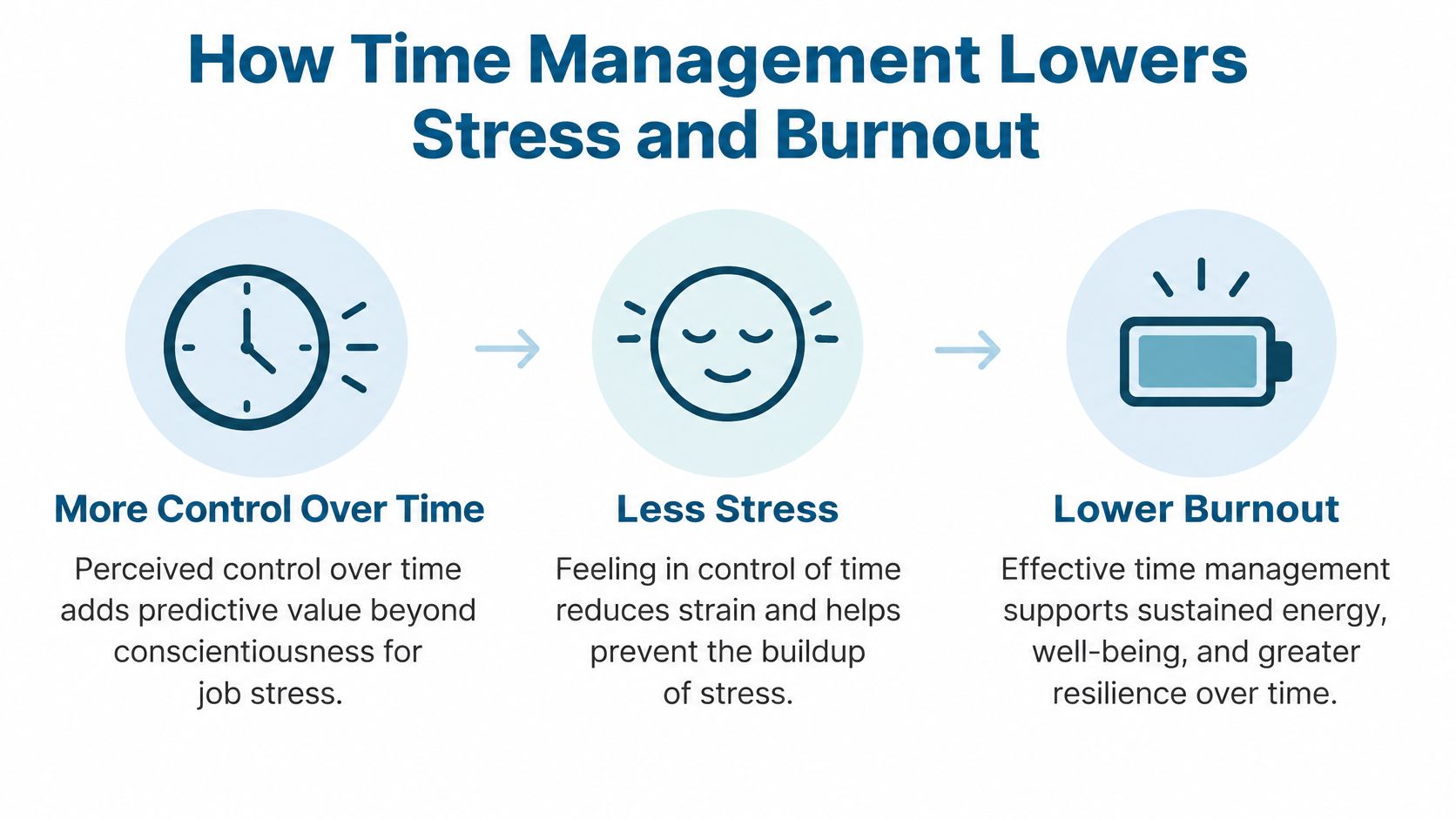
Stress falls less because you do fewer tasks and more because you can choose among them. A meta-analytic review in Applied Psychology: Health and Well-Being found that perceived control over time added predictive value beyond conscientiousness for job satisfaction, performance, and stress. The review also tied time-management behavior to higher satisfaction and performance, and to lower stress and burnout. Calendars and task lists do not create that effect by themselves. Control is the ability to make a deliberate trade-off.
Four practices that create control
Name a small set of outcomes for the day so the rest of the list is not pretending to be equal.
Reserve recovery blocks that are not focus time. A walk, a meal away from the desk, or a hard stop before dinner counts. If recovery waits until the inbox is empty, it never happens.
Set a response window. Non-urgent client messages get a reply within one working day, not within ten minutes. Speed on low-stakes mail is how evenings disappear.
Renegotiate out loud when capacity is gone. Name the item you will drop, delay, or hand off. Hidden overload stays invisible until it is a crisis. Named limits ease earlier.
I would not treat extra hours while depleted as a career strategy. Doing more work from a place of burnout is not a sustainable way up the corporate ladder.
Experimental evidence is limited, and one review cautions that time-management training has produced inconsistent results. Track Sunday-evening dread, sleep quality, and your time-pressure rating next to output. If output rises and dread rises with it, the routine is not working.
For a wider look at strain on the job, Vancouver Counselling Clinic's workplace stress guide pairs well with these limits.
This week's test: list three commitments you could renegotiate and the sentence you would use for each. "I can deliver A by Thursday if we move B to next week" is enough. If you cannot say the sentence, the commitment is still running you.
Spotting Workload Overload Early
In 2025, average workdays were 36 minutes shorter than pre-remote-work norms while measured productivity increased by 2%, according to ActivTrak's State of the Workplace report, as summarized by Eptura. Output does not depend on a longer day. The useful question is which symptom is already on your week, and which single change answers it.
Symptom | Likely Cause | Adjustment |
|---|---|---|
Deadlines met only through late work | Estimates too optimistic | Move the deadline or add a one-day buffer |
Weekends filled with unfinished tasks | More priorities than capacity | Drop or delegate one task each week |
Same priorities carried over for three weeks | Hidden blocker outside your control | Name the blocker to the person who can remove it |
Rising self-rated time pressure | Requests answered at any hour | Set a fixed response window for non-urgent messages |
Read the row as a decision
Late delivery that only clears after dinner means the estimate was optimistic. Move the date or add a buffer day before you promise the same pattern again.
A weekend full of leftovers means the priority list is larger than the week. Drop or delegate one item every week, not "when it calms down."
The same three items sitting for three weeks usually means a blocker you do not own. Say it to the person who can remove it.
Rising time pressure with an always-open inbox is a boundary problem. A fixed response window stops the hour-by-hour drain. Our workload management guidance walks through capacity, handoff, and what to stop.
This table diagnoses a personal load. It cannot override work someone else assigned. That needs a direct conversation, with the symptom and the adjustment in the same sentence.
Count unfinished priorities at the end of each week for four weeks. Compare the count before and after one change. If the number does not fall, you picked the wrong row.
Reclaiming Time Outside Work
Saved time does not become rest on its own. In a 2025 BCG survey of more than 10,000 workers, 47% said AI saved them at least six hours per week, yet only about one-third received guidance on how to reallocate that time, according to BCG's AI at Work findings. People reported spending the recovered hours on finishing earlier, strategic work, learning, wellbeing, or time outside work. U.S. Federal Reserve survey data in the same report put generative AI savings at 1.6% of total work hours.

The gap is widest for executives, consultants, accountants, lawyers, and owners who are expected to stay reachable. When a tool hands back an hour and nobody assigns it, the next obligation claims it. Faster output tends to raise expectations rather than lighten the week.
Assign the hour before it appears
Reclaimed-time governance means deciding in advance whether saved time goes to finishing earlier, cutting backlog, strategic work, family, health, or genuine rest, then writing that choice on the calendar before the hours show up.
A weekday stop at 6:30 pm is one assignment. A Saturday morning with no client email is another. Both fail if you wait to see how the week goes.
The signal to track is simple: how many saved hours land where you assigned them. At week's end, mark each reclaimed hour as kept or absorbed. If absorbed hours pile up, reclaimed time has no owner in your week.
"It's really allowed me to have work-life balance," said client Dayna S.
Time boundaries hold only when the first saved hour already has a job. If your boundary keeps slipping, check whether the hour it protects was ever assigned at all.
What will the first hour you save this week be used for? Answer it before Friday's new request arrives.
Benefits in Real Working Weeks
These are illustrations, not case studies. Each one turns on a decision made before the week fills.

Decision, change, signal
A tax accountant in busy season targets focus and personal time. She picks three priorities each morning, batches client calls into one afternoon window, and sets a stop time. Over six weeks the signal that moves is fewer nights of late work, not a longer list of returns.
A consultant targets workload. She renegotiates a weekly status report nobody reads and puts the two hours into client analysis. The signal is a deadline met without weekend catch-up.
A lawyer targets stress. She blocks two morning sessions for drafting and holds a response window for non-urgent email. The sense of constant availability eases because the phone is no longer the schedule.
A business owner targets personal time. In a fixed Friday review she sorts team decisions into ones she must make and ones she can delegate. Evenings stop carrying unresolved leadership questions.
None of these weeks needed a new app or a longer day. They needed a choice written down before the requests arrived.
Choose the Benefit to Build First
Find the row where your week is weakest. Set one measurable target for 30 days. Two finished focus blocks a day, or a 6:30 pm stop on three weekdays, is enough. I would start with the signal you can count on Friday without a debate.
Give the routine at least two weeks before you judge it. Review at day 30, not after one bad week. A single rough Tuesday is not a verdict.
Friday review
Check the chosen signal. Keep the change only if the number moved. Drop it if it did not. Changing five habits at once makes it impossible to see which change helped, so leave the other rows alone until this one is stable.
Some weeks the limit is not a calendar problem. Professional women who find burnout, workload, or pay pressure hard to shift alone can book a free consultation. Our Freedom 1:1 Coaching Program addresses burnout alongside career development, for women who want the job to stay and the strain to fall. The decision stays with you.
Which single benefit, if it improved by Friday, would change how the rest of your week feels?
Acheloa Wellness offers burnout and executive coaching for professional women and business owners who want clearer priorities, firmer limits, and fewer evenings lost to client work. If time management benefits keep slipping back into a fuller calendar, we can look at the workload, the boundaries, and the career goals in the same conversation. Visit Acheloa Wellness to see how we work and book a conversation.

