

Executive Coaching Services: A 2026 Buyer's Guide
The laptop is still open at 9:40pm. The client call ended two hours ago, eleven emails have gone out since, and the work that matters, the strategy memo, the promotion case, the team restructure, sits untouched in a tab you keep meaning to open. Tomorrow's calendar looks the same.
You've thought about hiring a coach. You've also talked yourself out of it, either because another standing meeting sounds like the last thing you need, or because the sales pages you read promised returns that sounded too good to check.
Executive coaching services are worth judging once you know what they're built to change and what they can't touch. That line is where most buyers get lost, so here's the honest version, including the parts that belong to your employer rather than to you.
Table of Contents
Executive Coaching Services at a Glance
Say a tax director is offered the chance to run a practice group. She's strong with clients and less certain about running people, and her firm offers to pay for coaching. She asks a fair question: what does this service do?
Executive coaching services are structured, confidential conversations between a leader and a trained coach, aimed at a specific role, decision or pressure, usually across several months. The coach doesn't run your team, doesn't report to your boss, and doesn't make your decisions. Think of a sparring partner who never plays on your side of the net. You keep the calls. You get a place to test them out loud before you make them in public.
Sessions commonly run about an hour, and engagements typically last months rather than a single afternoon. Format matters more than most buyers expect, because choosing the wrong one burns the first month.
Coaching is not consulting. A consultant hands you an answer. A mentor hands you their experience. A coach asks the question that makes you commit to an answer, then holds you to it next session.
Format | Typical setup | Best suited for | Typical focus |
|---|---|---|---|
One-to-one coaching | Private sessions with one coach, usually by video or in person | Individual leaders and business owners | Career decisions, leadership style, workload |
Group coaching | Small cohort of leaders working with one coach | Peers facing similar challenges | Shared skills and peer feedback |
Team coaching | Coach works with an existing team on how it operates | Leadership teams | Decision making, communication, conflict |
Transition coaching | Short focused engagement around a new role | New or newly promoted leaders | Transition plan and stakeholder relationships |
Burnout-focused coaching | Individual program on workload, boundaries and career goals | Professionals whose pressure continues after hours | Recovery, boundaries, sustainable advancement |
The quick check: if the problem sits with one person's goals, career or workload, choose one-to-one coaching. If it sits in how a team decides, communicates or handles conflict, choose team coaching. Everything else follows from that split.
Choosing the Right Service for Your Situation
Match the format to the situation in front of you, not to the trend in your industry newsletter.
Newly promoted, or inside the first 90 days of a bigger role. Transition coaching, because the first quarter sets expectations you'll live with for two years.
A question about your own career or leadership style. One-to-one coaching, where the agenda is yours alone.
A team that keeps reopening the same decision. Team coaching, since a room that can't close a question won't fix it through individual insight.
Evenings and weekends eaten by work. Burnout-focused coaching, paired with an explicit capacity conversation if the load is structural.
You own the business and have no peer to test decisions against. One-to-one owner coaching, which functions as a one-person board.
Specialisation is the next filter. Acheloa Wellness, run by Lauren Baptiste, a former CPA and consultant with 13 years in billable-hour environments, coaches lawyers, accountants, consultants, women in finance and business owners, with the stated aim of advancing without quitting or downshifting. That's one option among several. Check whether a provider's audience, hours and approach match the situation you just named, rather than whether their marketing sounds impressive.
Fees move with four things: the number of sessions, the format, the length of the engagement and how much access you get between sessions. Between-session access is the quiet driver, because it's what turns a fortnightly conversation into support you can use on a Wednesday afternoon when a decision lands.
Ask for a written fee outline that lists session count, engagement length, what happens between sessions, and how the work ends. Then compare two outlines side by side instead of comparing headline rates.
Common Goals Executive Coaching Addresses
Every senior leader eventually needs a room where the half-formed version of a decision can be said out loud. Partners have that room. Founders have a board. A senior manager inside a large firm often has nobody, because the people who could advise her are the people evaluating her. A coach is a board of directors for one person: a standing appointment where decisions get tested before they're announced.
The goals below cover most of what walks through the door.
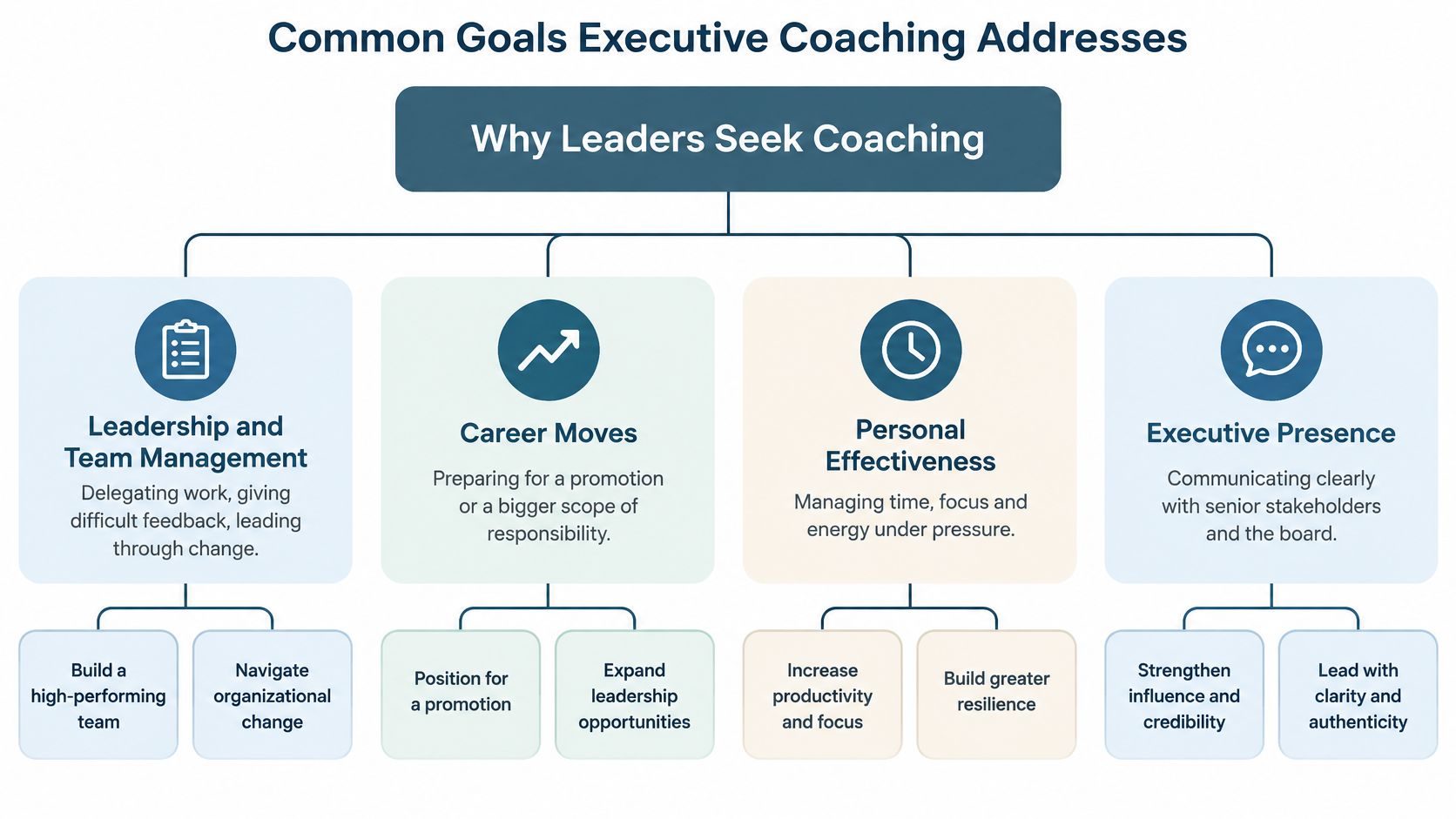
The four clusters that come up most
Leadership and team management. Handing work off without redoing it at midnight, giving feedback that changes behavior instead of damaging the relationship, and holding a team steady through a restructure or a merger.
Career moves. Building the case for promotion, weighing a lateral move into a different practice, or preparing for a role with wider scope than anything you've held.
Executive presence and communication. Presenting to a board that interrupts, managing a stakeholder who outranks you, and walking into a compensation conversation with numbers and a narrative rather than a hope.
Personal effectiveness. Protecting focus in a calendar sliced into 30-minute pieces, deciding faster when information is incomplete, and rebuilding recovery time that doesn't get spent on a second inbox.
A vague goal produces vague sessions. Take a finance director who inherits a team of twelve and needs to free two days a month for strategy. "Delegate more" is not a goal. "Hand the two recurring reports to a named team member by the end of next month, with a review checkpoint in week two" is. So is "decide on the vendor consolidation within five working days of the final quote."
That translation step is most of the early work. A coach takes the sentence you arrived with and turns it into something with a deliverable and a date attached, then asks about it at the next session.
Which cluster shows your biggest gap right now? Answer that before you shop, because it decides the format, the provider and the three goals you'll bring to a first call.
When Burnout Needs More Than Coaching
Coaching earns its place in burnout work. It teaches a leader to spot the early signals, the sleep that stopped resetting, the dread that arrives when the inbox pings, the irritability aimed at the wrong person. From there it addresses boundaries around after-hours contact, cuts overload through prioritisation and handoffs, and rebuilds recovery time in a way that survives a busy quarter.

Then comes the part that marketing tends to skip.
When the cause is structural, chronic understaffing, client expectations nobody renegotiated, a culture where availability is the price of belonging, a coach can help you name the problem, prepare a capacity conversation and propose escalation rules. A coach cannot restructure your department from a video call. Coaching changes how you carry the load. It shouldn't be the only fix for a load that is too heavy.
The pressure is not evenly distributed, and it isn't personal. Forbes's coverage of the 2025 Women in the Workplace study reports that about 60% of senior women frequently felt burned out, compared with 50% of senior men. A gap that size across a population points at working conditions, not at individual coping skills.
Where coaching stops helping
Three situations call for someone else, and a responsible coach says so early.
Persistent symptoms that suggest depression or anxiety. Low mood, sleep loss and loss of interest that last weeks belong with a doctor or therapist. Coaching can run alongside treatment, not instead of it.
A workplace problem involving discrimination, harassment or a contract dispute. Employment counsel handles that. A coach's notes aren't a legal record and shouldn't be treated as one.
Overload that affects a whole team or comes from policy. That needs a manager, HR or a policy change. One person's better boundaries won't fix a staffing model.
If you're unsure whether what you're feeling is ordinary overload or something that needs clinical attention, our guide to burnout treatment sets out the difference in plain terms.
A coach diagnosing workload would look at three numbers with you: hours worked per week, meetings per week, and the count of unanswered requests sitting in your queue. If all three are climbing while your authority stays flat, the fix is a capacity conversation, not a breathing exercise.
The rule to hold onto: personal coping cannot compensate for structurally unsustainable work. Ask any provider how they handle that, and listen for whether they name the organization's responsibility alongside yours.
Tracking Whether Executive Coaching Pays Off
Public claims about coaching returns deserve a raised eyebrow. A review of coaching outcome research notes that the widely quoted 788% figure came from a single company's internal calculation rather than an independent audit, and that broader research doesn't establish one universal dollar multiple (Today News review of the evidence). The same review finds independent evidence more supportive of effectiveness than of precise financial promises: randomized and meta-analytic studies indicate moderate gains in goal attainment, well-being, coping, self-regulation, self-efficacy and leadership behavior.
That's a useful shape for a buyer. Coaching tends to work, moderately, across a range of outcomes. It doesn't reliably produce a specific return, and anyone who says otherwise is selling.
Set the baseline before the first session
Define success in week one, in writing, while you're still unimpressed by everything. Pick no more than three indicators. Record where you are now, before any change, because a number you reconstruct from memory in month four is a guess.
Split the list into two kinds. Leading indicators move within weeks and sit mostly under your control. Lagging indicators take quarters or years and depend on other people, budgets and the economy.
Indicator | Type | How to measure | Example |
|---|---|---|---|
After-hours work | Leading | Hours logged outside working time each week | Fewer evening emails after the second month |
Recovery time | Leading | Days without work contact each month | Two full weekends off per month |
Delegation | Leading | Recurring tasks handed off each week | Two reports moved to a team member |
Decision latency | Leading | Days from issue raised to decision | Pending approvals cleared within three days |
Confidence in compensation conversations | Leading | Self-rated score before and after each review cycle | A 2 out of 5 at baseline reaching 4 by the second cycle |
Promotion or pay outcome | Lagging | Recorded result of a review or negotiation | Raise or title change reported by the client |
Retention and engagement | Lagging | Team turnover and survey scores | Lower turnover in the team over a year |
Absence | Lagging | Unplanned sick days per year | Fewer unplanned absences after six months |
Revenue | Lagging | Business or practice revenue per quarter | Quarterly revenue compared with the same quarter a year earlier |
A worked example you can copy
A litigation manager tracks her own hours for four weeks before coaching starts. The log shows 52 hours a week with 14 of them after 8pm. She picks two leading indicators, after-hours hours and delegation, and one lagging outcome, whether her team's turnover improves across the year.
She reviews the numbers monthly with her coach. By month three the evening hours have dropped and two recurring filings sit with a junior colleague. Her team's turnover number won't be readable until the year closes, so she doesn't pretend to know it yet.
One limit to plan for: a coach usually cannot verify your workplace results independently. Session content is confidential, and performance data belongs to your employer. Keep your own record, dated, so the case you eventually make to your firm rests on your evidence rather than your coach's impression.
Choose three indicators, no more. One you control this month, one your team controls this quarter, and one that depends on your firm's decisions. Track them on the same day each month and stop tracking anything you won't act on.
If cost is the live question, our breakdown of executive coaching cost walks through what drives the number, so you can compare quotes on scope rather than on rate alone.
How a Coaching Engagement Runs Step by Step
The sequence below is how a well-run engagement usually unfolds, whether you buy six sessions or six months.
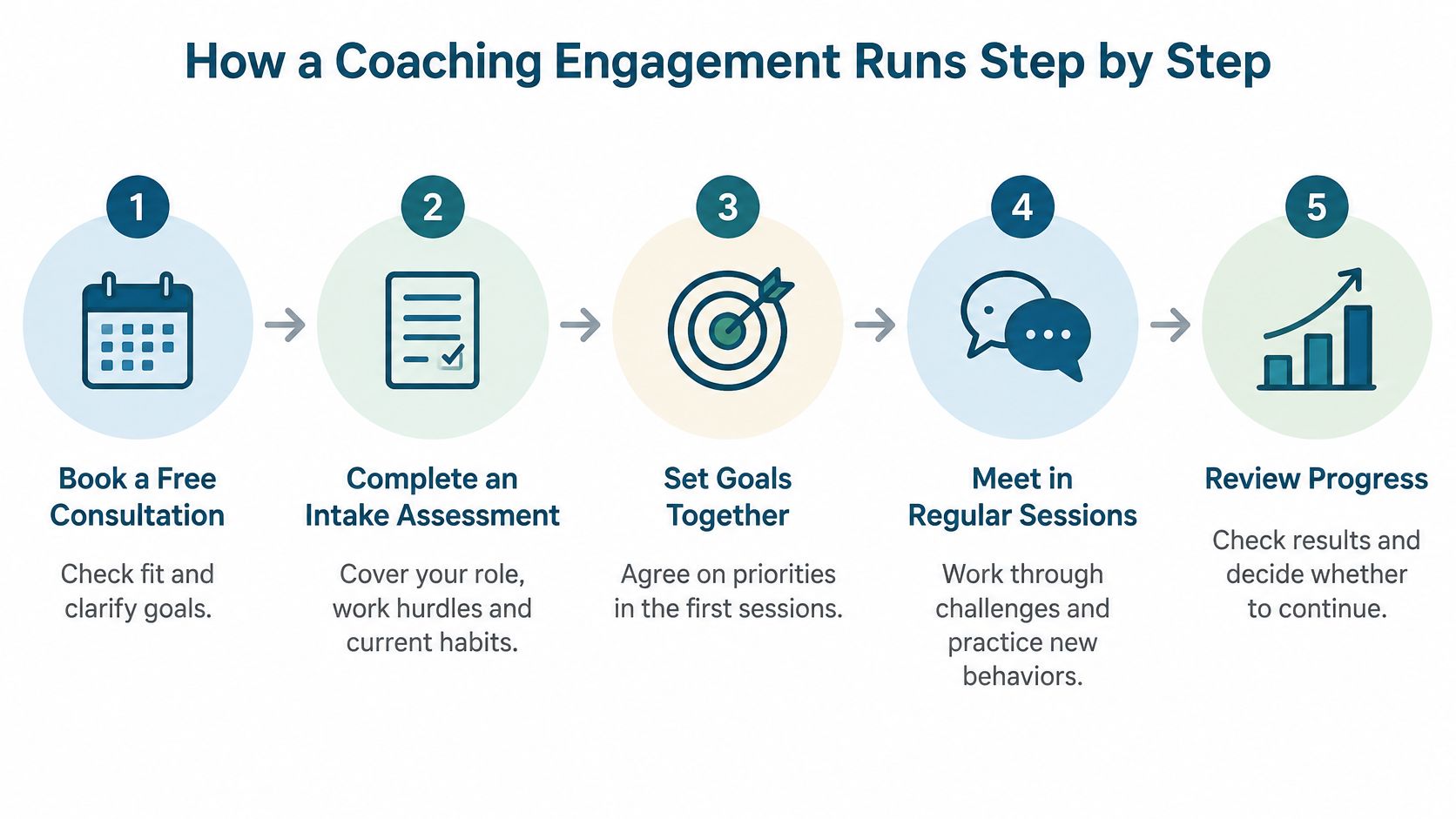
1. Book a free consultation. It's a fit check, not a sales call. You describe the situation, the coach tells you whether this is the work they do, and both sides decide whether to continue.
2. Complete an intake assessment. A form, survey or structured conversation covering your role, your work hurdles and the habits you've built. We ask clients for intake details, application responses and program participation information, so the first working session isn't spent on background.
3. Name the hurdles and the mindset behind them. Many clients arrive with a pattern, not a one-off problem: the person who absorbs every escalation, the one who edits a junior's work instead of teaching. Naming the pattern is what makes the later steps stick.
4. Agree on two or three measurable goals with a timeline. Not eight. Three, with a date and a way to tell whether it happened. This is the step people skip, and skipping it is why some engagements feel pleasant and change nothing.
5. Work a structured process, starting small. We start clients with small wins and scale up, which matters because the ambitious first move often brings the strain straight back. A five-pillar process gives the work a spine so each session builds on the last instead of restarting.
Here's a short view of how the early sessions feel from the inside.
6. Use the access between sessions. Short questions between meetings are where most of the value lands, because decisions arrive on Tuesdays, not at 3pm on the third Thursday. A two-line message about a stakeholder email beats saving it for a fortnight.
7. Review against the step-four goals every few sessions. Adjust a target, extend the timeline or end the engagement once the goals are met. An open-ended arrangement loses its value around month four if nobody checks the scoreboard.
What you should hold after the first two sessions: a written list of three goals, a baseline number for each, and one early win you can point to. If you don't have all three, say so before session three.
Our own view of how coaching pairs with leadership development sits in this piece on executive coaching and leadership development, for readers who want the longer version.
Book a Free Consultation Before You Commit
A first call tells you more about a coaching practice than any page on its website, but only if you arrive with evidence in hand.
Write your top three goals in one sentence each, with the outcome you want and the date you want it by.
Note your workload signals: the hours, the meeting count, the queue of unanswered requests, so the conversation starts from evidence.
List the decisions you face in the next 90 days, including any compensation or role conversation, because those dates shape the engagement.
Then speak to one or two providers. Acheloa Wellness offers a free consultation as the first point of contact, booked directly through the practice. Not every firm works that way. Some booking flows ask for card details or a deposit before confirming an initial appointment, and this guide to how online booking payments work explains what those requests typically cover. A free call should ask for none of that.
Ask three questions in every consultation. What measurable goal will we track together, and how often will we review it? What access do I have between sessions? Where would you refer me if the problem turns out to be medical, or structural enough to need my manager or employment counsel?
That last question matters more than it sounds. Coaching can change how you handle your workload; it cannot fix a staffing gap, a broken incentive plan or a health issue. A provider who names those limits on the first call is telling you the truth about what the engagement can deliver.
Compare providers on those answers. Warmth is easy over a single call. A standing review cadence takes structure.
Hold one principle through every conversation: good coaching should help you advance with less strain. Acheloa Wellness builds its coaching on the idea that success comes from having it all with greater ease and less overwhelm, not from doing more. Judge each provider on whether their work makes your load more sustainable.
If you're carrying a demanding practice, a deadline-driven team or a business where every decision lands on you, Acheloa Wellness provides burnout and executive coaching for professional women and business owners, combining leadership and career work with attention to the hours and boundaries that keep it sustainable. Lauren Baptiste brings 13 years in billable-hour environments as a former CPA and consultant, and for owners she describes the coaching role as a board of directors for someone who doesn't have one. Visit Acheloa Wellness to book a free consultation, and bring your three goals with you.

