

Executive Coaching and Leadership Development: How It Works
In 2025, organizations expected leadership-development spending to increase by 13.3%, according to the 2025 HR/L&D Trends Report from The Center for Leadership Studies and Blanchard. Budgets of that size deserve a harder question than whether people enjoyed the program. What changed in the way a specific leader ran a specific meeting?
Executive coaching earns its cost when the answer is concrete: who makes the call now, how the pay conversation gets handled, whether the Friday email still goes out at nine at night. That standard, coaching as a structural response to workload, availability and advancement rules, is the one applied throughout this guide. Confidence matters, but confidence isn't a result.
Most leaders who look for coaching aren't confused about what good leadership looks like. They're stuck inside a set of working patterns nobody has renegotiated, and the tool that fixes a pattern is different from the tool that teaches a skill.
Table of Contents
What Executive Coaching Is and How It Differs from Training
Executive coaching is a one-on-one, ongoing partnership in which a coach helps a leader change specific behaviors, decisions and results inside the leader's real role. The leader sets the agenda. The coach brings a method, sharp observations, and the willingness to ask the question everyone else in the building avoids.
The gym makes the distinction easy to feel. Leadership training is a class where everyone learns the same lesson on the same day: here is the feedback model, here is the framework for a difficult conversation. Coaching is the trainer standing beside you, watching the actual lift, and correcting your form between repetitions. One transfers knowledge. The other changes what you do under load.
Coaching took decades to become a discipline rather than a favor traded between executives. A literature review of the field's history found that coaching-related management research from the 1980s through 1999 consisted largely of graduate dissertations, 33 journal articles and several books, and it identifies 1992 as the year executive coaching began to flourish in the United Kingdom. Academic attention then accelerated sharply: a 2014 review counted more than 600 peer-reviewed coaching articles by 2011, up from only two published between 1935 and 1944. The practice you meet today has been examined, argued over and revised for three decades.
Where leaders get stuck is telling the four common development formats apart, especially when a senior colleague offers to "help".
Approach | Main Focus | Typical Format | Who Sets the Agenda |
|---|---|---|---|
Executive coaching | Changing behavior and decisions in the leader's real role | One-to-one sessions, in person or by video, across several months | The leader, with the coach |
Leadership training | Shared skills and frameworks for a group | Courses, workshops and modules | The program design |
Mentoring | Sharing experience from someone further ahead | Informal or scheduled conversations | The mentee's questions, guided by the mentor |
Consulting | Solving a defined business problem | Project-based engagement | The consultant's defined scope |
Mentoring and coaching blur most often, because both are conversations with someone more senior. The difference sits in whose experience gets used. A mentor answers from their own history; a coach asks a question that makes you examine yours. If you're weighing the two, this comparison of the key differences between mentors and coaches lays out the boundary cleanly.
Three questions sort the format faster than any definition:
Is this a skill gap? If you don't know how to build a budget model or run a structured review, you need training, and reflective questioning won't teach you the mechanics.
Is this a situation you have to handle? A compensation conversation, a restructuring announcement, a client escalation. That's coaching territory.
Is this a pattern you repeat? Same conflict, different employer, same ending. Coaching works here too, provided you're willing to look at what you keep doing.
How Coaching Builds Leadership Skills Step by Step
Coaching isn't a series of warm conversations about ambition. It's a cycle: a starting point, one goal with a date attached, a practice window, and a review that decides what comes next. Our coaching starts by identifying your work hurdles and the current mindset that got you here, then follows a five-pillar process. Inside that structure, the working rhythm from first session to changed habit looks like this.
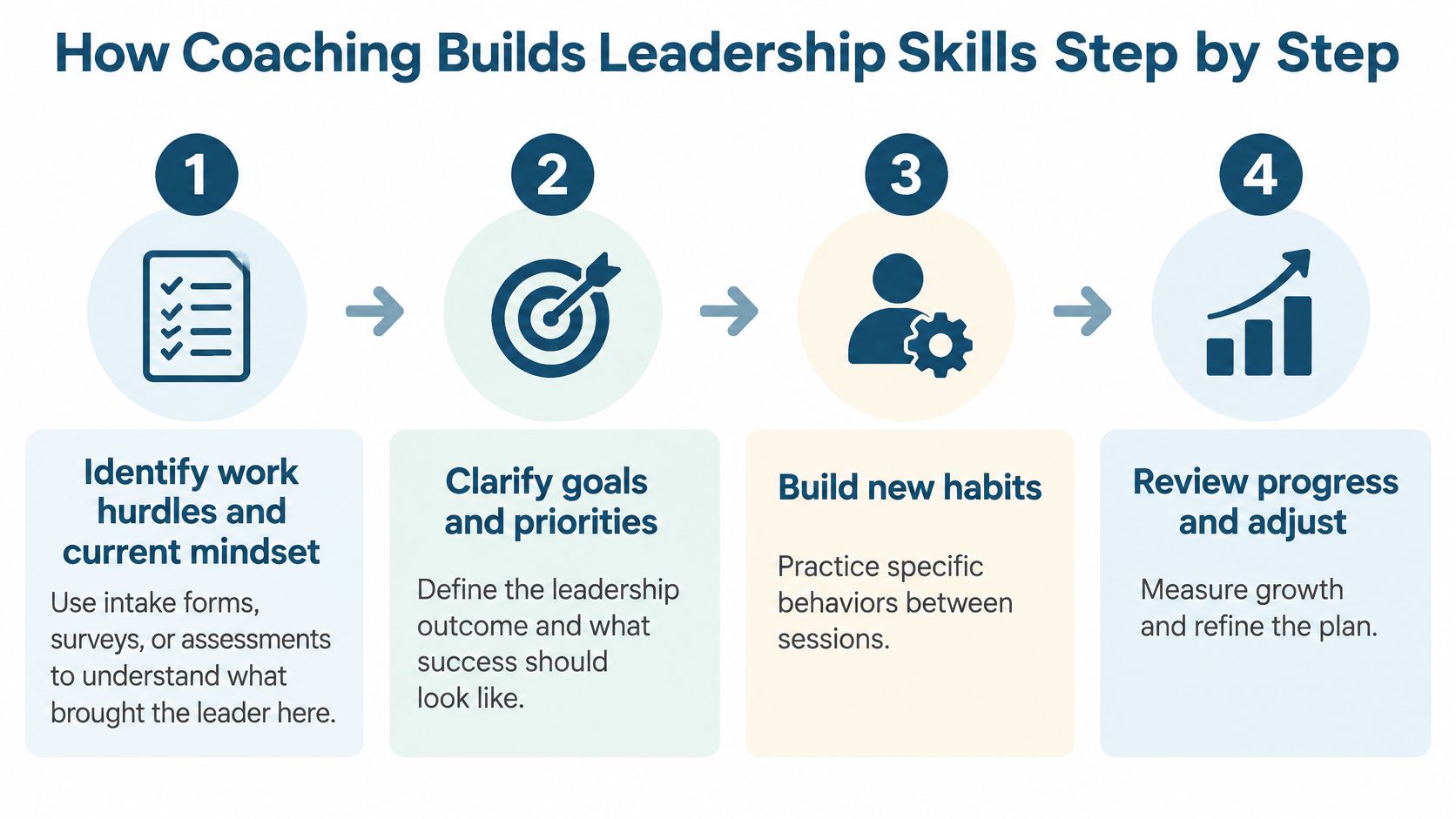
Name the hurdle and the mindset behind it. Intake forms, surveys or assessments give the coach a picture of where you are before the first conversation. The mindset question carries more weight than the logistics question: a leader who believes visibility is bragging will keep declining the panel invitation no matter how many delegation tactics they collect. The common slip is treating intake as paperwork and jumping straight to techniques.
Attach one goal to a decision already on the calendar. "Delegate more" has no finish line. "Hand the pricing model to Priya, let her present it at Thursday's review, and don't speak for the first ten minutes" does. Pick one or two goals tied to a real decision due within a month, because a deadline in the diary forces practice into the actual meeting instead of a rehearsal that keeps getting postponed.
Bank a small win before scaling up. We start clients with small wins and progressively scale up as capacity grows. A leader who has run one clean boundary conversation holds evidence that the method works; a leader who tried to rebuild their entire week on day two holds a story about how coaching doesn't help. Choose the smallest version of the goal that still counts.
Practice in the live week. Between sessions the work is specific: rehearse the conversation out loud, delegate one decision and leave it delegated, hold one boundary through the follow-up email. The coach is available between coaching sessions, so the question that surfaces on Wednesday afternoon gets answered while the situation is still open rather than three weeks later.
Review the cycle and reset the target. Review means examining what happened in the room: what you did, what the other person did, what you would repeat. Skip the feelings inventory and keep the record factual. Then set the next goal one notch harder than the one you just cleared.
What You Hold at the End
One changed habit, exercised in a real meeting with real consequences, plus a repeatable method for the next problem. That's the deliverable. Not a personality transplant, not a binder of frameworks, and not a longer list of things you already know you should do.
The method matters as much as the habit, because the situations that bring leaders to coaching don't stop arriving. A promotion brings new stakeholders. A new team brings different expectations. What transfers is the cycle: name the pattern, tie it to a decision, practice it under pressure, review what changed.
Leadership Skills Coaching Builds Across Seven Areas
Managers shape how people feel about their work more than any other single factor in an organization. Gallup's research on why managers need leadership development attributes roughly 70% of the variation in team engagement to managers, and the same research found that only slightly more than one in three managers understand how their performance affects their opportunities to advance into leadership roles. Just 8% strongly agree that their performance reviews inspire them to improve.
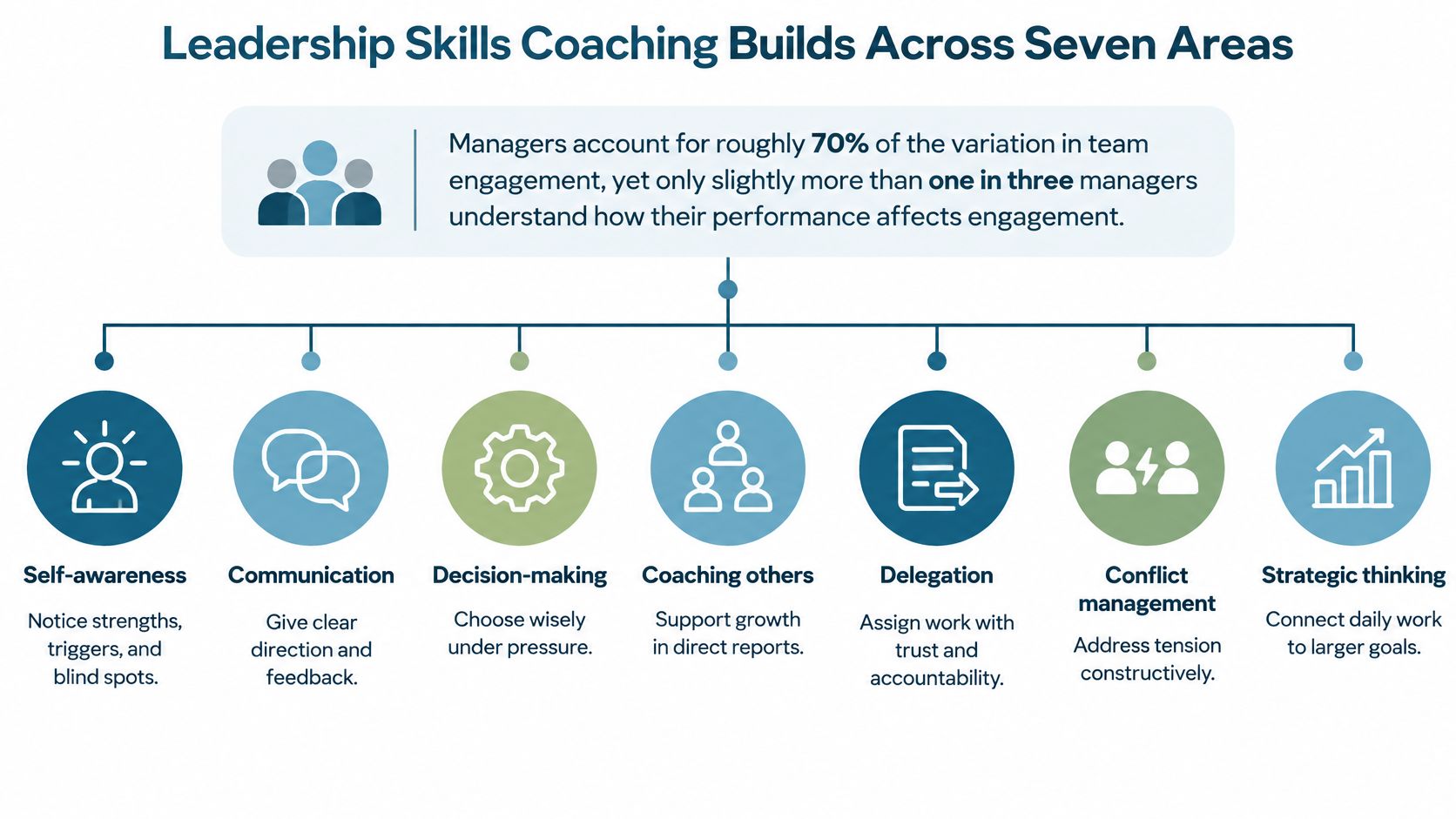
Read those numbers together and the gap comes into focus. Organizations lean on managers to carry team outcomes while giving many of them thin feedback and little clarity about how advancement works. Gallup also identified seven competencies that recur among managers of high-performing teams: building relationships, developing people, leading change, inspiring others, thinking critically, communicating clearly and creating accountability. Each one becomes coachable the moment you attach it to a recurring task on the calendar. Each is also a structural fix to how the week runs rather than a personality upgrade, which is why coaching treats them as workload and scheduling problems first.
Building relationships. The work is upkeep: a leader who books a fifteen-minute monthly check-in with each direct report stops discovering problems at the exit interview. The measure is whether the meetings take place, week after week.
Developing people. The test is whether anyone on the team got measurably better at something this quarter, and whether the leader can name it without checking notes.
Leading change. Coaching here usually means writing the three-sentence explanation of why the change is happening, then delivering it six times without drifting. If the message keeps shifting, the problem is the message, and coaching treats it that way.
Creating accountability. A leader stops chasing status updates and assigns a named owner and a deadline to every open item. The chase ends because the ownership is explicit, and the hours it used to consume become visible on the calendar.
Thinking critically. Replacing a reactive fix with a three-option decision memo forces the trade-offs into view before the meeting instead of after it.
Communicating clearly. Clarity survives rehearsal. A leader who has said the hard sentence out loud twice before the meeting rarely softens it in the room.
Inspiring others. People follow leaders who can explain their own reasoning. When the first six skills hold, this one tends to arrive on its own.
The scale of spending explains why so much attention lands on this set: per the same Gallup research, U.S. companies were estimated to invest about $14 billion annually on leadership-development courses. Much of that money buys competency models. A model tells you what good looks like; it cannot tell you which of the seven your calendar is starving.
Competencies only matter when they attach to something on the leader's calendar this week. A coaching plan that starts from a competency model instead of a real team produces elegant notes and no change.
That's why coaching starts with your actual calendar, your actual team and the decision you've been avoiding. Leaders who have had a bruising year often need to rebuild their footing before any competency work lands, and regaining leadership confidence covers that groundwork.
Why Burnout and Advancement Belong in the Same Coaching Plan
The exhaustion numbers split along a line that has nothing to do with commitment or competence. From 2022 to 2025, an average of 29% of women in leadership roles reported burnout, compared with 19% of men; among managers, the gap ran 34% against 27%, according to Gallup's workplace analysis of women's engagement and burnout. Deloitte's 2025 global survey, cited in the same analysis, found that 29% of women struggle to switch off from work and 22% report an excessively high mental load.

Typical advancement advice covers confidence, visibility, delegation and executive presence. Useful, and incomplete. It gives far less attention to the structural trade-offs: workload, availability expectations, job insecurity and unequal sponsorship.
So the question worth asking isn't "How does this leader become more resilient?" It's "Which work patterns, role expectations and relationship dynamics have to change so advancement doesn't require unsustainable availability?" Those are different problems with different fixes. Resilience training helps a person tolerate a broken schedule. Structural coaching changes the schedule.
Three situations where the structure is the problem
Say a litigator in a billable-hour firm stops logging evening hours. The intent is recovery. The read from partners is often reduced commitment, because the hours are the only visible signal they have. Coaching here works on building a visible alternative: how the work is staffed, who is told what, and which commitments get renegotiated in writing rather than absorbed.
A consultant facing a scoping conversation has more influence than they think. The useful preparation isn't a script for saying no. It's a model of what the engagement requires at each phase, so the scope conversation becomes a planning discussion instead of a refusal.
A business owner carrying every decision alone has a different problem, because there's no manager to appeal to. Coaching functions as the sounding board that a board of directors would otherwise provide, and the work usually starts with which decisions require the owner at all.
The reframe: the goal isn't to become tougher. It's to design a role where sustained performance doesn't depend on permanent availability.
For a fuller treatment of the advancement side, career advancement without burnout walks through how to pursue a promotion without treating exhaustion as an entry fee.
Before any career move, run three checks. First, what availability does it require? Count the evenings, the travel and the on-call expectations, not the version you'd put in a development plan. Second, who shares the decisions? A role where every call routes back through you is a heavier job even if the title is better. Third, how much recovery remains? If the answer is none, the move trades one unsustainable pattern for a better-paid one.
If you want a short primer before opening this conversation with your manager, the video below is a reasonable place to start.
Burnout prevention may ultimately require changing how leadership success is measured, not just teaching individuals to cope better. A team that rewards visible availability will keep producing exhausted leaders, whatever the coaching plan says.
Measuring Whether Coaching Changed Behavior and Results
Most leadership development goes soft at the evaluation stage. In a 2025 global study, Harvard Business Impact found that organizations most commonly evaluate leadership development through employee surveys (62%), while also reporting increased emphasis on reducing stress and burnout (46%) and improving emotional intelligence (42%). Each number captures something real. Together they still do not add up to a before-and-after account of how a leader behaves.
Judging a program by a closing survey works like judging a season by the final score: it records the feeling of the ending and skips the months of play. A confidence score will not tell you whether the leader stopped absorbing every team decision, ran clearer pay conversations, cut after-hours work or held performance steady through a holiday. Measurement has to catch the behavior itself, which means deciding what counts as change before the first session.
Build the baseline before the first session
Set the baseline roughly four weeks before coaching starts, then track the same measures monthly. The leader keeps the record rather than the coach or HR. That single choice keeps the numbers from turning into a performance file, and it makes honesty cheap rather than costly.
Measure | What to Track | Before-and-After Example | Data Source |
|---|---|---|---|
Delegation | Share of team decisions the leader makes alone | Makes 9 of 10 decisions alone, then 5 of 10 by month six | Leader log and team check-in |
Compensation conversations | Whether pay discussions happen and are documented | One pay talk a year, then quarterly with written impact notes | Calendar and HR records |
After-hours work | Evening and weekend hours per week | Works most evenings and two weekend days, then weekends free by month six | Calendar and time records |
Team retention | Voluntary exits from the leader's team | 3 exits in one year, then none in the next year | HR exit data |
Time off | Whether the leader fully disconnects on leave | Checks email daily on leave, then not at all | Self-report and team feedback |
The same tracking works when the leader also owns the business. Advisory-firm owners have no HR department to hold the record, so they keep the baseline and the monthly log themselves, the setting Advisor Momentum's business coaching guide is written for.
Artificial intelligence adds a new complication. In the same 2025 study, 47% of surveyed organizations named real-time feedback and coaching with AI a popular initiative, and 45% cited AI-supported emotional-intelligence tools. Those tools do one job well: they prompt a leader to prepare for a hard conversation. They stay weak on context, confidentiality, values, power dynamics and the judgment call that depends on knowing the room.
Practical rule: if a measure would make a leader afraid to be honest, it stops being a measure and becomes surveillance with a dashboard.
Keep well-being out of the productivity column. The moment time off becomes a KPI someone scores you on, people take it strategically and stop recovering fully. Ask three questions at every review instead: what changed in behavior, what changed in results, and what did the team notice?
That last question is the hardest to fake.
Choosing Coaching for Your Career Stage
Demand for coaching runs ahead of supply at every level. In 2024, 31% of frontline leaders said they wanted more coaching than they were receiving from their managers, according to Development Dimensions International's global coaching research. Organizations are hedging by combining sources of support: in 2025, 43% reported using both internal and external leadership-development training programs, per Harvard Business Impact's global study.
What changes by career stage is the focus, not the format.
Situation | Coaching Focus | Signs It Fits |
|---|---|---|
New manager moving from doing to leading | Delegation, feedback and team routines | Doing the work of others, late nights, unclear priorities |
Senior leader preparing for promotion | Visibility, decision-making and pay conversations | Strong results but no clear case for advancement |
Business owner without a sounding board | Leadership decisions and workload | Carrying every decision alone, weak boundaries |
Billable-hour professional under pressure | Boundaries, recovery and workload design | Constant availability, reduced time off, rising exhaustion |
For an owner, a coach works like a board of directors for someone who has no board: patient, outside the business, willing to ask what happens if this decision goes wrong.
Choosing well also means knowing when coaching isn't the tool yet. If the role itself is badly defined, fix the role first; coaching a person around an impossible scope just makes them more articulate about the impossibility. If the gap is technical, training closes it faster and cheaper. And if the leader has no authority to change the conditions being discussed, coaching will surface the problem and then run out of options. Comparing leadership development programs for 2025 side by side helps here, because format and provider matter less than whether the program touches real decisions.
Consultants face a particular version of this, since advancement depends on visibility across engagements rather than performance in one. How to get promoted in consulting covers the sponsorship side.
Confirm Coaching Is the Right Next Step
Readiness comes down to three conditions. You can name one specific decision due in the next 90 days, not a general aspiration. You can commit to practicing between sessions, which means rehearsing, delegating and holding a boundary when it's inconvenient. You have enough support or authority to act on what you learn, whether that's a manager who will hear a scope conversation or an owner who can change staffing.
If all three are true, book a free consultation. Bring three things: your current work hurdles, one recent decision you handled poorly or wish you had handled differently, and the situation you most want to change. Coaching is one-on-one, and the coach meets you where you are with the tools to match, so the first conversation can start from your real week rather than a template.
Vet the coach while you're there. Ask how they measure change, what happens between sessions, how confidentiality is handled, and whether they've worked with leaders in your role or industry.
Then look at the first month. A baseline set four weeks before coaching starts using the measures above. One goal, drawn from the engagement steps and tied to a real meeting. A review date already in the calendar. That's a plan you can hold someone to.
Decision rule: if you can't yet name a decision or a measure, don't book anything. Spend two weeks writing down the three recurring situations that drain your time, then come back to the checklist.
Acheloa Wellness combines burnout coaching and executive coaching in one service for professional women, including accountants, attorneys, consultants and women in finance, so advancement and workload get worked on together rather than in separate conversations. If the patterns in this guide sound like your week, book a free consultation and bring the three things listed above. Start at Acheloa Wellness and choose the conversation your calendar has been postponing.

