

Time Management Training: An 8-Week Practice Plan
It's Friday at 4:40pm. Your calendar shows eleven meetings, two of them double-booked, and the client memo that decides whether the deal closes is still open in a browser tab you haven't touched since Tuesday. You've downloaded five productivity apps this year. The last one still sends streak notifications you swipe away without reading.
That gap, between a full calendar and unfinished important work, is where time management training earns its place. Not as another system to maintain, but as a set of practiced behaviors that recover hours and protect boundaries. Judged properly, training should show up as fewer after-hours messages, an earlier stop on Wednesday, and less mental replay of work at dinner. It should not show up as a prettier color-coded week.
Table of Contents
What to Train First in a Time Management Program
Start with the skills, not the tool. Installing an app before the underlying skill exists usually creates one more place to feel behind, because the app inherits your current priorities instead of fixing them.
The evidence supports a careful promise. A 2021 meta-analysis published in PLOS ONE synthesized 158 studies, 490 effect sizes and 53,957 participants across workplace, academic and well-being contexts. Time management had a moderate relationship with job performance, at roughly r = 0.25, and a stronger association with well-being and life satisfaction than with output. That is the boundary to hold: training is more reliable at restoring a sense of control and consistency than at producing a dramatic performance jump. Time management also sits alongside role clarity, autonomy, staffing and leadership conditions as one contributor among several, so nobody should sell it as a cure for chronic overwork.
Here is the curriculum to train, with the drill and the proof point that tell you whether it's working.
Training skill | What it changes | Practice drill | Workplace proof | Practice hours |
|---|---|---|---|---|
Prioritization and goal setting | Turns a long task list into a ranked shortlist tied to impact and deadlines | Rank 15 open tasks by impact, deadline and effort; cut to five; write a not-this-week list | The top two tasks are finished before the inbox is opened | 3-4 hours |
Planning and scheduling | Converts priorities into realistic calendar blocks with buffer | Estimate every task, add a 25% buffer, place it on the calendar; compare planned with actual | Planned blocks hold for a full week and actual time stays within the 25% buffer | 3-4 hours |
Task execution and focus | Reduces switching and unfinished work | Run one 45-minute focus sprint with phone away and one tab open; log start, stop and distractions | One complex deliverable moves forward before noon | 4-5 hours |
Interruption recovery | Preserves responsiveness without carrying unfinished work mentally | Before every call or chat, write where you stopped, the next physical step and the open question | Return to the task in under five minutes with less mental replay | 2-3 hours |
Workload negotiation and boundaries | Separates a skill gap from a capacity problem | Script one scope conversation using committed hours and trade-offs | One deadline renegotiated, one low-value task delegated or one meeting declined | 3-4 hours |
Review and adjustment | Makes the training stick after the course ends | Run a 15-minute Friday review of planned versus actual, wins, carryover and one change | The weekly plan reflects real capacity for three weeks in a row | 1-2 hours |
Choose two skills for the first month, not six. Prioritization and planning pair well because one feeds the other, and they produce visible results within two weeks. Focus and interruption recovery come next, once the shortlist exists. Negotiation and review arrive later, when you have logged evidence to negotiate with. Treating all six as a single course load is how people finish a program with good intentions and no changed week.
Sequencing rule: Month one, priorities and planning. Month two, focus and interruption recovery. Month three, negotiation and review. Everything else waits until the earlier skills survive a busy week.
The order matters for a practical reason. If you read about time management and prioritization techniques while your calendar is still packed with untriaged commitments, the new method competes with the old chaos instead of replacing it. Build the shortlist first. Then the calendar has something honest to hold.
Where Planning Alone Stops Working
The most common misdiagnosis in this field is treating a capacity problem as a character problem. People who are drowning rarely need a better planner. They need someone with authority to see the arithmetic.
The evidence base itself is a warning here. A 2024 review in Applied Psychology: Health and Well-Being notes that the evidence for workplace time-management interventions remains limited and inconsistent, especially for well-being outcomes, and that research shows a reinforcing relationship between time pressure and emotional exhaustion. Pressure raises exhaustion. Exhaustion makes the following week feel even more pressured. Individual planning techniques cannot compensate for excessive demand or unclear responsibility, which is why the question worth answering is what to do when workload, client demands or meeting culture are objectively incompatible with available time.
Use a diagnostic rule before you enroll in anything. If the work fits inside available hours and the plan still fails, train planning and focus. If committed work exceeds available hours by 20% or more for three consecutive weeks, the issue is capacity, scope or role design. That 20% figure is a working rule of thumb rather than a research finding, but it's a useful threshold because it's large enough to be visible in a calendar audit and small enough to catch before a crisis.
Signal | Skill-gap read | Capacity read | Response |
|---|---|---|---|
Work expands to fill every hour but priorities are clear | Needs planning, estimation and focus practice | Committed hours exceed available hours | Count committed hours for two weeks and bring the total to a manager |
Urgent requests arrive all day from clients or partners | Needs interruption triage and response windows | Role lacks scope control, staffing or clear service levels | Agree response windows and escalate the volume with examples |
Task lists get finished but the important work slips | Needs prioritization and calendar placement | Performance is judged by availability rather than output | Renegotiate success measures and protect one focus block daily |
Boundaries collapse after hours | Needs boundary scripts and a shutdown routine | Culture rewards constant responsiveness | Propose a team agreement and ask a leader to model it |
The same crisis repeats every month | Needs a review habit and earlier planning | Recurring under-resourcing or a broken process | Fix the process, add staff or renegotiate the deadline |
One person absorbs every team request | Needs delegation training | Role has no backup or decision rights | Clarify decision rights and assign a backup |
Read each row as something to check against your own calendar, not a verdict about you. The negotiation itself is a document, not a feeling: one page listing what's committed, the hours each item consumes, and what moves if something new arrives.
Capacity script: "Here is what's committed and the hours it needs. To add this project, which of these should move, wait or go?"
For women in law, accounting, consulting and finance, the stakes extend past this week. Availability expectations shape promotion conversations, and absorbing unlimited scope to appear committed has a predictable cost. Document the mismatch for two weeks, then take the evidence to the person who controls the work. That conversation is the training outcome that changes your calendar.
Measure the Training by What It Recovers
Completed tasks are the wrong scoreboard. A busy week can produce a full checklist and zero recovered hours, which means the training hasn't touched the problem.
Set a baseline in week 0 and repeat the same measures in week 8 and week 12. Use your own numbers as the standard, with one external benchmark for perspective: in 2024, 37% of 382 professional-services employees surveyed in the United States and United Kingdom said they felt in control at work five days per week, according to Timewatch's time management statistics. That's a conversation anchor, not a personal failing.
Measure | Week 0 baseline | Week 8 | Week 12 | What it shows |
|---|---|---|---|---|
Planned versus actual hours | Record in week 0 | Gap narrows by week 8 | Gap holds by week 12 | Smaller gap means estimates match capacity |
After-hours messages | Record in week 0 | Fewer than baseline | Stays lower | Fewer evening replies signal recovered time |
Latest working time | Record in week 0 | One earlier stop per week | Earlier stop holds | Earlier finish shows the boundary is held |
Meetings per day | Record in week 0 | Declined or shortened meetings | Stays reduced | Fewer meetings free focus blocks |
Uninterrupted focus blocks | Record in week 0 | More blocks per week | Sustained | More blocks show protected time |
Carried-over tasks | Record in week 0 | Fewer tasks carried into next week | Fewer still | Fewer carryovers show finished work |
Sense of control (1-10) | Record in week 0 | Higher than baseline | Sustained | Benchmark: 37% of professional-services staff felt in control five days a week (Timewatch, 2024) |
Read the pattern, not a single line. More finished tasks with unchanged after-hours work is not success. Fewer carried-over tasks plus one earlier stop per week is. If you want a structured way to record these measures week to week, these training checklist sample templates give you a repeatable format to adapt rather than building a tracker from scratch.
Keep a weekly scorecard of three wins, one bottleneck, one change for next week and one boundary held. Skip the vanity metrics: color-coded calendars, app streaks and a flawless task list all look like progress while your laptop stays open at 9pm. Understanding what time management benefits look like in practice keeps the scoreboard honest.
At week 4 and again at week 8, take 20 minutes to decide one of three things: continue the same training, add a workload conversation with whoever controls demand, or move to coaching because the pattern looks like burnout rather than a missing system.
How to Run the Eight Week Training Plan
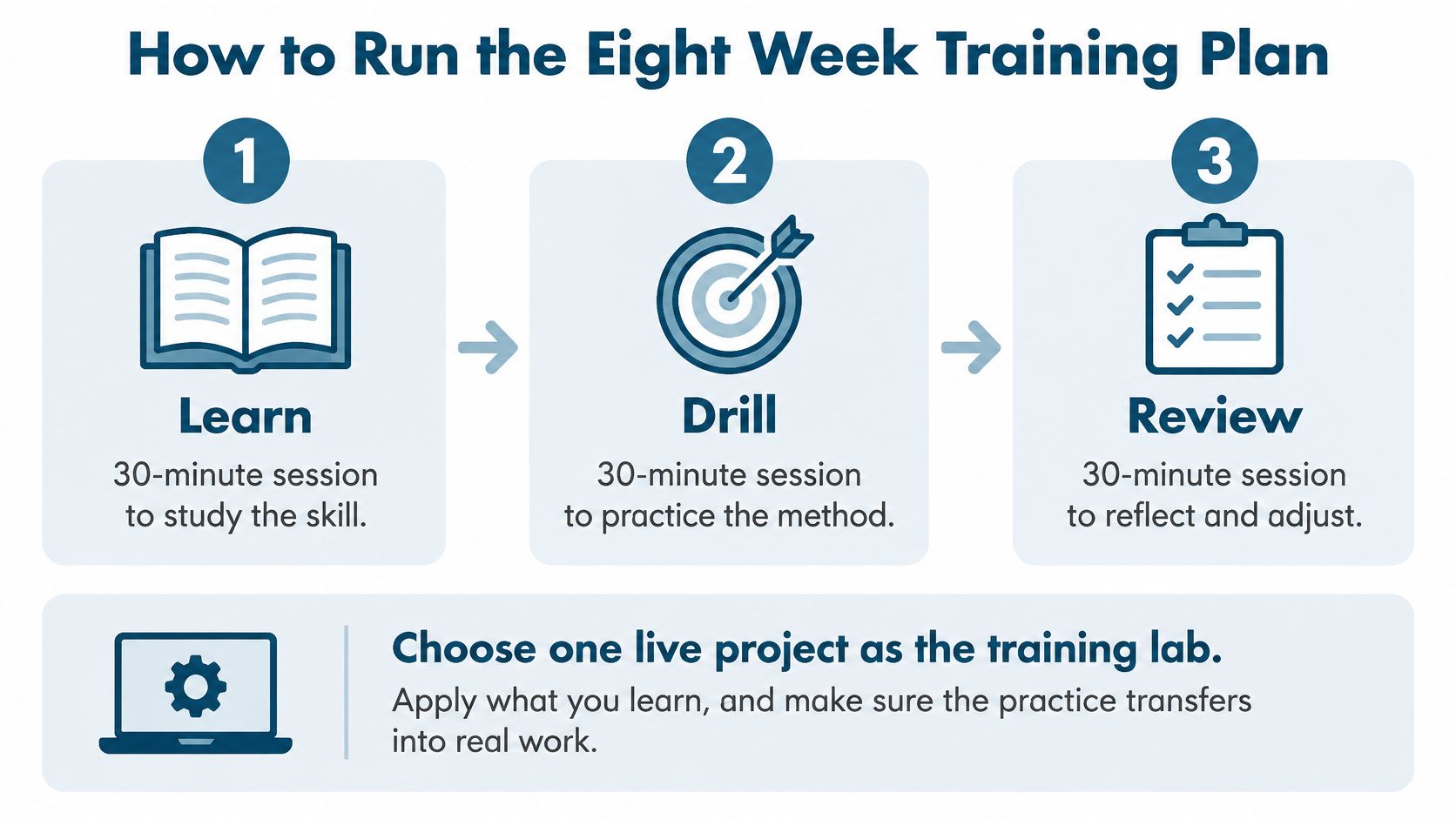
The structure is deliberately small. Three 30-minute sessions a week, one live project as the lab, one review that closes the loop.
Book three sessions weekly. One to learn the skill, one to drill it, one to review what happened at work. Put them on the calendar as appointments, because a session that isn't scheduled becomes a session you meant to do.
Choose one live project. Practice should produce real work. Pick a deliverable due within the eight weeks and run every drill against it.
Baseline one normal week first. Record calendar hours by category, after-hours messages, carried-over tasks and interruption counts. Without this, week 8 has nothing to compare against.
Run the weekly loop. Twenty minutes of instruction, twenty minutes of drill, one full workday of application, then a 15-minute review.
Add a 25% buffer to every estimate for the first four weeks. Estimation error runs in one direction when you're learning.
End with a maintenance week. Keep the standing Friday review permanently.
Week | Training focus | 30-minute drill | Workplace application | Evidence to collect |
|---|---|---|---|---|
1 | Baseline and priorities | Audit last week's calendar and rank 15 tasks by impact | Use a top-five list for three workdays | Hours by category, carryover tasks, after-hours messages |
2 | Planning and buffers | Estimate five tasks and add a 25% buffer | Place buffered tasks on the calendar for two workdays | Planned versus actual time |
3 | Focus sprints | Run two 45-minute sprints with notifications off | Complete one important deliverable before email on two days | Start and stop times, distractions, output |
4 | Interruption recovery | Write ready-to-resume notes before three calls | Use the protocol for every interruption for two days | Return time, unfinished tasks, mental replay |
5 | Meetings and email norms | Draft response windows by channel | Agree one norm with a teammate or client | Response time, urgent messages, meeting hours |
6 | Negotiation scripts | Rehearse the trade-off script with a real deadline | Hold one scope or capacity conversation | Commitments moved, delegated or dropped |
7 | Delegation and scope control | List five tasks only you should do | Delegate or decline one recurring low-value task | Hours recovered, tasks removed |
8 | Review and maintenance | Compare week 1 baseline with week 8 | Set a 15-minute Friday review and a three-month check | After-hours work, focus blocks, sense of control |
Training of this kind can move real behaviors. In a randomized clinical trial with critical-care nurses, reported through the trial record on PMC, the intervention group's overall time-management score rose from 120.38 to 132.67 immediately after training, significant at P < 0.001, and held at 130.56 three months later against 124.95 for controls, again significant at P < 0.001. Gains concentrated in goal setting, prioritizing goals and activities, and operational planning. Controls moved only from 126.06 to 126.71, which was not statistically significant.
Two caveats keep this honest. The trial sampled one population, so transfer to professional-services work is plausible but not proven, and broader reviews of workplace training find mixed results, with some studies reporting performance gains and others finding no significant relationship. Check your own week-0 baseline rather than assuming the nurse-trial result will replicate in your role. Then repeat the week-8 review at week 12 and keep the 15-minute Friday habit in place.
Practice That Transfers to Deadline Heavy Work
Deadline work punishes theory. The test is whether the drill survives a filing date, a busy season or a client call that runs long.

Take three common situations. A litigator with a filing deadline runs one 45-minute focus block before opening email, writes a restart note before every hearing or client call, and closes the day with a 10-minute restart list. An accountant in busy season runs a Monday capacity check, comparing committed hours against available hours, and holds one scope conversation before the week collapses rather than after. A consultant or business owner triages meetings by purpose: keep the ones that produce decisions, delegate the updates, shorten or decline the status meetings nobody needs.
The interruption protocol that keeps working
When you're pulled away mid-task, write four things before you leave the screen: where you stopped, the next physical step, the open question, and the person you're waiting on. That note takes 30 seconds and buys back the ten minutes you'd otherwise spend re-reading your own work to remember the thread.
This matters more than most training admits. A field study indexed on APA PsycNet, covering 200 daily observations, found that employees experience greater attention residue and exhaustion on days with more work intrusions, and that ready-to-resume plans reduced that residue and weakened the link between intrusions and exhaustion. Interruption handling is a skill, not a personality trait, and it's trainable in a week of deliberate practice.
Response windows by channel: chat within two hours, email by end of day, urgent matters by phone. Write the agreement down with your team or client, because unstated norms default to instant.
Some interruptions are self-initiated or socially rewarded, which is why app settings alone won't fix the pattern. Team agreements and a leader who models slower replies do more than a silenced notification.
Then close the day properly. Ten minutes before you stop, clear open loops: update the restart notes, set tomorrow's first task in writing, and shut the laptop. The point isn't tidiness. It's stopping the mental carryover that follows you into dinner, and it's the same reason learning how to delegate well changes your evenings as much as your workload.
When the Plan Slips and How to Recover
Training stalls in predictable ways. Each has a fix that costs less than restarting.
A brutal week erases the plan. Shrink instead of quitting: a 10-minute daily review and one 45-minute focus block. Zero is the only outcome that breaks the habit.
You keep rebuilding the system. Cap setup at 20 minutes and commit to one calendar, one task list and one capture note. Rebuilding feels productive and isn't.
The drills feel childish. Tie every drill to a live deliverable and score recovered time. Relevance is what makes practice stick.
A manager or client treats responsiveness as availability. Agree response windows in writing, and escalate only genuine urgencies with specifics.
Perfectionism turns planning into procrastination. Plan the next physical action, not the entire project. "Open the file and draft the first paragraph" beats "write the memo."
If a to-do list has stopped working, it's usually missing two fields. Add estimated minutes and a calendar slot to your top three tasks, so the list describes time rather than ambition.
Minimum viable week: three priority tasks, two focus blocks, one boundary held and a Friday review. That's the floor. Anything above it is a good week, not the requirement.
After a missed week, restart with one session. Don't rebuild the tracker, don't reread the course, don't redesign the categories. Run the next scheduled drill on the project you already chose, and let the Friday review absorb the lost week. Momentum comes back faster from a single completed session than from a perfect relaunch.
Choose the Training Format That Fits Your Week
Three routes work, and the right one depends on what's broken.
Self-study with the eight-week template suits a repeatable system problem. If your priorities are clear but scattered, and the work fits inside available hours, a structured plan plus a live project is enough. It's cheap, flexible and honest about its limits.
An employer-sponsored program with peers adds accountability and, as well, access to a manager who will review workload. Choose this when the calendar conflict is real and you need someone with authority in the room.
One-to-one coaching fits when the problem includes burnout, boundaries or a promotion conversation. Those need private rehearsal and a plan built around your specific role, not a curriculum built for a group.
The decision criteria are simple. If you need accountability and face a live workload conflict, coaching or a peer group beats another course. If you need a system you can run alone, self-study is sufficient.
Acheloa Wellness provides burnout coaching and executive coaching in one service, for accountants, attorneys, consultants and women in finance, through the Freedom 1:1 Coaching Program, and prospective clients can book a free consultation.
Whichever route you pick, take one step this week: run the week-0 baseline, book the three weekly sessions, and choose the one conversation you'll have with a manager or coach before week 3. Training should leave you with more control and more recovered time, not a longer productivity list.
If this sounds like your week, Acheloa Wellness offers one-to-one burnout and executive coaching for professional women, combining workload and boundary work with career and leadership support so the changes hold under real deadlines. Lauren Baptiste, a former CPA with 13 years in billable-hour environments, built the practice around advancing your career without quitting or downshifting. Book a free consultation and visit Acheloa Wellness to start with the week-0 baseline and one capacity conversation.

