

How to Manage Client Expectations Without Losing Trust
You're finishing one client's file when another emails with urgent in the subject line, a third asks for a quick extra review, and your calendar says you promised all of them an answer today. Nothing is late. You're unsettled anyway, because nobody agreed on what urgent meant, what was included, or who could approve a change.
That's the core problem behind how to manage client expectations. It's not a personality test or a promise to reply faster. It's a workload-protection system built on written scope, response windows and capacity-based priorities, so you can hold a boundary without sounding unresponsive and protect other deadlines without apologising for having them.
Table of Contents
Lock In Scope, Timelines and Decision Rights at Kickoff - Six Agreements to Write Down
How to Run Check-Ins That Keep Expectations Current - A Six-Step Check-In Routine
Handle Scope Creep and Mid-Project Changes - A Four-Step Response That Protects the Relationship
Repair Expectations After a Missed Deadline - What to Say in the First Message
Lock In Scope, Timelines and Decision Rights at Kickoff
A vague kickoff feels friendly in week one and expensive in month three. Clients judge you not only on the final result, but on whether your communication is clear, timely and consistent with what you promised. When those promises were never made precise, an ordinary delay or trade-off reads as a service failure.
The Edelman Trust Barometer has tracked trust in institutions across global markets annually since 2000, building more than two decades of evidence that credibility depends on repeated communication and alignment between stated commitments and observed behavior. You don't need to promise everything. You need to make the promises you do make specific, then revisit them when circumstances change.
Six Agreements to Write Down
Agree these six items in the first meeting and put them on one page. Name one approver on each side and state who decides when that person is unavailable. If you want a sharper way to sort those choices under pressure, this guide to effective decision-making for high-achieving women gives you a useful frame for naming the decision, the owner and the deadline.
Agreement | Question it answers | Example wording | Revisit when |
|---|---|---|---|
Scope | What is included and excluded | Monthly reconciliations and quarterly review are included; system migration is not | A new deliverable is requested |
Deliverables | What finished work looks like | Draft tax memo delivered as a PDF by 14 March | Acceptance criteria change |
Decision rights | Who approves each choice | Client finance lead signs off on figures | The approver changes |
Response windows | How quickly each message type gets a reply | Urgent: same business day; routine: two business days | Team capacity shifts |
Milestones | Dates for each phase | Draft review completed by 10 April | A dependency slips |
Change process | What extra work costs and how it is approved | Additions quoted in writing before work starts | Any new request arrives |
Make exclusions explicit. The most common surprise isn't work you did badly, it's work nobody thought was included until the client assumed it was.
Add one line on AI-assisted work too. State which tasks use AI tools, which steps still need human review, and that faster drafting doesn't mean instant replies. That distinction matters because Thomson Reuters' 2026 global study of 1,816 professionals found 78% of corporate clients considered AI-enabled quality improvements very important or essential, while only 6% said most or all of their providers were delivering them. Clients are expecting more from AI than they're seeing, so don't let them fill the gap with assumptions about speed or fees.
Send the one-page recap the same day and ask for corrections in writing. Silence isn't agreement, so follow up within two working days if you hear nothing.
Do this first: Draft the one-page recap before the kickoff call, with blanks for approver, dates and exclusions. You'll fill it faster and you won't forget the uncomfortable parts.
How to Run Check-Ins That Keep Expectations Current
Expectations drift when information only moves one way. A polished proposal can't track a client's changing priorities, new boss or slipped internal deadline, and silence between updates gets read as either progress or neglect depending on the client's mood.
Clients also expect you to get ahead of problems. Five9's 2025 Customer Experience Study found 79% of global consumers wanted companies to anticipate their needs rather than react to problems. Meanwhile, PwC's 2025 Customer Experience Survey found 70% of executives said customer expectations were outpacing their organization's ability to adapt. You can't meet that gap with more frantic updates. You meet it with a predictable, two-way routine.
The chart below shows the basic rhythm to keep visible between formal check-ins.
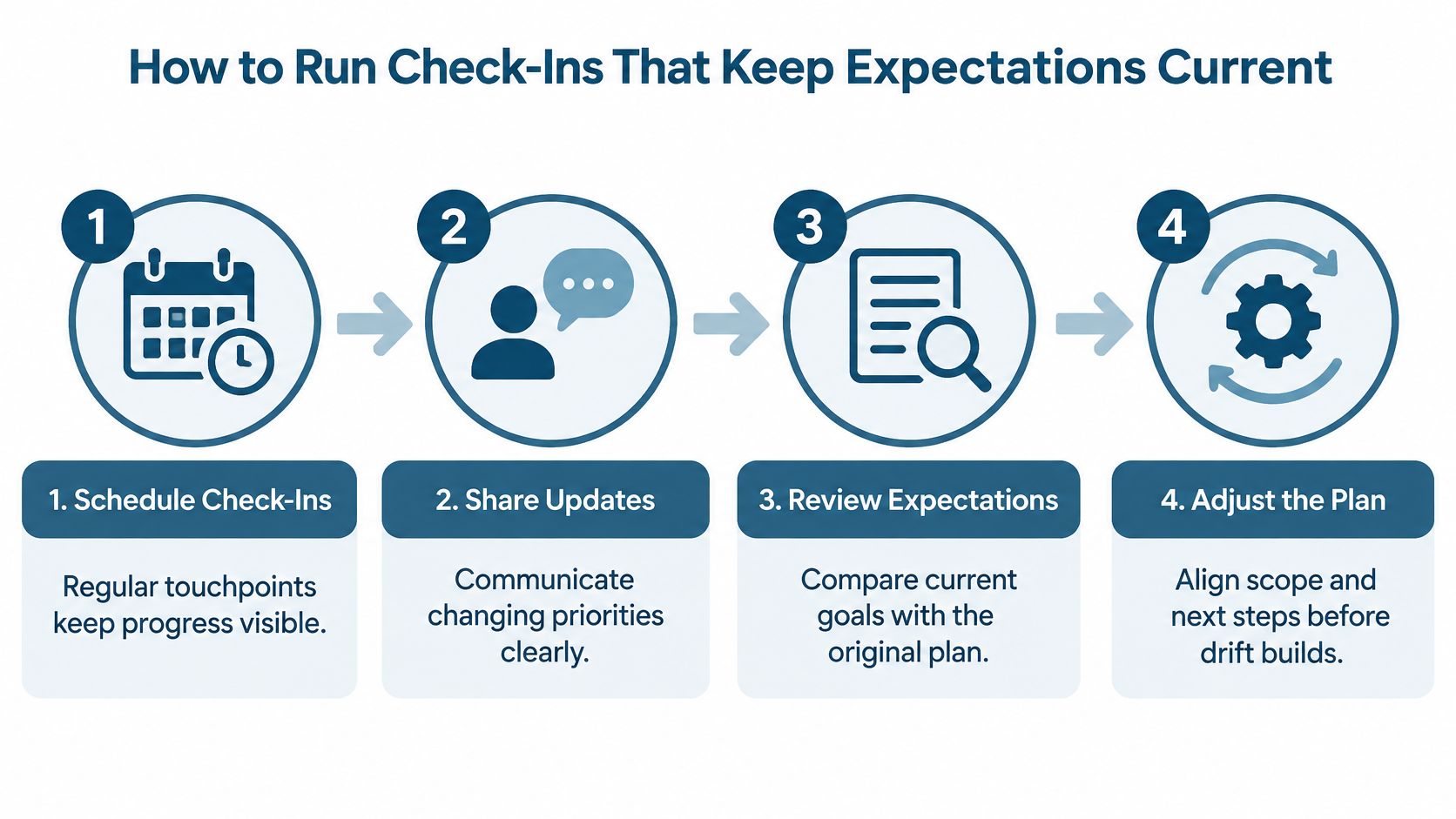
A Six-Step Check-In Routine
Book a fixed slot: Hold a 20-minute check-in every two weeks at the same time. It becomes routine, not a crisis call. The common slip is meeting only when something goes wrong, which trains clients to dread your name in their inbox.
Send a short agenda: Share it 24 hours ahead, listing open decisions and any date at risk. Skipping the agenda turns the call into a status hunt.
Ask what's changed: Cover priorities, team capacity and deadlines on their side. Don't assume last month's priority is still first.
Mark fixed versus flexible: Label each item as fixed or open to renegotiation and state the trade-off. A new priority means something moves, costs more or drops.
Recap within the hour: Send decisions, owners and dates in writing. A recap without owners is just meeting notes nobody acts on.
Invite challenge: Ask the client to correct the recap in writing. That's where hidden disagreement surfaces safely.
Two-way contact matters more than volume. Edelman's 2026 Trust at Work report found only 40% of associates preferred learning about workplace transformation through one-way information channels, compared with 65% of executives. People closer to the work want a chance to question and clarify, and your client contacts are no different.
You'll know it's working when clients raise concerns early and changes arrive as questions, not complaints.
Set Response Windows Without Seeming Unresponsive
Setting a response window doesn't make you unresponsive. Surprise delays do. A client who knows you'll reply by tomorrow at noon can plan around you. A client who expected an answer in an hour and heard nothing for six feels ignored, even if you were doing excellent work for someone else.
That pressure is familiar in billable-hour work. A 2025 Minnesota Society of CPAs survey found practitioners reported clients expecting immediate email responses or expecting their CPA to interrupt other client work to answer questions urgently. If you let the loudest request set your queue, you're not providing better service. You're letting one client's urgency demote every other commitment you've made.
Four Tiers Clients Can Understand
Define the tiers at kickoff and measure responsiveness against agreed service levels and business risk, not pressure alone. If you want language for formalising those levels, Recepta's guide to service level agreements is a practical reference for turning informal promises into clear commitments.
Message type | Example | Agreed response window | Who decides the tier |
|---|---|---|---|
Urgent | Deadline moved today or a system outage stops work | Same business day | Criteria agreed at kickoff |
Time-sensitive | Answer needed before a Friday approval | Within one business day | Project lead |
Routine | Document request or scheduling question | Within two business days | Standard tier |
Non-urgent | Ideas for future phases | Next scheduled check-in | Standard tier |
Three Questions to Sort Any Message
Run a new request through these tests before you react.
Does it block something critical: Would this stop a filing, approval or payment if it waits?
Is a deadline close: Does it affect work due within two business days?
Would waiting cause harm: Would holding it until the next check-in create a real problem, not just impatience?
If the answer to all three is no, it's routine, however strongly worded the email is. Say so kindly and give a time.
Thanks for flagging this. It's urgent, so I'll respond today by 4 pm. For routine questions, you'll hear from me within two business days.
Adapt that script, but keep the structure: acknowledge, classify, commit to a time. Always acknowledge receipt even when the full answer takes longer. A two-line confirmation protects trust while you protect your calendar. If saying that out loud still feels risky, this framework for setting boundaries at work helps you phrase the limit without over-explaining it.
I would write the four windows into every kickoff recap this week. That's the decision that turns a personal boundary into a shared agreement the client already accepted.
Handle Scope Creep and Mid-Project Changes
Scope creep rarely arrives as a formal request. It shows up in passing. "Could you quickly add one more region?" "While you're in the file, can you review this too?" Each ask feels harmless. Each one sets a precedent and consumes capacity another deadline depends on.
The trap isn't the client's request. Asking is normal. The trap is the small yes you give without logging it, repeated until you've delivered a second project inside the first one.
The photo below captures where most of these asks happen, in ordinary working conversations, not in formal change meetings.

A Four-Step Response That Protects the Relationship
Acknowledge and pause: Thank them and say you'll confirm the impact within one working day. Don't price it on the spot to seem helpful.
Log it in writing: Record the date, the requester and exactly what was asked. Keep the log where both sides can see it.
Quote the effect: State the impact in time, cost or the date of a current deliverable. Vague warnings about capacity don't change decisions.
Let the client choose: Approve it with a new date, swap it for an existing item, or defer it to the next phase. Their choice becomes the record.
Happy to take this on. To keep the March deadline, we would need to move the review to April, or we can add it as a separate phase.
That line works because you're not refusing. You're showing the trade-off and handing back the decision. For a fuller walkthrough of logging and approval steps, Fluidwave's advice to prevent uncontrolled project expansion lays out a similar change-control habit you can copy into your own process.
Long-standing clients need the same log. You may choose to discount a change deliberately as goodwill, and that's a legitimate business decision. Don't absorb it, because absorption becomes the new baseline and you'll resent work the client thinks was easy.
The short video below is worth watching before your next change conversation, especially for the wording around options rather than refusal.
Keep one rule: never say yes to unlogged work. Log first, decide second, start third.
Repair Expectations After a Missed Deadline
A late deliverable becomes a trust problem when the client hears about it after the deadline passes. Silence gives them time to imagine the worst, make promises downstream based on your date, and then feel misled twice, once by the delay and once by the surprise.
Contact the client within 24 hours of knowing a date will slip. Don't wait until you have a perfect recovery plan. A short, honest update now beats a polished explanation next week.
What to Say in the First Message
Give the cause in one plain sentence, the revised date you can meet, and what you need from them. Apologise once, clearly. Repeated apologies can make a manageable delay look like a serious failure and shift the conversation from the plan to reassuring you.
Add a buffer to the next date rather than promising the minimum time. If the work needs two focused days, don't commit to two calendar days when you know other clients, reviews and approvals sit in between.
Expectation slip | Likely cause | Recovery step |
|---|---|---|
Deliverable late by a day or two | Client input arrived late | Send a revised date within 24 hours with the dependency named |
Scope expanded without a record | Requests made in casual conversation | Log the request in writing and quote its impact |
Client assumes a decision is approved | Decision rights were never confirmed | Confirm the approver and deadline in a written recap |
Frequent urgent requests | Response windows were never defined | Restate the windows and show the trade-off in time |
Client goes quiet after bad news | Delay was reported only by email | Schedule a short call and confirm the plan in writing |
A delay caused by the client needs the same discipline. If documents arrived late, name that dependency without blame and tie the new date to receiving what's missing. "Once we have the signed schedules, we'll deliver the draft three business days later" is fair and testable.
If the client goes quiet after bad news, don't keep sending longer emails. Book a short call, agree the plan verbally, then confirm it in writing the same day. When those conversations leave you drained or second-guessing yourself for days, this piece on managing tough clients and building resilience at work addresses the recovery side, not just the script.
Close the repair by changing one thing in your process. Add a buffer day before each client deadline, or set a standing check-in after any slip until you're back on schedule. Name that change to the client so they see a system, not just an apology.
Confirm Your Kickoff Recap This Week
Pick one active engagement and send the one-page kickoff recap before your next client meeting, even if the work started weeks ago. A late recap still prevents the next misunderstanding. Use your next check-in to confirm it within two weeks and correct anything the client disputes.
Log any change the client raises from that point forward rather than absorbing it. Choose one boundary to practise this week and name the specific conversation where you'll say it, whether that's a response window, an approval deadline or a swapped deliverable.
Review it after 30 days. Note whether client questions have shifted from complaints about surprises to planning questions about choices. That shift is your evidence the system is working.
If managing expectations is already leaving you exhausted or unable to say no, you don't have to solve that alone. Prospective clients can book a free consultation, and Acheloa Wellness offers a free handout titled 'The 3 Steps to Healthy Boundaries' as a simple starting point for these conversations. Lauren Baptiste coaches professional women in billable-hour roles on boundaries and workload, so the support fits the exact pressure described here.
If client demands are crowding out your evenings and you're struggling to hold response windows without guilt, Acheloa Wellness offers burnout and executive coaching for professional women who want clearer boundaries without quitting or downshifting. You can start with a free consultation and practical tools you can use in your next client conversation. Visit Acheloa Wellness to book your consultation and download the free boundaries handout.

