

Work Life Boundaries: What They Are and How to Set Them
About 479 million people, roughly 9% of the global population, worked at least 55 hours a week in 2016. The World Health Organization and International Labour Organization treat that threshold as the line defining exposure to excessively long working hours, and their global analysis linked the pattern to an estimated 745,000 deaths from stroke and ischemic heart disease in the same year.
Those are population figures. They can't tell you what your next deadline will cost your own body. They do settle a more useful question: is this a productivity preference or a health exposure?
This guide treats work life boundaries as a practical skill, with real constraints. You'll see what a boundary means, why recovery depends less on the clock than on what your mind does after hours, how to set one step by step, and what to do when your role, your manager or your caregiving load limits how much you can negotiate.
Table of Contents
Why Work Life Boundaries Matter More Than You Think
Work life boundaries are a career strategy, not just a self-care habit. In deadline-driven jobs, the person with the most power to decide workload, availability and urgency often sets the actual boundary. A professional who can refuse a same-day request has a certain advantage. A professional who fears being passed over for a promotion has another. That difference matters, because boundaries depend on who holds the power to negotiate time and attention.
A senior accountant sits down to dinner at eight and puts her phone face down on the table. It lights up twice before she finishes her first bite. By dessert she has read a client email, drafted a reply and started rebuilding a schedule in her head. No single minute of that looks like a health risk.
Stacked across a busy season, those minutes become weeks of work that never officially happened. Compared with people working 35 to 40 hours a week, those working at least 55 hours had an estimated 35% higher risk of stroke and a 17% higher risk of dying from ischemic heart disease, according to the WHO and ILO global analysis. The same analysis reported that deaths associated with long working hours rose 29% between 2000 and 2016.

Those figures describe populations, so they cannot predict one person's outcome. They do show that long hours are a health exposure worth designing around, the way you would design around repeated late-night driving or a job that keeps you standing all day. The practical question is not whether work matters. It is what access work gets after the official day ends.
A work life boundary is a limit that decides when, where and how work is allowed into your life. It works like a gate on a fence. The fence marks the line, and the gate sets the terms for what passes through. That makes a boundary a rule about access, not a personality trait and not a measure of how much you care about your career.
Power enters the picture here. A boundary at home may be easy to announce and hard to enforce if your role rewards instant replies. Lauren Baptiste, who works with professional women and business owners through Acheloa Wellness, helps clients pursue more promotions, more money, more time off and more respect without quitting, downshifting or blowing up their careers. That framing treats boundaries as part of career design. The point is to change the terms of access without giving up the role you have built.
The owner's view is direct: doing more work from burnout is not a sustainable way up the corporate ladder. Doing the same things as before will not produce a thriving work and personal life either. Success comes from having more with greater ease and less overwhelm, not from endless extra effort. That idea challenges a common trade-off in professional work, where people are taught to prove commitment through availability and then wonder why personal life disappears.
If the emotional side of this is what has caught your attention, you can browse burnout recovery book picks for reading that goes deeper into recovery than scheduling advice does.
Here is a quick self-check. In the last month, how often did you:
Answer a work message during a meal or after you had mentally finished for the day
Wake at 2 am with a task running through your head
Skip a break because the calendar had no gap in it
Feel behind on Monday for work you did on Sunday
Two or more, most weeks, means the boundary problem is already live. The boundary itself may still be reasonable. The issue is that the route into your evenings, attention and recovery time has stayed open.
The Four Kinds of Work Life Boundaries
A boundary works less like a wall and more like a fence with a gate. The fence marks the line. The gate decides what passes through and when. Walls with no gate get knocked flat in the first week of a filing deadline. Gates get used, because everyone can see how they open.
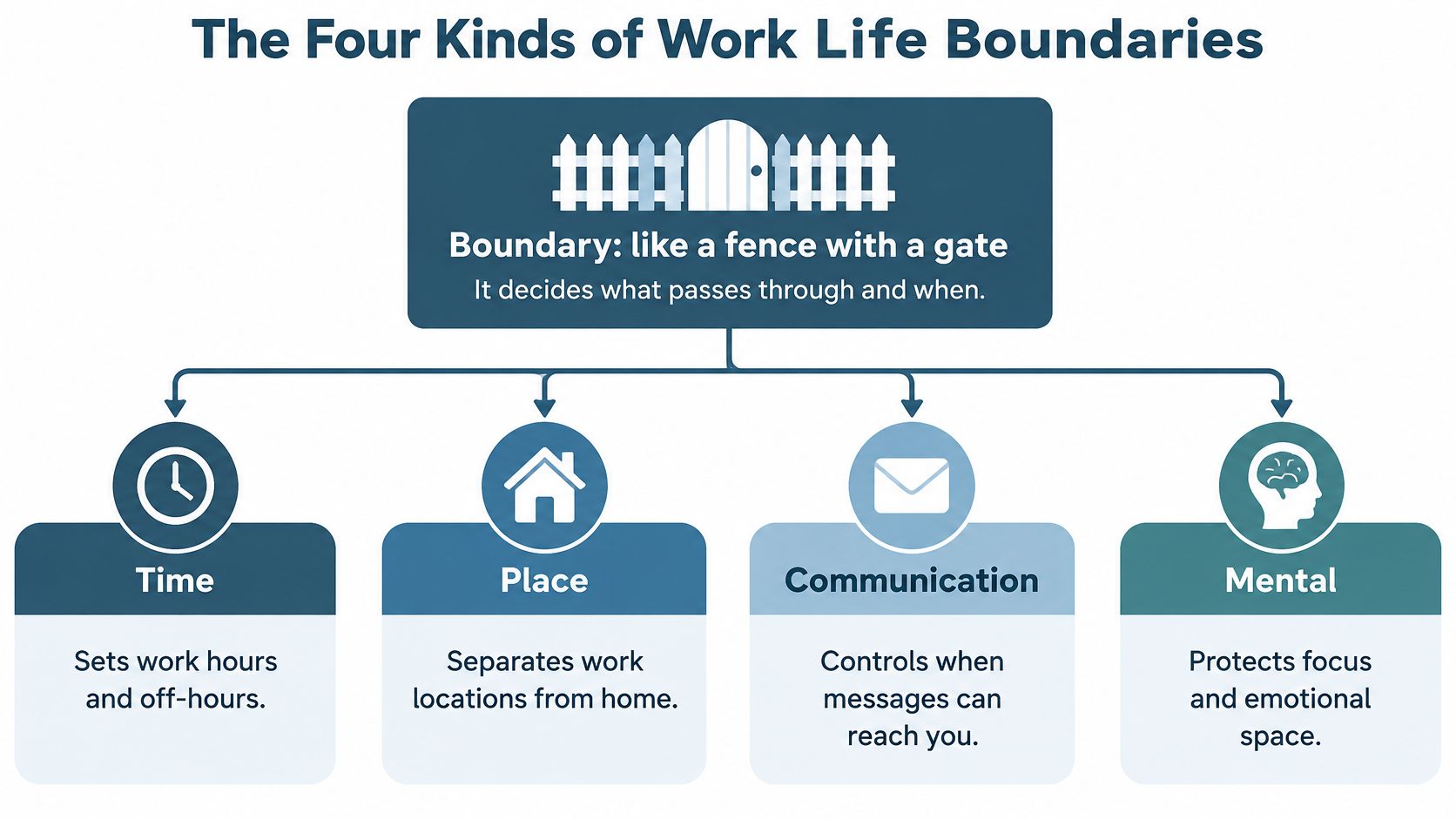
Most professionals aren't missing boundaries entirely. They have one strong type and three open doors. Someone who guards Saturday fiercely will still answer a partner's message at 10 pm on a Tuesday, because the fence covers the weekend and the gate has no lock on weeknights. That's why a single time limit so often collapses: work doesn't need your hours, it needs a route in, and three of the four routes are still open.
The four types cover different routes.
Boundary type | What it limits | Everyday example | Sign it is working |
|---|---|---|---|
Time | Hours when work may occupy your day | Weeknight cutoff at 6:30 pm, with alerts off | Evenings return to personal time |
Place | Locations where work is allowed | No laptop in the bedroom | Home stops feeling like an office |
Communication | Channels and speed of replies | Email checked twice a day; calls only for true urgencies | Replies land inside the agreed window and evening messages fall |
Mental | Thoughts about work during off hours | Written next-step list before leaving the office | Fewer work thoughts intrude at night |
Read the last column as a diagnostic, not a scorecard. A time boundary is working when you stop checking the clock to see whether you're allowed to relax. A place boundary is working when you walk past the kitchen table on a Sunday and feel nothing. A communication boundary is working when nobody is surprised by your response time, because you told them what it is. A mental boundary is working when the work thought arrives, gets written down, and leaves.
For a walkthrough of the same four categories, this short explainer is a useful companion to the table above.
Why Boundaries Protect Recovery, Not Just Hours
A shorter day doesn't automatically produce rest. Anyone who has closed a laptop at six and spent the evening rehearsing tomorrow's client call knows the difference between being off work and being recovered.
Hospitals handle this deliberately at every shift change. The outgoing nurse gives a structured handover, the incoming nurse takes ownership, and the first nurse walks out without the patient still running in the background. Nothing is dropped, and nothing is carried home.
That handover is the model for a boundary that restores you, because the mechanism at work is psychological detachment, the ability to stop thinking about work during your off hours. A representative German study of 8,586 employees drawn from the 2017 BAuA-Working Time Survey found that boundaryless working hours, meaning work that spills into leisure time and schedules with no predictable limits, were associated with poorer recovery. The mediation analysis pointed to detachment as the central mechanism: people who kept thinking about work during non-work periods recovered less, according to the study published in the International Archives of Occupational and Environmental Health.
The pattern holds when the stressors are emotional rather than long. A study of 136 Protestant pastors and 97 spouses measured workload, emotional demands, work-home boundaries, detachment, emotional exhaustion and need for recovery. High workload, emotional dissonance and weak spatial separation between work and home predicted poorer detachment, and poor detachment then predicted greater exhaustion and a stronger need for recovery, as reported in the Konstanz institutional repository record.
Detachment partially mediated that relationship, which matters for how you design a boundary. Demanding work conditions can impair your ability to switch off, and impaired switching off keeps your body activated long after the work stopped.
Practical rule: A fixed end time is a fence. Detachment is the gate. If unfinished tasks, notifications or tomorrow's anticipated demands stay open, the fence holds and the gate doesn't.
So the test of a boundary isn't whether you closed the laptop. It's whether your brain was released from monitoring duty for a stretch of the evening. When the answer is no, the fix is usually structural rather than motivational, and it sits in the same place as sleep and rest quality. If you want a fuller vocabulary for what you're missing, this guide to the seven types of rest separates physical fatigue from mental and sensory depletion.
Setting Boundaries When Power, Caregiving or Career Pressure Pull Back
The standard advice frames boundaries as a communication problem. Say no more clearly. Turn off notifications. Protect your calendar. That framing assumes everyone at the table holds the same negotiating power, but this is often not the case.
Boundary control is distributed unequally by occupation and socioeconomic status, as a 2025 scholarly discussion of the care crisis argues in the Journal of Management Inquiry. Professional workers often have some schedule flexibility. Caregivers in less autonomous roles frequently can't refuse unreasonable hours or after-hours connectivity without risking the job. The same discussion identifies schedule negotiation as a key resource for professional women balancing career and caregiving ambition, and notes that access is uneven, sometimes requiring senior women to informally bend organizational policies to use flexibility they're technically entitled to.
That produces the question most boundary content never answers. How do you set a limit when your employer offers flexibility, but using it could cost you a promotion, a client relationship or the reputation of being the person who's always on?
One finding cuts against the fear. In a study of more than 600 U.S. employees reported in the same discussion, leaders who showed clear work-family segmentation were viewed as more effective and promotable, with the effect particularly pronounced for female leaders. The worry that boundaries read as low ambition looks, in that evidence, backwards.
Organizational policy moves the needle too. Among employees covered by a right-to-disconnect policy, 92% said their working hours aligned well with private life, compared with 82% of those without one, a 10-percentage-point gap, according to Eurofound's Living and Working in Europe reporting. Whether you're covered at all is decided by your employer, not by how well you communicate.
Rigid rules rarely survive real pressure. Flexible ones do.
Pressure point | Constraint behind it | Flexible boundary to try |
|---|---|---|
Clients expect after-hours replies | Client service expectations | Agreed response window, such as next working day by 10 am |
Caregiving emergency | Unpredictable needs that cannot be scheduled | Predefined escalation rule plus named backup care |
Late-night team decisions | Leadership load carried alone | Decision cutoff with a named owner for each call |
Promotion or pay timing | Fear of seeming less committed | Written record of output and stated availability |
Document before you reduce. A one-page log of hours worked, turnaround times and the decisions you've absorbed turns a boundary request into a resourcing conversation.
If you're in an hourly, shift-based or low-autonomy role with no schedule negotiation available, start with the boundary you do control. Keep a written record of hours worked and name one person to escalate to when those hours exceed the agreed limit. Then raise the constraint in writing with a manager, HR or an employee representative, citing the logged hours as evidence. The boundary isn't the conversation. The record makes the conversation possible.
There's a related pattern in the work that never appears on a calendar. This piece on invisible labor covers the coordination, remembering and cleanup that fills the gap between the job description and the actual week.
How to Set a Work Life Boundary Step by Step
Seven steps, in order. Each one is small enough to do this week, and each has a common slip worth knowing before you hit it.
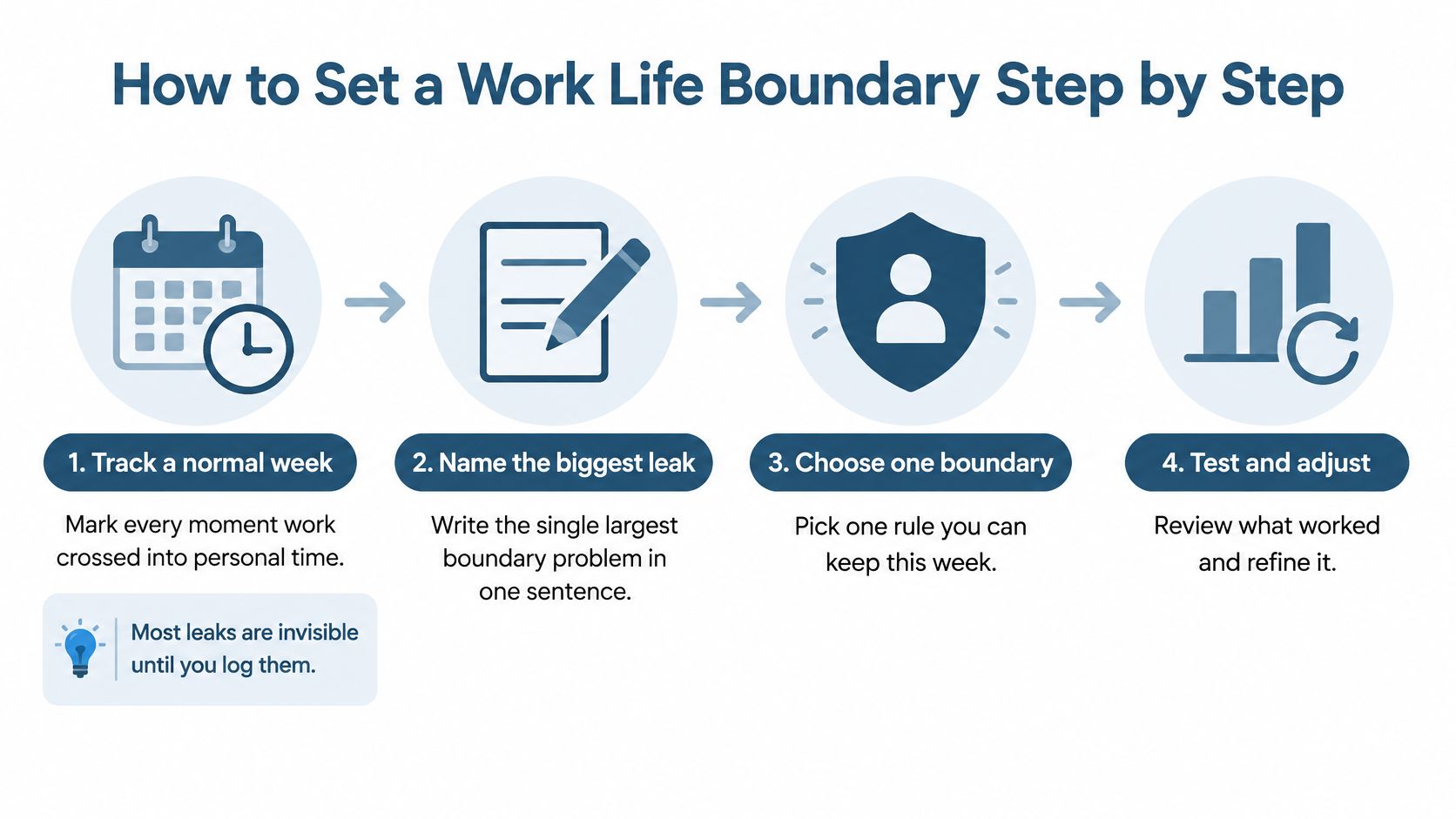
Track one normal week. Mark every moment work crossed into personal time: the 9:40 pm email, the Sunday spreadsheet, the call you took in the car. Most leaks are invisible until you log them, which is why people try to fix the wrong one. The slip is tracking only official hours, which hides every intrusion that never made it to a timesheet.
Name the biggest leak in one sentence. Something like "work email after 8 pm affects my sleep" is specific enough to design against. A sentence you can act on beats a general intention to do better. The slip is listing five problems at once and changing nothing.
Pick the boundary type that fits the leak. Email after eight is a communication problem, not a time problem, so a stricter end-of-day won't fix it. Use the four categories and match the tool to the route work is taking in. The slip is choosing the type you're already good at.
Set a default schedule with a cutoff time and a channel policy. Name both. Alerts off after 7 pm on your phone, work app logged out on the laptop, one number for genuine emergencies. A cutoff with no channel rule just pushes traffic to the app that still pings. The slip is defining the hour and leaving the channels undefined.
Tell the people who depend on you before the change lands. Frame it around service rather than your needs, for example: "I'll answer client messages by 10 am the next working day, and call me if something can't wait." People accept a predictable rhythm far more readily than an unexplained silence. The slip is announcing the boundary without saying what happens in an urgent case.
Build a five-minute shutdown ritual. Write the next step for each open task, close the tabs, change clothes, take a short walk. This is the handover that makes detachment possible, and it costs less time than the rumination it prevents. The slip is skipping it on the busiest nights, which are exactly the nights it earns its keep.
Review after two weeks and change one variable. Ask what held and what broke, then adjust a single element: the hour, the channel or the wording of what you told people. One change at a time tells you what worked. The slip is changing three things, getting a mixed result, and abandoning the whole attempt.
The one-week version: take the smallest boundary from your list, write down the cutoff time, the channel rule and the urgent-case exception on a single line, and run it for five working days before you judge it.
If saying the sentence out loud is the part that stops you, this guide to how to say no professionally covers the wording for clients, managers and colleagues.
Myths to Drop and Your First Boundary This Week
Four beliefs keep capable people stuck, and each one has a correction that changes what you do next.
Myth one, boundaries signal lower ambition. The evidence runs the other way: leaders with clear work-family segmentation were rated more effective and promotable, especially women. State your cutoff to your manager as a performance standard, not an apology. "I'm reachable until 6:30 and I review anything urgent first thing" sounds like operating discipline, because it is.
Myth two, turning off notifications is enough. The device goes quiet and the task keeps running. Pair the cutoff with the shutdown ritual from the step above, and the silence has somewhere to go.
Myth three, a boundary means never being reachable. Response windows and escalation rules protect availability and rest at the same time. Write one escalation rule for the next urgent request instead of waiting for a policy to arrive.
Myth four, legal protections solve the problem. Australia's right-to-disconnect protections were phased in for larger employers in 2024 and smaller employers in 2025, and other countries have adopted or proposed similar measures, as noted in recent research on working women caregivers. Legal rights don't resolve unpredictable caregiving demands or the career penalty someone fears for using them. Women providing informal care for aging, ill, disabled or special-needs relatives often face added duties and exhaustion that create conflict in both directions, and rigid work-hour rules can make that worse rather than better. Pair any legal right with a caregiving contingency plan and named backup care.

This week, take the single biggest leak from your tracking log. Write one boundary for it with three parts: the cutoff time, the channel rule, and what counts as urgent. Test it for two weeks, then review what changed. Our free handout, The 3 Steps to Healthy Boundaries, gives you a short structure to work from if you'd rather not start from a blank page.
If you're ready to stop treating boundaries as a personal failing and start using them as a career strategy, Acheloa Wellness offers 1:1 burnout and executive coaching for professional women, including the Freedom 1:1 Coaching Program. Lauren Baptiste works with professional women and business owners who want more promotions, more money, more time off and more respect without quitting, downshifting or blowing up their career. Visit Acheloa Wellness to book a free consultation and find out what a sustainable version of your working week could look like.

